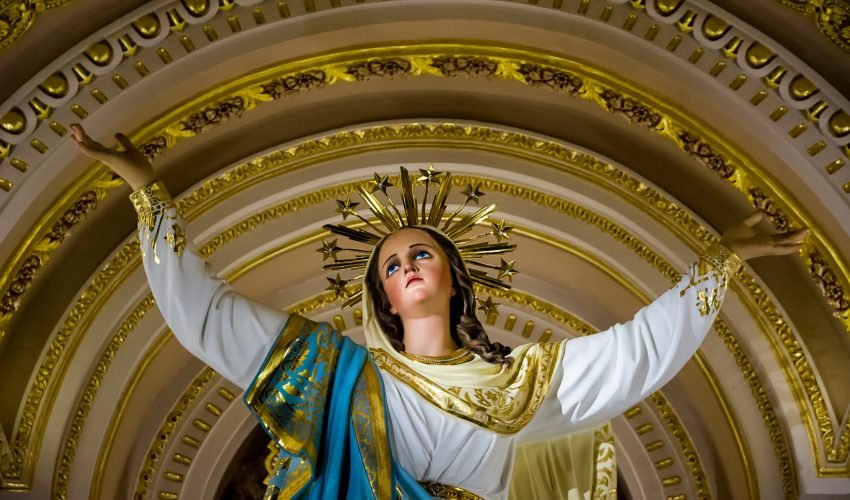
Each year on the 15th of August, the Church celebrates one of the greatest Marian mysteries: at the close of her earthly life, the Most Holy Virgin Mary was raised, body and soul, into the glory of Heaven. The Assumption does not merely celebrate the singular glory of the Mother of God: it reveals to the Church the destiny to which God calls the whole of mankind.
The Assumption of the Blessed Virgin Mary belongs to those great solemnities in which the Church does not contemplate merely a privilege granted to the Mother of God: she contemplates in Mary the anticipated fulfilment of her own hope. What the Church hopes for each of her children at the end of history is already accomplished, in an eminent and singular manner, in her who gave to the Word of God his human flesh.
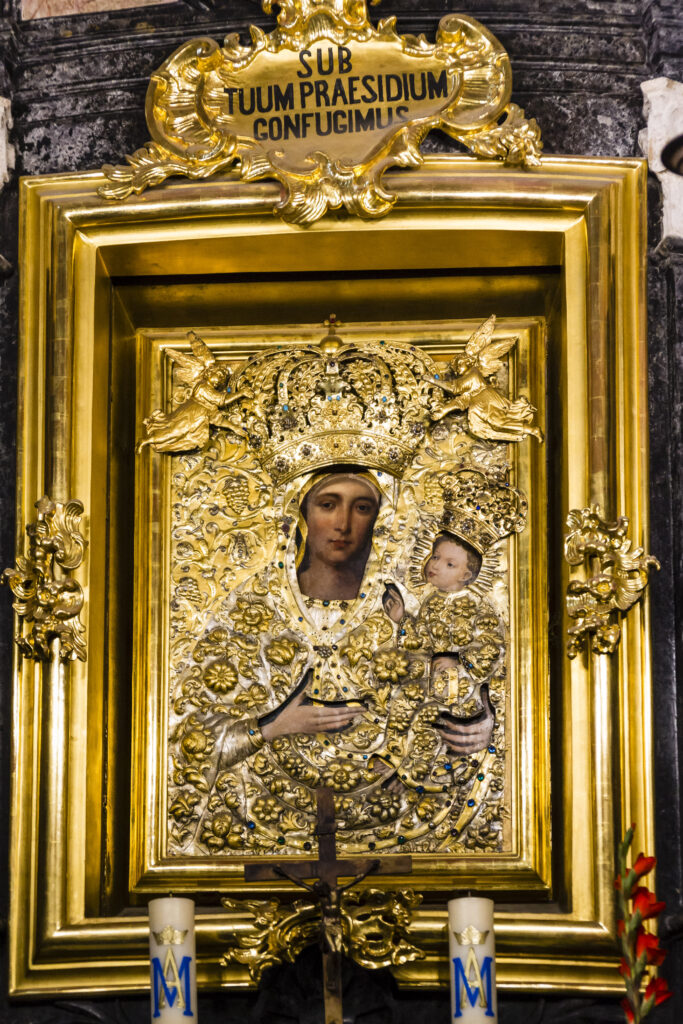
Icon of the Virgin Mary in the Basilica of Saint Mary (Church of the Assumption of the Blessed Virgin Mary), in Gothic style, in Kraków, Poland.
The dogma was solemnly defined by Pius XII on the 1st of November 1950 in the apostolic constitution Munificentissimus Deus. The Supreme Pontiff therein proclaims as a truth revealed by God that Mary Immaculate, Mother of God ever Virgin, «at the end of the course of her earthly life,» was raised body and soul into heavenly glory. This definition deliberately refrains from settling the theological question of whether the Virgin did indeed experience death before her Assumption. These words must be weighed in all their depth. The Church does not simply say that Mary's soul is with God. Such an assertion would not constitute the proper mystery of the Assumption. She confesses that Mary whole and entire, body and soul, has entered into glory. It is here that the properly Christian depth of this feast is revealed.
Christianity does not proclaim contempt for the body, nor the liberation of a soul finally freed from matter. It proclaims the resurrection of the flesh. The human body, created by God, sanctified in an incomparable manner when the Word became flesh, and called to become the temple of the Holy Spirit, also possesses an eternal destiny. In Mary, this promise is already fulfilled.
It is necessary, however, to understand this Marian privilege correctly. Mary does not ascend to Heaven by her own power. The Ascension belongs to Christ: the risen Lord ascends to the Father in the power of his divinity. Mary, for her part, is «assumed»—that is, raised up by God. Therein lies all the difference. The greatness of Mary is never independent of that of Christ. It is his most perfect fruit.
The Assumption is therefore profoundly Christocentric. If Mary is glorified, it is by the victory of her Son. She is the creature in whom the redemptive grace of Christ manifests, with incomparable splendour, what it wills to accomplish in each of us. The Immaculate Conception had preserved her from original sin by anticipation of the merits of the Cross; the Assumption manifests the completion of this work of grace. Thus the extraordinary unity of the Marian mystery is revealed. She who had responded to the angel Gabriel with her fiat, she who had given to the Word his human flesh, she who had carried Christ in her womb, she who had stood at the foot of the Cross, is henceforth with her Son in glory.
The Christian tradition also contemplates Mary as the new Eve. Where the first Eve had welcomed the word of the serpent, Mary welcomes the Word of God. Where disobedience had marked human history, her fiat becomes the expression of an obedience entirely offered to God. But this comparison takes on its full meaning only in relation to Christ, the new Adam. Mary is never understood apart from Christ: all that she is comes from Him and leads to Him.
The Assumption thus manifests something of the restoration of creation wounded by sin. The final word over man belongs neither to the tomb, nor to corruption, nor to death. It belongs to God. Mary raised into glory is as the dawn of that renewed creation which the resurrection of Christ has inaugurated.
But the Assumption also possesses a profoundly maternal dimension. Mary glorified is not a Queen who has become inaccessible to her children. Her entry into glory does not distance her from the Church: on the contrary, it manifests her motherhood in a new manner.
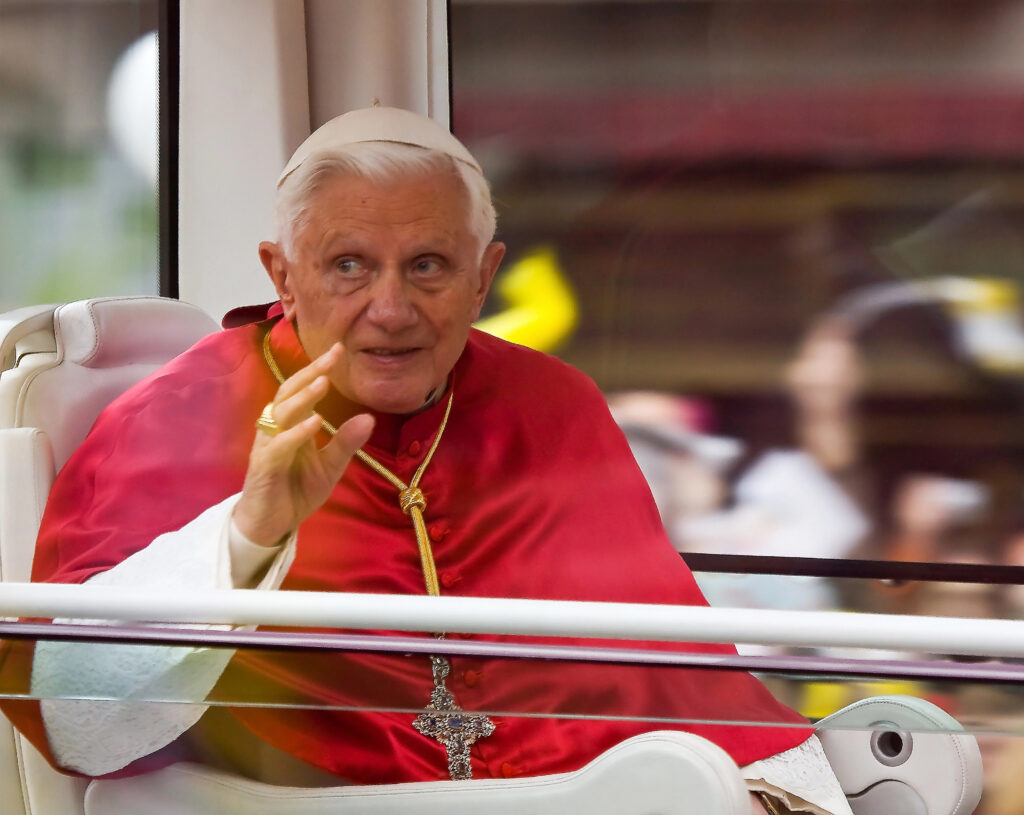
Pope Benedict XVI, Joseph Alois Ratzinger, in Barcelona for the consecration of the Sagrada Família, on 7 November 2010, in Spain.
This is one of the most beautiful teachings of the homily delivered by Benedict XVI at Castel Gandolfo on 15 August 2005.
The Pope explains that, precisely because Mary is now with God and in God, she can be close to each one of us. Her glorification therefore does not abolish her motherhood: it gives it a new dimension. Mary remains the Mother whom Christ himself gave to his disciple at Calvary when he said to him: «Behold your mother.»
This is why authentic Marian piety is never a sentimental devotion artificially appended to the Christian faith. It flows from the objective place that God has given to Mary in the economy of salvation. The Church does not divinise Mary; she contemplates in her the masterpiece of grace. She does not adore her; she venerates her as the Mother of God and recognises in her glorification the sovereign work of Christ the Redeemer. The Assumption finally takes on a particular force before the mystery of death. In a world that often seeks to conceal death while devoting to the body a veritable cult of youth, performance and appearance, Christianity offers a radically different response. It does not promise biological immortality. It promises something greater: resurrection.
The body will age, earthly beauty will pass, and death will accomplish its work. But man was not created for nothingness. Mary glorified silently announces the ultimate destiny of the redeemed. In her, the Church already contemplates what she hopes to become.
This is why the Assumption is a feast of joy. Not a superficial joy, but the paschal joy of a people who know that the tomb will not have the last word. Benedict XVI expressed this in the very opening words of his homily of 15 August 2005: «The feast of the Assumption is a day of joy. God has conquered. Love has conquered. Life has conquered.»
The Pope added this phrase of exceptional theological density: «even for the body, there is a place in God.» He then immediately directed this contemplation towards the motherhood of Mary: «In Heaven, we have a mother.»
The Assumption is thus far more than the exaltation of a Marian privilege. It is a prophecy concerning the destiny of man. In looking upon Mary, the Church looks towards her own future. The Mother goes before her children. She who was the first to welcome Christ in faith is also she in whom the definitive victory of her Son already appears, in all its splendour. Following upon this meditation, it is particularly illuminating to reread the homily delivered by Benedict XVI on 15 August 2005 in the pontifical parish of Saint Thomas of Villanova at Castel Gandolfo. The Pope there contemplates the Assumption as the victory of God, then meditates upon the Magnificat, that prayer in which Mary wills that God be great in her life and in the world.
Benedict XVI insists upon an essential paradox of the Christian faith: God is never the rival of man. When God becomes great in human existence, man does not become smaller; on the contrary, he recovers his true greatness. «Only if God is great does man also become great,» he teaches. He sees in Mary the perfect demonstration of this truth: because she gave herself entirely to God, her person was not diminished but raised to a greatness that no human power could have conferred upon her.
The Pope then meditates upon the Magnificat as a veritable «icon of Mary.» He remarks how deeply the prayer of the Virgin is imbued with Scripture. Mary lives by the Word of God to such a degree that her thoughts are shaped by it. For Benedict XVI, this intimacy with the Word explains her wisdom, her goodness and her strength. Marian holiness is therefore never presented as an abstract reality: it is born of an existence entirely inhabited by God. Finally, Benedict XVI returns to the heart of the mystery being celebrated. Mary is raised body and soul into glory and, because she remains «with God and in God,» she is not distant from us. On the contrary, the Pope teaches, she participates mysteriously in God's closeness to every man. She knows the hearts of her children, hears their prayers and accompanies them with her maternal goodness.
The homily thus concludes in filial trust. The Assumption does not merely show us a Queen crowned in glory; it reminds us that this Queen remains our Mother. Heaven is therefore no longer merely the mysterious dwelling towards which Christian existence is directed. According to the admirable expression of Benedict XVI, because Mary has entered therein in the glory of her Son, «Heaven has a heart.»
Benedict XVI, homily for the solemnity of the Assumption of the Virgin Mary, pontifical parish of Saint Thomas of Villanova, Castel Gandolfo, 15 August 2005.