
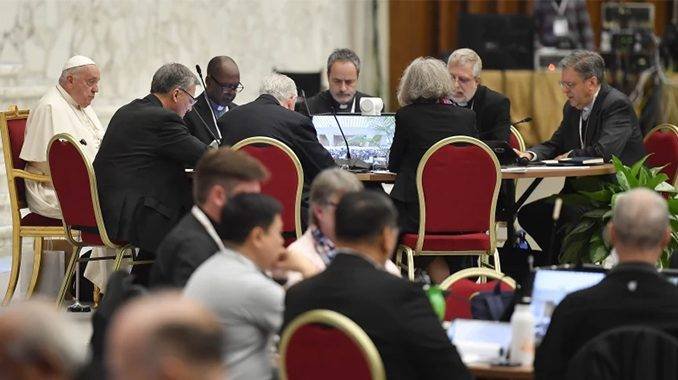
(InfoCatólica) The Synod on Synodality published the Final Report of the Study Group 9, dedicated to «theological criteria and synodal methodologies for shared discernment of emerging doctrinal, pastoral and ethical questions». The document, one of ten study groups derived from the synthesis of the first session of the XVI Ordinary General Assembly of the Synod of Bishops, continues to provoke criticism for its opaque language, its selective methodology and what several analysts consider an ideological instrumentalization of the synodal process.
Following this publication, Randall B. Smith, holder of the J. Michael Miller Chair of Theology at Saint Thomas University in Houston and author of numerous works on scholastic and medieval theology, publishes in Catholic World Report an extensive analysis in which he dismantles both the rhetoric of the document and its ideological assumptions, drawing on the work Abuse of Language, Abuse of Power by philosopher Josef Pieper.
A jargon designed for bureaucrats
Smith poses a direct question: to whom is this document addressed? Not to persons of good will nor to the common faithful, he argues, but exclusively to other ecclesiastical bureaucrats. The theologian deliberately employs the term argot, recalling that its origin designates the secret jargon used by criminals and rogues to communicate without being understood by others.
To illustrate his thesis, Smith reproduces passages from the report in which the increasing number of adult catechumens is described, for example, as an «emerging question» that requires communities to «reassemble functions, roles and habits in light of the newly arrived». The document presents the «conversation in the Spirit» as «a cornerstone in the acquisition of paradigm change inspired by the principle of pastorality» and as «the appropriate experiential framework for employing the tools and procedural criteria available to ecclesial communities».
Smith wonders whether any of that prose has the capacity to move the heart or inspire the mind. If the Gospels had been written thus, he contends, there would be no Christians. And he adds that the document's description of «pastorality» (a term whose very existence he questions) resembles more the labor of an office manager than that of a pastor. The synodal habitus that the report proposes, the theologian observes, explicitly guarantees that a final decision will never be reached, but rather that «capacities for listening and learning will be constantly reactivated»: more meetings, indefinitely.
The result, Smith argues, is not transparency nor participation, as the document claims, but exactly the opposite: no one reads such texts, no one assumes responsibility for what they say, yet their authors claim the mantle of a shared vision that everyone knows is false. With this dynamic, he concludes, authority is not won: bureaucratic power is imposed.
A very selective listening
One of the most incisive criticisms in the analysis is directed at the «listening» methodology of Study Group 9. The document includes a section on «experiences of people of faith with attraction toward the same sex» based on the testimonies of two homosexual men before whom the group «positioned itself in a listening stance».
Smith points out that two testimonies hardly constitute the standard of sociological research. Are there no women? Are there no persons with same-sex attraction living in celibacy? The listening of Group 9, he maintains, proves remarkably selective.
The theologian recovers an illustrative anecdote: a former dean of his university, discontent with the Catholic character of the institution, proposed surveying students who had not enrolled to find out why they had not come. A probable reason, Smith notes, was that they were not interested in a Catholic liberal arts education, and neither was the dean. A consultant advised downplaying the Catholic profile because it «deterred» prospective students, a conclusion based on the comments of two Chicago teenagers who reacted negatively to an advertisement featuring a nun in habit. These are examples, he argues, of selective listening with a clear purpose: voices are heard that confirm what one already wants to do.
The Courage case and «liberation theology»
One of the testimonies collected in the report describes, according to Smith, a «problematic» experience at Courage, the Catholic apostolate for persons with same-sex attraction, whom it accuses of promoting «reparative therapy» and «separating faith and sexuality». The theologian states that testimonies are lacking from those who have found in Courage vital and sustained support over time. The organization itself has publicly criticized the report, calling it «calumny and detraction», and denies any association with so-called reparative therapy. Smith, who knows Courage's founders and leaders personally, corroborates this denial. As for the reproach that meetings are «secret and hidden», the apostolate responds that confidentiality is essential so that participants can speak freely, just as in any Twelve-Step program.
What did help the testifier, according to the report, was the study of theology, which allowed him «the opening of new horizons for a contextual interpretation of the Bible, transcending traditionalist or even fundamentalist readings». Smith observes with irony that, being himself a theology professor, he suspects that this assertion might constitute a case of special pleading by persons engaged precisely in teaching theology.
The theologian directly questions the use of «traditionalist» in this context: does it refer to the reading of Scripture according to the long tradition of reflection of the Fathers and Doctors of the Church? Everything sounds very different when it becomes an «-ism». And it is here, Smith argues, that language games shift from tedious to grave: it is no longer bureaucratic prose, but attributing to Scripture and to official Church documents positions that are not found in them, such as that Christ loves us «just as we are» and that the key is «self-acceptance».
A «paradigm shift» without conciliar foundation
The document uses the expression «paradigm shift» 22 times in its 33 pages and justifies it with generic references to the Second Vatican Council, in particular to Gaudium et spes and Ad gentes. Smith argues that this invocation lacks foundation. The report speaks of a «hermeneutic of the human that embraces its historical, experiential, practical and contextual nature», but omits the two central affirmations about the human being proclaimed by Gaudium et spes.
The first, in Gaudium et spes 22: «In reality, the mystery of man is only clarified in the mystery of the incarnate Word». The second, in Gaudium et spes 24, which culminates in its celebrated formulation: «Man, the only earthly creature whom God has loved for his own sake, cannot find his full realization except in the sincere gift of himself to others».
One can wave a magic wand over a pig and pronounce the words «Vatican II» with lots of added jargon, Smith writes, but that will not turn it into a prince. Nothing in this document shows fidelity or even a basic understanding of the teachings of that Council.
The role of Fr. James Martin
Smith notes that Jesuit James Martin has hailed the report of Group 9 as a «historic change», asserting that the inclusion of testimonies from «married» homosexuals represents «a new ecclesiastical paradigm». The theologian observes that, according to recent reports, it was Fr. Martin himself who facilitated the inclusion of those two testimonies. That is to say, Smith argues, he contributed covertly to insert the testimonies into the report and then publicly celebrated the «emergence» of a new paradigm. One might ask, he concludes, whether this constitutes fidelity to the Council or fidelity to his own ideological agenda.
Pieper: where language is corrupted, coexistence degrades
The backbone of the analysis is the work of Josef Pieper. Smith recalls the warning of the German philosopher: word and language are not a specialized domain, but the medium that sustains the common existence of the human spirit; if the word is corrupted, human existence will not remain intact.
Those who are not interested in reality, Pieper argues (as Smith recounts), are incapable of dialogue: «All discourse severed from the norms of reality is at the same time mere monologue». The authors of Group 9 claim to listen and seek dialogue, but their document, the theologian contends, is an ideological declaration whose aim is to end dialogue, not to engage it. Whoever speaks to another without commitment to truth ceases to regard him as an interlocutor, an equal; he ceases to respect his dignity as a person.
The result, Smith concludes with Pieper, is tyranny: on one hand, apparent authority not sustained in any intellectual superiority; on the other, a state of dependence for which «servitude» would be a more exact term.
Behind the jargon, a clear goal
Smith closes his analysis with an unequivocal verdict: behind all the unintelligible and incomprehensible jargon of the report lies a clear ideological objective, and that objective is not liberation but domination. Only truth makes us free, he recalls. Tyrants answer: «What is truth?». And that answer, the theologian concludes, at least had the virtue of being brief and clear; they did not bury it under a mountain of sophistic verbiage.