
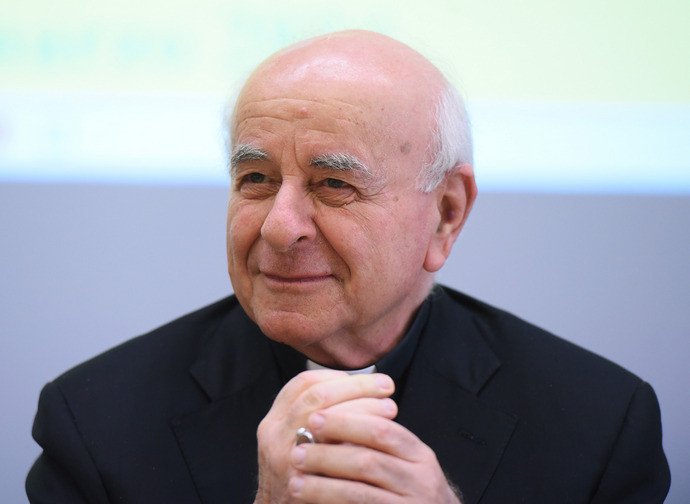
One year ago, Monsignor Vincenzo Paglia concluded his term as president of the Pontifical Academy for Life (Pav). On the occasion of this anniversary, the site Settimana News interviewed him.
In the interview, Paglia confirms a doctrinal orientation that over the years we have always had the opportunity to criticize, an orientation that catered to the wishes of Pope Francis. Monsignor Paglia retraces the steps that led to the revolutionization of the Pav and, always with his help, to the dismantling of the John Paul II Institute for Studies on Marriage and Family to replace it with the Pontifical Theological Institute John Paul II for the Sciences of Marriage and Family. A revolution wanted by Francis because, as Paglia recalls, these two bodies «had thus become, to understand, places of pronounced doctrinal resistance to the pontifical teaching, which was claimed to be more coherent with the Christian truth of the perspective outlined by Amoris Laetitia», the infamous encyclical of Bergoglio. In short, Paglia, by his own proud admission, was for Francis the ideal candidate to revolutionize moral doctrine within the Church according to Bergoglio's thought.
What was the fulcrum that transitioned these two realities towards a heterodox drift? Paglia is very clear: «One of the neuralgic points of the entire operation was the rethinking of the concept of “nature”, which was the foundation of a static and immutable vision of natural law, and with it the questioning of the essentialistic and ahistorical paradigm on which all sexual and family moral theology developed so far. A historical conception of nature chipped away at the paradigm of a natural law intended as a set of immutable principles, and it is here that the greatest criticisms and resistances arose». According to the Church's perennial teaching, which takes up the Thomistic lesson, nature expresses itself as a bundle of inclinations tending towards ends and therefore towards goods: life, property, knowledge, sociality, transcendence, etc. Now this teleological orientation, in addition to being immutable, also has a prescriptive character, equally immutable: if life is a good it is never lawful to kill the innocent; if the knowledge of truth is a good it is never lawful to lie and so on.
Paglia, as he had the opportunity to demonstrate on several occasions, contests this metaphysically founded moral philosophy. He denies that a valid moral doctrine can be founded metaphysically and replaces this paradigm with another, historically founded: the phenomenological paradigm. Practice, the concreteness of existence, the changing particular conditions, read through subjective conscience, thus become the sources of morality. The process is therefore inductive – from fact to principle – and not deductive – from principle to fact, in the sense that the principle informs the particular action, guides our acting. In this perspective we no longer have moral absolutes – conducts that must never be assumed – because there is no norm that can always be adapted to all circumstances, but rather moral relatives, i.e., conducts that from time to time, in relation to particular circumstances, can be good or bad. Morality is always a posteriori, never a priori. This is the celebrated ergonomic morality, which adapts to situations, fluid, elastic. In short, the usual ethical relativism.
The interview confirms in several points this absolutely heterodox orientation. «At the time – continues Paglia – both Institutions were characterized by a strongly moralistic emphasis: with very weak attention to the transformations of the social ethos and to the developments of culture, which should have solicited a theology and a pastoral care capable of dialoguing – dialectically and dialogically, not only apologetically and conflictually – with a new humanistic sensitivity». It is not reality that must adapt to the principle, but the opposite: the principles must adapt to reality. And reality is composed of infinite particular situations and each of them is irreducible to a general and abstract norm: «life understood as concrete human existence, not abstract, which did not let itself be exhausted by a simple casuistic declination», says Paglia. And so, for example, if in reality we verify the existence of social bonds lived as family bonds, albeit not generated by conjugal ties, well these relationships are “family” in every respect. There are therefore «relational figures specifically activated by the family experience: not only that, albeit foundational, of the conjugal couple».
Paglia adds: «the two Institutions [John Paul II and Pav] were, in fact, very “desk-bound”. The reduction of such a delicate and complex matter to the application of a doctrinal algorithm of morality and discipline, imposes a vision of human reality alien to the actual forms of conscience and to the real conditions of experience, which from time to time create the context of life stories». Reality is multifaceted, whereas doctrine is rigid and monolithic. Reality therefore escapes in its complexity the discipline of moral norms. Paglia thus coherently comes to criticize Benedict XVI's non-negotiable principles: «Think of the re-proposal and defense of the discourse on “non-negotiable values”, to a strong moralistic conception, to the transmission of abstract principles». Paglia fails to see that even classical morality preaches a declination of principles in the contingent: the intellect formulates both general principles that always hold and have a negative character – do not kill, do not steal etc. – because actions that always contrast with personal dignity, and, thanks to conscience and the virtue of prudence, particular norms that adapt well to concrete circumstances, norms that can be of negative sign (do not do) and of positive sign (do). Paglia's problem lies in having canceled the non-negotiable principles, i.e., the category of mala in se, of intrinsically evil acts, of absolute negative duties.
This anti-metaphysical and therefore anti-Catholic approach inevitably led Paglia to serious openings on the front of abortion, of euthanasia (click also here), of artificial fertilization and of contraception. All intrinsically evil conducts. These openings have been parallel to other openings, those made towards figures in favor of all these practices (click here and here). Open doors therefore to doctrinally carefree figures and, on the contrary, massive purging of those personalities faithful to the perennial Magisterium.
A final reflection that concerns the strategy put in place by the progressive front in the Catholic house. This interview is not casual, but fits into a series of initiatives and public interventions – not only by Paglia, understand – aimed at not letting the disruptive impact of Francis' pontificate in order to natural morality (and also in order to other matters) fade away in order to counter the orthodoxy of thought within the Church. In short, Francis' legacy must not end up in a museum.