
The Abrahamic Family House, Muslim prayer mats and prayer spaces in the Vatican, the Pachamama debacle, the 2019 Abu Dhabi statement on religious pluralism, and now the Ambrosian Monastery.
They have repeatedly and openly been showing us their not-so-secret project and the only ones who do not see are those who choose not to see or who have been spiritually blinded by the Wicked One.
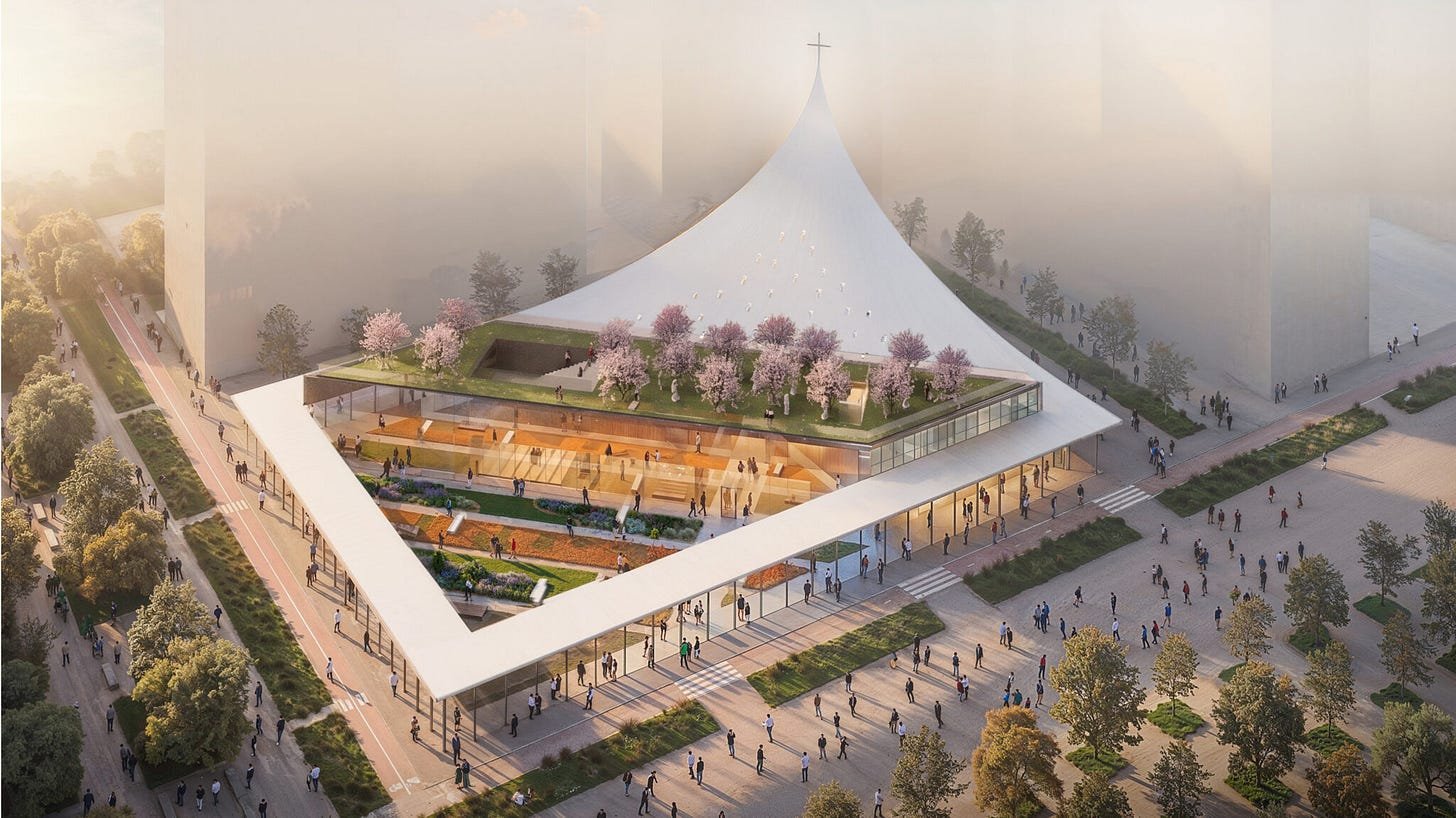
The Archdiocese of Milan has unveiled what it calls the “Ambrosian Monastery,” a vast new religious complex to be constructed in the MIND district—the sprawling “Milano Innovation District” built upon the grounds of Expo 2015 and envisioned as one of Europe’s premier hubs for biotechnology, artificial intelligence, scientific research, and technological development.
The project, personally promoted by Archbishop Mario Delpini and entrusted to the celebrated architect Stefano Boeri, is expected to occupy roughly 2,700 square meters at the intersection of the district’s central axes, the Cardo and Decumano. It is intended not merely as a parish church, but as a symbolic ecclesial presence within the “city of the future”. Its expected date of completion is around 2030.
The symbolism of the project was crafted to create a deliberate narrative. The presentation itself was held at the ancient Chiaravalle Abbey, founded by the Cistercians in the twelfth century, in order to evoke continuity between the medieval monastic tradition and this new experiment in urban spirituality. Church officials repeatedly insisted that the monastery is meant to recover the “historic vocation” of monastic life (prayer, hospitality, and the cultivation of knowledge), but the very need to insist upon this continuity only highlights how radically different the new project is from the monasteries that sanctified Christendom for more than a millennium.
The issue is not whether the Church should be present in modern cities. The Benedictines, Cistercians, Carthusians, and countless other religious orders transformed Europe by entering hostile or uncultivated environments and consecrating them to God. The question is whether this new “monastery” remains recognizably Catholic in its purpose, symbolism, and theological orientation, or whether it instead represents the continued hybridization of Catholic institutions into centers of anti-christian spiritual pluralism adapted to the ideology of modernity.
The official descriptions of the project leave little to the imagination and makes it difficult to give these traitors of the Catholic faith the benefit of the doubt. At the heart of the complex will stand not only a church and cloister, but a “Cloister of Religions,” a “Garden of Religions,” and a “Library of Religions,” all explicitly dedicated to interreligious dialogue and exchange. Different monotheistic faiths will be represented symbolically through trees and plants. The transparent “Library of Religions” is intended to promote interaction between theology, science, ethics, and the religious traditions present in Milan. The complex will include public discussion spaces, study halls, an amphitheater, and cultural venues aimed at fostering encounters among diverse spiritual traditions.
Stefano Boeri himself described the monastery as “a contemporary monastery designed to meet the needs of a plural society and to promote social cohesion, interfaith dialogue and knowledge production.” Archbishop Delpini likewise explained that the Church seeks to be present “inside the questions of modern man” and within the scientific and technological world emerging in MIND. Monsignor Luca Bressan stated openly that the project aims to create spaces for “dialogue between faiths” and confrontation between theology and the life sciences.
It is blindingly clear that this is not simply a monastery with a guesthouse for non-Catholics or an abbey willing to host academic conferences or charitable initiatives. The entire architectural and symbolic identity of the project is structured around interreligious coexistence as a positive theological principle. The “Cloister of Religions” is not peripheral to the design, but one of its organizing concepts; just as the “Garden of Religions” is not incidental decoration, but a visible symbol of the equal presence of multiple faith traditions within a shared sacred environment.
The fools whose rotten minds and hearts birthed this insult to St. Ambros, are presenting false religious traditions architecturally as complementary expressions of humanity’s spiritual search, rather than as mutually contradictory truth claims. The result is inevitably syncretic in effect, even if they try to verbally cover up their dark intentions with orthodox formulas elsewhere.
The Ambrosian Monastery is painstakingly and with satanic intent designed around the premise that the central task of religion today is coexistence, encounter, and dialogue rather than conversion and supernatural truth. The symbolic vocabulary revolves around inclusion, pluralism, cultural exchange, scientific dialogue, and social cohesion.
Historically, monasteries were ordered toward transcendence. Whether Romanesque, Gothic, Byzantine, or Baroque, Catholic monastic architecture directed the soul upward toward eternity. The cloister enclosed a sacred order separated from the world so that monks could wage spiritual warfare through prayer and sacrifice. The monastery existed as a visible contradiction to worldly civilization. A holy Christian place where man renounced earthly ambition in order to seek the One True God.
The MIND project perverts this logic and the new monastery is repeatedly described as “permeable,” integrated into the technological city, open to cultural exchange, and designed to accompany scientific modernity. Rather than separation from the world, it celebrates immersion within it, and instead of the primacy of Catholic truth, the symbolic coexistence of religions under a common civic-spiritual umbrella.
The irony is particularly painful given the invocation of Ambrose of Milan. Saint Ambrose battled heresy fearlessly, defended the integrity of Catholic doctrine against imperial pressure, and understood the bishop’s office as a guardianship of revealed truth. To attach his name to a project whose central emphasis is religious plural coexistence borders on sacrilegious.
The whole project is an arrogant mockery of the First Commandment and a prideful exercise in practical religious indifferentism. It is a paean to their coming One World Religion and an insult designed to provoke Christ the King.
More importantly though, never forget for one moment that it is happening under the watch of Prevost and his mob of spiritual sodomite gangsters. Yes, the very men who think they get to decide who is in the Catholic Church and who is not.
We should feel intensely sorry, and pray, for those who still think this Luciferian dog and pony show is the Catholic Church.