
A Very Beautiful Name
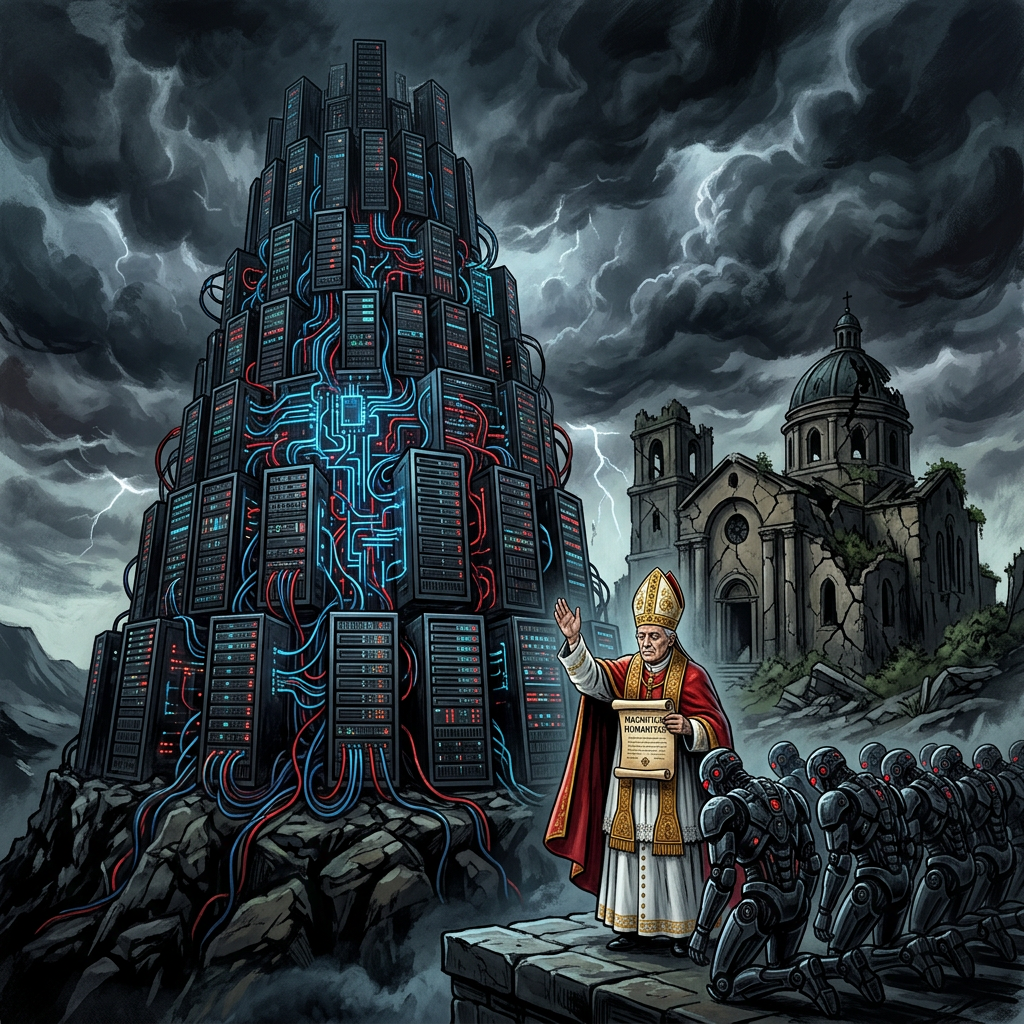
Lucifer, which history tends to make us forget, is a very beautiful name, meaning "Bearer of Light," in this case the divine light that the first of the Seraphim was tasked with spreading to the other angelic choirs and then to humanity—a role he refused, unwilling to lower his superior nature, endowed with exceptional gifts, to serve a God made man, imprisoned in matter. By rebelling against the divine plan, by shouting that he would not serve, Lucifer breaks his alliance of boundless love with the Most High and condemns himself to an irreparable, immeasurable misery, which we can barely imagine. In doing so, he loses not only the extraordinary virtues he once possessed, now corrupted and twisted, but also his place at the pinnacle of the angelic hierarchy, which passed to Saint Michael. He also loses his name, which he no longer deserves, taking instead that of Satan or Devil, meaning in Greek "Divider," for he will relentlessly seek to separate man from his Creator.
Under the Protection of Our Lady
In Latin, Lucifer also designates the "morning star," the last to shine as day breaks, heralding the sunrise, which is why this name of Stella Matutina is borne by Mary, who announces and gives birth to Christ, the Sun of Justice. This explains why, in the early days of the Church, it did not seem shocking to baptize a child Lucifer, which meant placing him not under the protection of the Evil One but, on the contrary, under that of Our Lady. And thus, at the beginning of the 4th century, a future bishop received this name at baptism.
To be frank, what we know about him is limited, and his memory has faded, not because of a name deemed increasingly unthinkable, but due to courageous but somewhat rigid positions that ultimately led him to provoke a schism…
Against Arius, the Nicene Creed
The first trace of Lucifer, whose place of birth, possibly Italy, and family origins we ignore, dates back to 325, when he participated in the Ecumenical Council of Nicaea, on the outskirts of Constantinople. This council was convened to examine the doctrine of a priest from Alexandria, Arius, a former academic convert to Christianity who, steeped in Greek philosophy and finding the Gospels too simple, set out to rewrite the history of Christ in a version more in line, in his view, with the aspirations of intellectuals. The result of these speculations, which would poison Christianity for centuries in various forms and resurgences, was a outright denial of the divinity of Jesus, a "Son of God" in an honorary sense, so to speak… It was against these delusions that the conciliar fathers drafted the Creed of Nicaea, which we still recite, proclaiming Jesus as the "Only-begotten Son of God, born of the Father before all ages, God from God, Light from Light, true God from true God, begotten and not made, consubstantial with the Father, by whom all things were made."
Perhaps Lucifer was then a very young priest, attending the debates alongside his bishop. The experience, which resulted in the condemnation of Arius and his theories, deeply marked him. We find him nearly thirty years later in the entourage of Pope Liberius, who had granted him the rank of legate. In this capacity, Lucifer traveled to Arles, where a council had been convened to arbitrate between the archbishop and the bishop Hilary of Poitiers. Alas, in the meantime, and despite the death of Arius, his ideas had prevailed, at least at the imperial court of Constantinople. Emperor Constance II was a militant Arian and intended to eradicate Catholicism from the Empire. By force. Athanasius, who, in 325, as an assistant to Patriarch Alexander of Alexandria, had drafted the Nicene Creed and had since ceaselessly defended the Catholic faith, was its primary victim, banished from his episcopal see, exiled to Trier, recalled to Egypt, and banished again, at the whim of the political fluctuations of the hour. Lucifer and Athanasius knew each other well and were probably friends.
A Dishonorable Compromise
The Council of Arles was intended to result in the condemnation of the Nicene party; it did. Hilary was exiled to the East, and Athanasius, once again deposed, had to hide in the desert of Thebaid. Lucifer, who had just been appointed to the episcopal see of Caliaris, today Cagliari, in Sardinia, witnessed all this with consternation, and, as he was courageous, he protested against these decisions. To no avail. He had no more success the following year, at the council held in Milan, a stronghold of Arianism in Europe, tightly controlled by the heretical bishop Auxentius.
The worst was yet to come… At Christmas 355, Pope Liberius, in whom the virtue of fortitude was sorely lacking, in order to spare himself the fate of Athanasius and Hilary, to save his tiara, and to escape exile, accepted a dishonorable compromise with state Arianism and replaced the Nicene profession of faith with a "mitigated creed," known as the Creed of Rimini, which denied, or nearly so, the divinity of Christ… As Saint Jerome would later say, then a teenager: "The stunned world awoke Arian."
The great defenders of Catholicism, imprisoned, exiled, were unable to react, and the Catholic prelates still in place were too cowardly to protest.
This scandal outraged no one. The great defenders of Catholicism, imprisoned, exiled, were unable to react, and the Catholic prelates still in place were too cowardly to protest. With one exception, which would bring him glory: Lucifer of Cagliari. The bishop of Sardinia had this very dignified formula, which would become a rallying cry for the faithful: "One must die for the Son of God." In other words, it is better to accept martyrdom than to deny the divinity of Christ. Unlike the legitimate bishop of Milan, Denys, who died from ill-treatment in deportation, Lucifer did not obtain martyrdom but was immediately deposed and then exiled to Syria. Like Hilary, he took the opportunity to preach sound doctrine to the local populations abandoned, which forced them to move him in the hope of limiting the damage; he was sent to Palestine, then to Egypt, where he may have had the chance to see Athanasius again. And there, against all expectations, the two friends would quarrel…
To Punish or Forgive?
In 361, Constance II died, leaving the purple to a distant cousin, Julian, who would go down in history under the nickname of the Apostate. Julian, a survivor, due to his very young age at the time, of the massacre perpetrated by Constance and his brothers to eliminate potential rivals, and who had seen his father and mother slaughtered before him, hated the Arians. Initially, before daring to admit that, baptized by force, he did not believe in Christ and remained faithful to the paganism of his parents, he took the side of the persecuted Catholics. Athanasius and the other exiles were allowed to return home. Everything suggested—though things would prove more complicated than expected—that Arianism had lost the battle and would disappear. All the more quickly as the imperial authorities would help by using coercion against its supporters… Deposing Arian bishops and priests would be an excellent start. This was, in any case, the opinion of Lucifer, whose ordeals did not incline him to great leniency toward his tormentors.
Yet this line of conduct would not be that of Athanasius or of Damasus, who, in 366, succeeded Liberius on the Chair of Peter. They preferred forgiveness and reconciliation. For them, an Arian who renounces heresy should be reinstated in the Church after a period of penance. This question of reconciliation had plagued the Church for over a century, ever since 251 and the persecution of Decius, which, though it produced very few martyrs, caused a record number of apostasies among the faithful, and even the clergy and episcopate, poorly trained, who did not feel they had betrayed Christ by agreeing to sacrifice to the goddess Rome, a gesture presented as a civic allegiance to the imperial regime.
Faced with this massive collapse, and in the absence of a pope, for Fabian had been executed in 250 without it being possible, in the general panic, to elect his successor, two currents emerged within the communities: some, led by a priest named Novatian, who would have liked to sit on the Chair of Peter, decreed that the cowardice of the apostates deserved no pardon and that reinstating them in ecclesial communion would be an intolerable insult to the martyrs and confessors who had endured all torments without flinching. Those who had renounced their faith deserved the eternal fire that no remorse, no penance, could spare them…
Lucifer Advocates a Hard Line
Faced with this drastic position, which risked despairing thousands of faithful, weak perhaps but genuinely repentant, stood the archbishop of Carthage, Cyprian, whose moral authority was unquestioned. Cyprian did not minimize the terrible gravity of the fault committed but called for examining each case individually, refusing to condemn with the same severity the bishop, aware of the weight of his actions, who not only abjured but incited the clergy and flock to imitate him, and the illiterate Christian who did not grasp the stakes, the wife whom her husband forced to sacrifice against her will, and the husband in question, the young children led to the temple and mixed with pagan practices, and the adults who took them there. Some were guilty, others not, or barely. And then there were those who, humanly, had yielded to fear and wept with shame and regret.
One could condemn all these people even more because, in some dioceses of North Africa, Spain, and Italy, it would amount to excommunicating entire communities… To reconcile justice and mercy, Cyprian advised light penalties, or no penalty at all for those who seemed little guilty, long, severe penances, on bread and water, sometimes for life, for the others, with only the possibility of being reconciled, for the most guilty, in articulo mortis… The Church followed his advice, which, moreover, provoked a schism with Novatian, furious at not having been elected pope, and his friends, who modestly baptized themselves "the Pure"…
This story, Lucifer knew it; he knew, therefore, that Athanasius and Damasus were following an established and tested line of conduct. They considered the use of public force in ecclesiastical affairs to be bad, to the point that Damasus would not even want to depose heretical priests and prelates, saying that death would one day rid the Church of them. It must be said, in favor of Lucifer of Cagliari, that his position, if not charitable, was lucid. He knew the Arians well enough to know that they would see in the Catholic attitude not clemency and leniency but weakness and would take advantage of it; he was not wrong, the future would prove him right. And then, not deposing these people was abandoning their flocks exposed to their bad doctrine.
A Confessor Forgiven?
Athanasius could always object that it was a matter of reconciling those who accepted to renounce heresy, but Lucifer doubted their sincerity en bloc… In his view, a heretic remains a heretic, and it is better not to deal with him. In 362, the break between the bishop of Cagliari and Rome turned into a schism. In fact, this "Luciferian" schism impressed more by its name, though it had nothing demonic, than by its gravity. It would affect very few faithful and disappear after the bishop's death, on May 20, 371.
Moreover, was the ecclesial communion ever really broken? Lucifer was buried in his cathedral, according to custom, and archaeological excavations in the 17th century would allow the discovery of his tomb and his epitaph, which made no mention of his disputes with the papacy. Thus, Saint Lucifer of Cagliari appears in the Catholic martyrology with the title of confessor. No one could deny him that!