
The 22 October saw the publication of the Dicastery for the Doctrine of the Faith (DDF) document Venite ad me and, although the themes are those tiresome, classic synodal ones, this text is not as botched as the latest ones signed by Víctor Manuel Fernández, as it maintains a certain internal coherence and presupposes the intervention of a more attentive hand.
Venite ad me, is entirely focused on the urgency of evangelization so ardently desired by ‘Pope Francis’: «Faced with the situation described above, it seems entirely natural that for believers, the task is to embark on a great season of Gospel proclamation, finally giving effect to what Pope Francis asked in Evangelii gaudium regarding the urgency for the entire Church to embark on a new evangelizing phase» (72).
Are we certain that Bergoglio’s desire was to promote evangelization?
Complaining about catechists who feel like ‘evangelizers,’ here is what the Argentine said at Santa Marta in 2016: “I go to evangelize, I have brought many to the church… making proselytism is a boast, evangelizing is not making proselytism. Taking a stroll; reducing the Gospel to a function; making proselytism… all of us know people who have been driven away from the Church, what should we say to them?… the last thing you should do is say anything!”. In Tbilisi, he said: «There is a grave sin against ecumenism: proselytism. One must never proselytize with the Orthodox!». Taking pretext from an expression of Benedict XVI, Bergoglio abhorred proselytism, forgetting that it was practiced in the early Church (Acts 6:5; 13:43). Announcement of the kerygma and proselytism are closely connected (Acts 2:37-41).
Francis’s intention has been to stifle in every way the proclamation of the Gospel, closing flourishing seminaries rich in vocations and removing capable bishops such as Joseph Leonard, Mario Olivieri, Héctor Aguer, Giovanni D’Ercole, Joseph Strickland, and others.
At the Vatican, they now believe we have all become imbeciles, and they even try to convince us that Leo XIV could not go to Assisi by helicopter, nor by train, nor by car, because it was too risky for a person operated just a few days earlier for lung adenocarcinoma, whereas instead, he can undertake a journey of over 31,000 kilometers by plane and even reach Cusco, which is at 3,400 meters above sea level, a true boon for a seventy-one-year-old man just operated on the lungs!
The DDF document is steeped in synodal sentimentalism: for the believer, the important thing is to be ‘illuminated’ by ‘love’ and to follow the emotions of the ‘heart’ irresistibly drawn to the kerygma.
The word heart is repeated 57 times, and I report only a few excerpts:
«As Pope Francis reminds us at the beginning of the Evangelii gaudium: ‘The joy of the Gospel fills the heart and the whole life of those who meet Jesus’ (24); ‘Discovering that the Church can offer concrete spiritual help in the face of these concerns, predisposes the heart to receive the kerygmatic announcement with renewed vigor’ (69); ‘the beginning of a journey of knowledge and love of Christ, made possible by the acceptance of the announcement by those who receive it with a free and sincere heart’ (76); ‘It must be a “performative” announcement, capable of truly touching the heart of those who receive it and of urging their steps toward the heart of the Lord Jesus’ (77); ‘For this reason, the language of faith must not limit itself to a cold exposition of concepts; it must certainly possess that clarity which facilitates understanding, but above all, it must be characterized as an appeal of the heart’ (80).
Susanna Tamaro would have suggested for the document a title dear to her: Follow Your Heart.
For 47 times, the word love is repeated:
«Those who open themselves to the light of the revelation of God’s love receive from Jesus a word of forgiveness, a word of liberation, a word of love, a word of freedom, a word of life, a word of hope (cf. Lk 4:18-19). Jesus arouses in all those who approach Him and open themselves to Him with a sincere heart a renewed interest and love» (13); «the light and power of that love are always available to anyone at any time and in any place» (11); «finally, the beginning of a journey of knowledge and love of Christ, made possible by the acceptance of the announcement by those who receive it with a free and sincere heart» (76). It is superfluous to add that all the Bergoglian slogans are cited.
The absolute primacy belongs to the term light, which in the document appears 88 times.
«The light and power of that love are always available to anyone at any time and in any place. Whoever receives this revelation abandons forever the kingdom of darkness, finally opening themselves to the light of life and to a life of light» (11); «He continually wishes to direct the heart and mind of all to the true light of the Father’s love» (12); «This is, therefore, the heart of the Christian experience: the encounter with the Lord Jesus, who puts us in contact with the true light of divine love» (25); «The experience of faith can thus be imagined as the vital and decisive encounter with that ‘true sun’ which is Christ, who frees from darkness and fills with light the human existence. It is an experience of light» (26); «Since faith is listening and vision, it is also transmitted as word and as light» (27).
I recall that the mascot doll of the Jubilee is named Luce, and is the work of a designer who supports the gay pride and manages a line of sex toys. Luce holds in her hand a staff, whose shape has nothing to do with a jubilee pilgrimage, and can signify both an erotic object that we find in sexy shops, and the staff of the god Anubis, similar to the one used by Bergoglio. On January 6, 2025, the Antipope said: “We are capable of giving hope to others with the light of our faith”. The gadget has esoteric-satanic meanings, because the light brought by Bergoglio – I will not tire of repeating – is that of Lucifer.
It is true that Fernández seems to specify: «This true light has the name of Jesus, the Christ» (9), however, there is a well-founded suspicion that the repetition of the same word in a compulsive and obsessive manner has no other purpose than to evoke and actualize Bergoglian thought.
What is the purpose of these synodal saccharines in a document where for dozens of times the sacred words of Pope Francis are recalled? It is explained in the text itself.
The evangelical announcement has not been incarnated in the lives of people (52; 66), «To this is added the need to rethink the very way of announcing the Gospel, privileging narrative forms over the simple transmission of abstract concepts» (66); «the transmission of faith not remain confined in languages that can be labeled as “scholastic”, “dogmatic”, or “moralistic”» (80); «The centrality of the kerygma requires […] that it not impose the truth and that it appeal to freedom, that it possess some note of joy, stimulus, vitality, and a harmonious completeness that does not reduce preaching to a few doctrines sometimes more philosophical than evangelical» (83).
Finally, a good piece of news: after the failure of the missionaries who for two thousand years have announced the Gospel with ‘abstract concepts,’ ‘few doctrines,’ and without ‘joy, stimulus, vitality,’ now they will have a sure point of reference, the Defensor Fidei Cardinal Víctor Manuel Fernández!
And what has become of the Church’s Magisterium?
The Magisterium is cited only to be ignored and contradicted. What Fernández calls “Considerations on the Transmission of Faith in the Changing Era” invite one to distrust Catholic doctrine and not to be dispersed in its ‘many areas’ (84); «For this reason, faith is not transmitted first of all as a set of doctrinal contents or religious information, but as a form of ecclesial life in which the believer is progressively introduced» (29).
Beware of the deception: the ‘ecclesial life’ mentioned by Fernández is that synodal and deceptive one promoted by the false church of Rome. El Tucho besame mucho invites one to free oneself from the useless doctrinal burdens that until now have oppressed the freedom of persons; the important thing is to follow one’s inner voice and one’s emotional sensations. A do-it-yourself faith is proposed, a subjective experience of the heart that arouses emotions and inspires a love free from any Law.
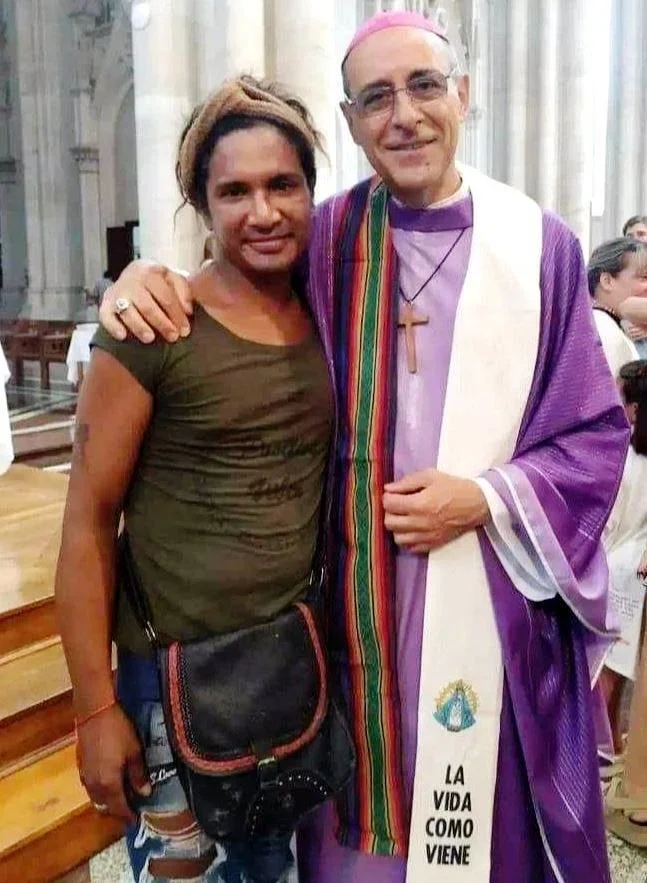
The DDF announces a kerygma emptied of conversion and the Last Things, in perfect harmony with a photo – now famous – depicting a trans person next to Fernández dressed in liturgical vestments and a stole bearing the inscription: «La vida como viene».
The document has been practically ignored by the bishops, as it deserved. After verifying yet another flop in Fernández’s management, the journalist of Religión Confidencial asks the prefect of the DDF: “Did you expect the document on the Transmission of Faith to have a greater impact?”. Answer: “Not really. I was realistic… It is understandable that this topic, so closely linked to that of the previous document (Dilexi te), does not arouse particular emotions”.