"Le style c’est l’homme", said Buffon
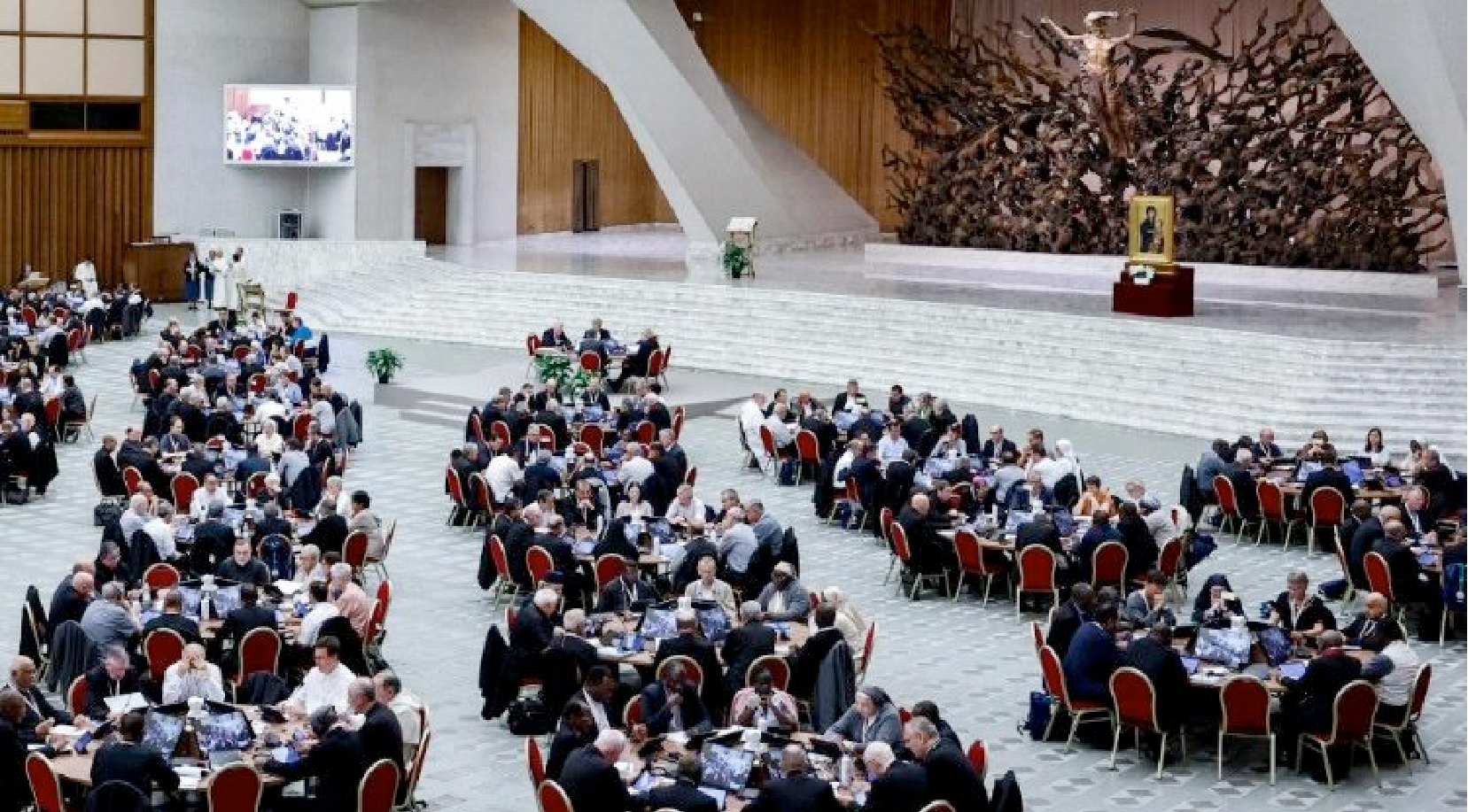
The General Secretariat of the Synod indeed published on May 5 two astonishing texts: the final reports of the study groups 7 ("Some aspects of the figure and ministry of the bishop in a missionary synodal perspective", including the criteria for selecting candidates for the episcopate: GE_7_FRA_Synthese.pdf) and 9 ("Synodal theological and methodological criteria for the shared discernment of emerging doctrinal, pastoral and ethical questions": GE-9_FRA_Synthese.pdf). Astonishing by the style, for these texts constitute a true anthology of the amphigourous mode of expression of the postconciliar clerical discourse, which even AI would have a hard time translating clearly.
But astonishing also by the content. Perhaps less the synthesis of group 7, which is largely synodal eye powder, talking about groups and committees that will take part in giving names of candidates for the episcopate, but we understand that the ultimate designation will remain the fact of the nuncio, a key figure – we know especially in France – to appoint bishops in line, or at least inodorous and insipid clerics.
The synthesis of group 9, on the other hand, plunges into abysses of perplexity. It speaks of doctrine, or rather – let's avoid big words – of "shared discernment". Part of this group were: Mgr Castillo, Archbishop of Lima, member of the Pontifical Academy for Life, Mgr Iannone, appointed by Pope Leo XIV Prefect of the Dicastery for Bishops, Fr. Coda, professor of dogmatic theology, Fr. Casalone, professor of moral theology at the Pontifical Gregorian University, Sister Ngalula, professor of dogmatic theology, Professor Morra, professor of fundamental theology at the Pontifical Gregorian University.
We believe that the Christian message must be deeply inculturated: "It is possible to enhance anthropological and cultural diversities, without inhibiting or betraying the novelty of the Gospel, but rather allowing it to flourish in listening to the Holy Spirit, in the exchange of the gifts received and cultivated". How far can this "exchange of gifts" with cultures go? We understand that the scruples that fueled the quarrel of the "Chinese rites" are no longer in season.
No more "controversial questions", but "emerging questions"
The disappearance of doctrinal controversies is indeed enacted. The "controversial questions" become, admirable find, "emerging questions": "While the formula "controversial questions" refers to the theoretical plane and the necessity of "solving a problem", the expression "emerging questions" refers rather to the qualities, dispositions and dialogue open to "relational conversion", which the whole People of God is called to assume in the journey of the synodal Church."
No more trials for heresy or schism – well, almost no more, follow my gaze… – but a "dialogue open to relational conversion". It's a change, we are confirmed by the synthesis of this group 9, which "had already been initiated during the Second Vatican Council."
We must understand that each believer is relative: "To develop and implement this paradigm shift, we must elaborate an hermeneutics of the human that enhances the historical, experiential, practical and contextual character of man himself, who finds his fulfillment in Christ."
As a result, his faith is also relative, for "the universal truth of man cannot be determined historically once and for all, but it manifests itself in the concrete forms of different cultures, namely in an incessant dialogue where cultures, communities and persons progress in the exchange of gifts, under the impulse of the search for truth and justice, in the light of the Gospel". And that's why your daughter is mute, said the doctor of Molière. And that's why the Christian can say anything without moving the Dicastery for the Doctrine of the Faith says the Synod (except, of course, if he said something bad about the Council).
And the group affirms the priority of praxis, like the progressives of yesteryear who did "a bit of the way" with Marxism, except that here it is a matter of a praxis that elaborates a new conceptual framework, as in a multi-stage rocket of relativism: "Relational conversion concerns primarily the processes through which all the baptized are able to learn through practices (ecclesial, liturgical, social). Through these practices, individuals do not merely solve the more or less important problems of their daily life, but together contribute to sketching the linguistic, symbolic and cultural framework in which problems can emerge, be named and elaborated together."
The goal of this mutation of "paradigm" is, as one might expect, an aggiornamento: to understand the meaning of the "signs accomplished by Jesus" for "today's life" by opening up to "the voice of the Spirit". For today's life.
The resignation of the shepherds
One could be reassured by the assertion that the Church has a "culture of transparency" that pushes it to "say and do the truth". Except that it is specified to us that the Church is now moved by the "principle of pastorality" which makes "it is not a question of solving problems, but of building the common good."
Consequently, it is no longer a question of condemning anyone or anything: "The starting point does not consist in the correction (on the doctrinal, pastoral, ethical level) of situations possibly judged problematic in concrete believing experience, but [of building the common good] in the recognition and discernment of the aspirations for good that religious practices express, often through a diffuse and informal knowledge." Not to deal with what was once called sin, but to discern "the aspirations for good" relevant to a "diffuse and informal knowledge".
Is this diffuse knowledge a remnant of learned knowledge, an old memory of catechism? Not at all, for there is no longer any teaching by the representatives of Christ – those who were once called, the Church teaching, the pope and bishops united to him – but there is listening. And the Synod group in charge of dealing with doctrine arrives at this extraordinary proposal that defines what is now the role of authority in the Church, a proposal on which all the thunders of condemnations would have fallen in the past: "From this perspective, the specific role of authority [it is we who underline] is above all to listen, to activate processes of discernment and to accompany them in order to arrive at the expression of a consensus, even differentiated, when this contributes to the construction of the common good." Not only does the authority have nothing more to do than to accompany "the expression of a consensus", but with this precision, to avoid that this consensus itself becomes a kind of replacement dogma, that it can be "differentiated"
From "who listens to you, listens to me" (Lk 10, 16) which founded dogma and magisterium, let us make a clean slate!
Examples follow. "In the third part of the document, two synodal discernment exercises are proposed around two emerging questions: the experience of believing homosexual persons (cf. Appendix A, 1 and 2) and the experience of active nonviolence on the part of persons and associations in a situation of war (cf. Appendix B)." The members of the group listened to two testimonies "to offer some reflections and above all some questions as a contribution to the implementation of synodal discernment practices."
In plain terms, if one can say so, they did not "wish to conclude the process of listening and reflection with a final declaration, but with some guidelines for an ethico-theological discernment and some questions for the continuation of the synodal journey."
The conclusion is referred to the "individual communities and [to] "the whole Church" To decide whether a certain attitude is moral or immoral? Not at all! The final sentence of the synthesis is a kind of definition of resignation: they [the individual communities and the whole Church] will take "personally in charge the commitment to recognize and promote the good through which God acts in history and in the experience of persons."
The Church no longer teaches. The Church and its synodal communities undertake to "recognize" and to "promote" the good that springs from the experience of men, but above all to say nothing. And those who practice homosexuality and unjust violence will remain in their sin.