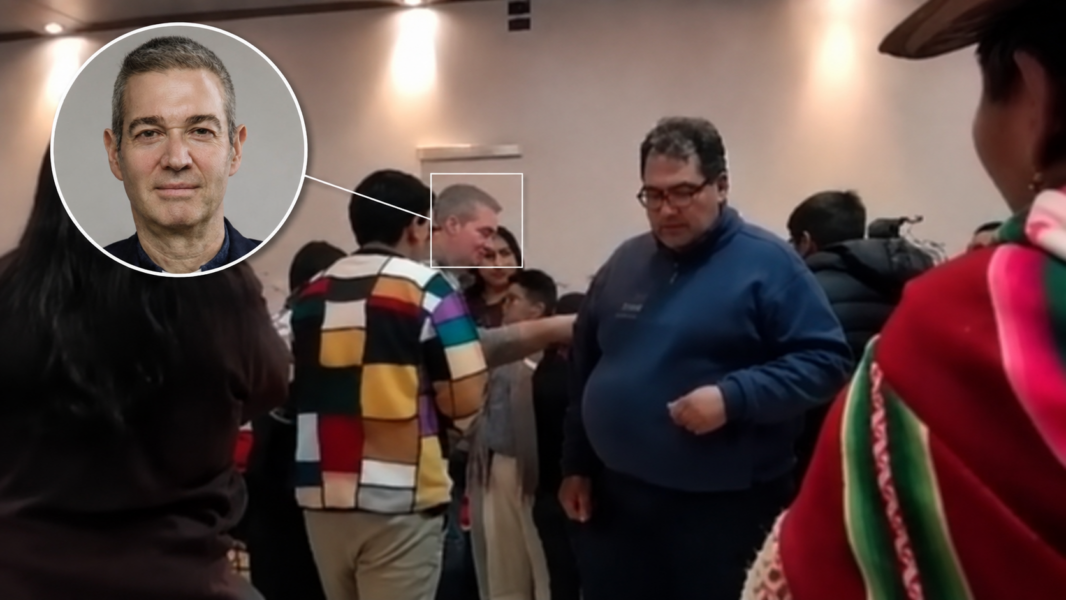
The Southern Macroregional Meeting «Weaving Voices for Dignity», presented by Vatican News as part of the preparation for the visit of Leo XIV to Peru, began without any Catholic prayer: in its place, a rite of invocation to Mother Earth with the distribution of coca leaves, breathing exercises, and the offering of food on the ground.
Among the offerers, as shown in the images, Msgr. Jordi Bertomeu, official of the Dicastery for the Doctrine of the Faith and Pontifical Commissioner for the Sodalicio, who deposits his coca leaves in the bowl of the «pago» with visible reverence, and who, after concluding his intervention on the Sodalicio case, turns upside down the placard with his name and exits the camera’s field of view.
[[IMG_1]]
00:00
00:53
The meeting took place in Cusco on 13 and 14 August, «Weaving Voices for Dignity: for human rights and the common good», bringing together representatives of social organizations, indigenous communities, and collectives from nine regions in southern Peru. The event was inaugurated by Msgr. Lizardo Estrada Herrera, Auxiliary Bishop of Cusco and General Secretary of CELAM, and included the participation of Msgr. Miguel Ángel Cadenas, Bishop of Iquitos. What the official account by Vatican News fails to mention is how it began—or who else was present.
«It is the month of Mother Earth, who loves us so much»
According to the video circulated on social media, before the lectures a woman led the opening ceremony. «This month of August is very special for us, for Andean cosmovision; it is the month of Mother Earth, who loves us so much, who is so tender, so kind, who gives us food», she explained to those gathered. In Andean tradition, August is the month when the Pachamama is «fed» through offerings and «payments to the earth».
Next, coca leaves were distributed among all attendees, followed by guided breathing exercises: «let us see how our interior is», the officiant instructed, as those present closed their eyes. «This body, this flesh we inhabit is earth, is territory», she continued.
The rite concluded with the deposition of the coca leaves into bowls placed on an altar on the ground, alongside food offerings—including cheese—to the earth: «we thank the earth in this most important month; we give her three breaths as we place them», the ceremony leader instructed. The gesture of blowing three times over the coca leaves before offering them is part of the Andean ritual of the «pago» or dispatch to the Pachamama.
The video contains no Catholic prayer, blessing, or Trinitarian invocation. The spiritual dimension of the meeting’s opening was entirely covered by the Andean cosmovision rite. The bishops were present in the room, though for much of the ceremony they remain outside the camera’s field of view.
[[IMG_2]]
00:00
01:29
Bertomeu, offering with reverence and departure concealing his name placard
The most striking attendee of the meeting does not appear in Vatican News’s account: Msgr. Jordi Bertomeu, official of the Dicastery for the Doctrine of the Faith, a trusted man of the Holy See in the most delicate cases in Latin America and Pontifical Commissioner for the Sodalicio de Vida Cristiana.
The images show him fully participating in the rite: Bertomeu deposits the coca leaves into the bowl of the «pago», with visible reverence, immediately after the Auxiliary Bishop of Cusco. There is no indication that he merely observed the ceremony: he offered as one of the participants.
His subsequent behavior is equally striking. The lectures begin immediately after the Pachamama rite, and when Bertomeu takes the floor to recount his actions in the Sodalicio case before the audience, the camera focuses exclusively on the public, not the speaker. As if he had requested not to be documented there. Upon finishing, the images capture him turning the name placard upside down on the table and exiting the camera’s field of view. A functionary of the doctrinal dicastery of the Holy See who offers coca leaves to Mother Earth and then immediately ensures that no visible record remains of his presence at the event: each reader may draw their own conclusions about the reasons for such discretion, and whether participation in Pachamama rites is the kind of image fitting for one who represents the Pope as Pontifical Commissioner. This outlet has attempted to contact Jordi Bertomeu but has received no response.
A Church event, not an external act
What is concerning is that this was not a civil society event to which the Church was invited as a guest. The meeting was inaugurated by the very General Secretary of CELAM, who set the framework by appealing to the Social Doctrine of the Church: «the defense of human dignity, justice, peace, and the common good are not matters foreign to faith», said Msgr. Estrada, who set the goal of moving «from scattered voices to a shared word […] and from proposals to concrete commitments». The format aligns with the gatherings organized by the structures of social pastoral care and the Andean vicariates alongside the National Human Rights Coordinator.
Among the speakers were Tania Pariona, Executive Secretary of the National Human Rights Coordinator and former congresswoman of Nuevo Perú; the Cusco congresswoman Ruth Luque, from the same political sphere; José Antonio Lapa, Director of Human Rights Without Borders; and Victoria Taco, from the Platform of Those Affected by Toxic Metals of Espinar.
Vatican News highlights it; the rite and Bertomeu, silenced
It is striking the prominence given by Vatican media to the meeting. Vatican News dedicated an extensive report—reproduced by other outlets—in which it emphasizes the episcopal protagonism and frames the event, explicitly, within the preparations for the upcoming visit of Pope Leo XIV to Peru. In that report, not a single line mentions the opening ceremony: no coca leaves, no «pago a la tierra», no month of the Pachamama. Nor is there any mention of Bertomeu, despite his speaking to the audience immediately after the ceremony. The contrast between what the images show and what the official narrative recounts is, in itself, telling: the meeting is publicized as a prelude to the papal journey, while omitting that it was a pagan ritual event attended by an official of the Dicastery under Prefect Víctor Manuel Fernández.
Questions remain unanswered: Was the rite included in the official program? Who led it and on what authority? Do the organizers consider that a «pago a la tierra» can substitute for Christian prayer at the opening of a Church gathering? And does the Dicastery for the Doctrine of the Faith consider the active participation of its officials in offerings to the Pachamama compatible with their role? Until answers are provided, the images speak for themselves.