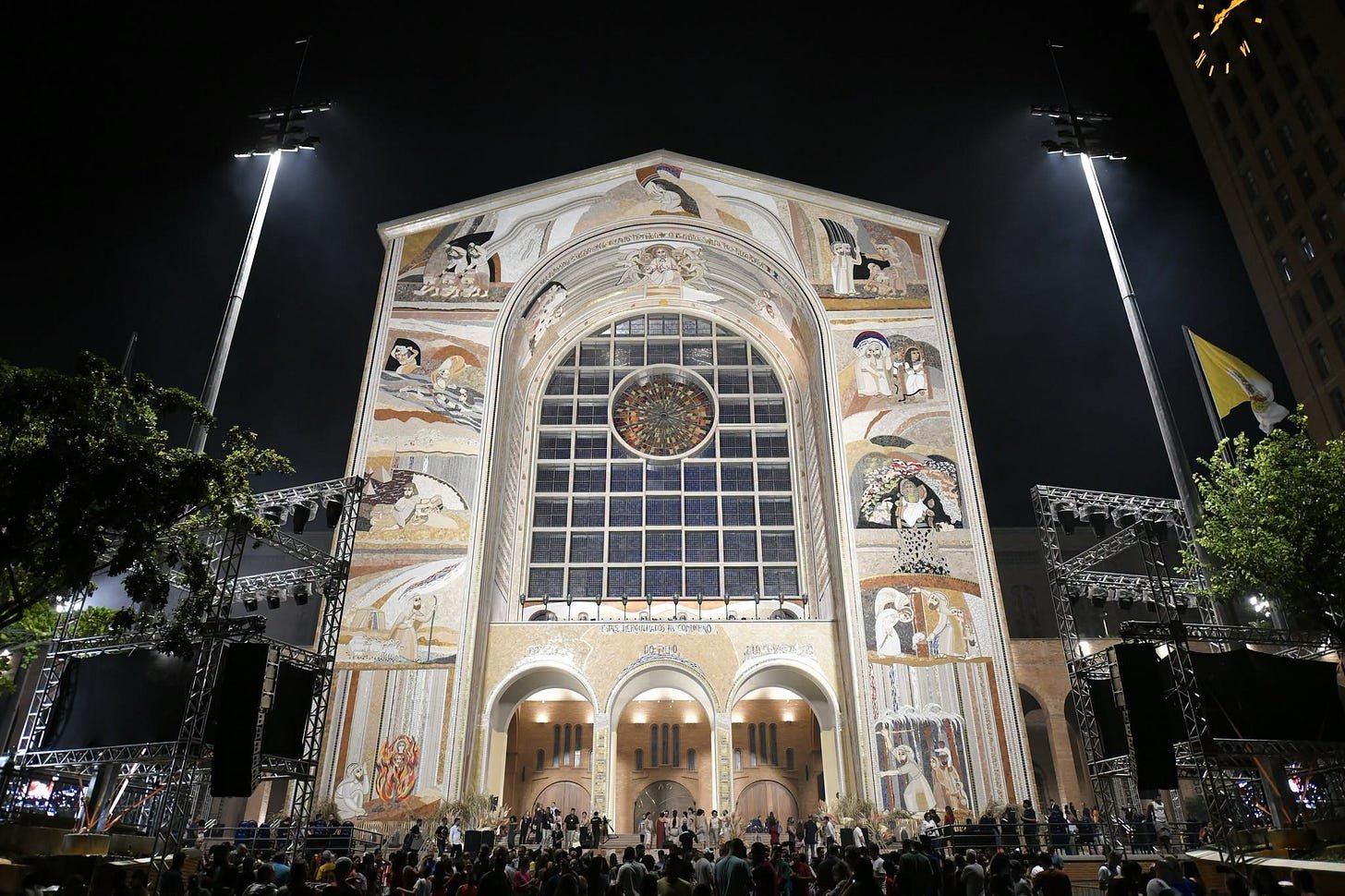
On Saturday, 12 September in Aparecida, Brazil, a large mosaic on the façade of the largest basilica in South America will be solemnly inaugurated, blessed by the pope. The signature is that of Marko Rupnik, the former Jesuit now on trial at the Dicastery for the Doctrine of the Faith on charges of sexual abuse against some thirty women. This is precisely why, two weeks later in Lourdes, the same pope will visit the shrine where Rupnik’s mosaics on the façades of the Basilica of the Rosary have been definitively covered due to the gravity of the accusations against the Slovenian artist. In both cases, the pope’s approval is full, unwavering, and widely communicated in the media.
It is all true. On 12 September in Aparecida, in the state of São Paulo, a grand ceremony will take place, featuring music and theatre performances, and of course an appropriate religious celebration, to mark the inauguration of the west façade adorned with mosaics recounting the story of the Apocalypse—the fourth and final façade of the second-largest basilica in the world after St Peter’s. In 2017, Don Marko Rupnik was commissioned for this monumental work by the Redemptorist Fathers who manage the shrine, with the approval of the Brazilian Episcopal Conference.
The former Jesuit continued to oversee the Brazilian project directly: here we see him posing in front of the west wall alongside the shrine’s former administrator, Father Luiz Cláudio Alves de Macedo, and the engineer overseeing the construction site to his right.
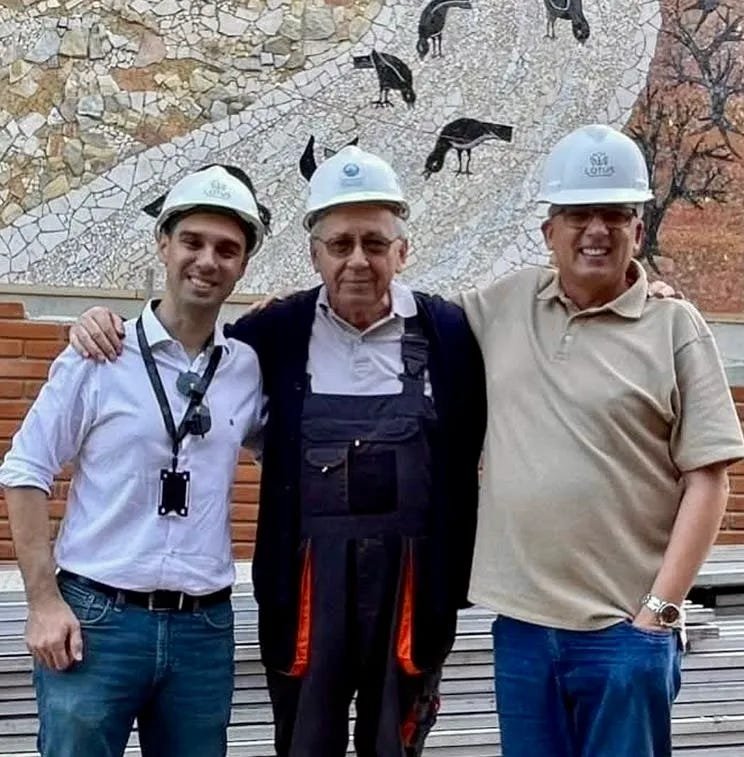
The great work of covering the Brazilian shrine began seven years ago, in 2019, faced a halt during the pandemic but is now finally complete, to the delight of the Redemptorists, Bishop of Aparecida Mário Antônio da Silva, his predecessor Don Orlando Brandes, and all the faithful who funded it.
On one side, the global press is shining a spotlight on Lourdes, praising Bishop Jean-Marc Micas’ initiative, which, with the pope’s approval, has decided to permanently conceal Rupnik’s mosaics on the façade of the Basilica of the Rosary. On the other, in a media blackout as vast as the ocean, the completion of the decoration of the Sanctuary of Our Lady of Aparecida is about to be celebrated. Four façades of Rupnik-branded mosaics, naturally created by the artists of the Centro Aletti.
Thus, just fifteen days after Pope Leo’s visit to the Basilica of Lourdes—against a backdrop of mosaics covered by the bishop as a symbol of the Church’s attention to the suffering of victims—in another Catholic basilica (not a small church, but the largest Marian shrine in South America and one of the most famous pilgrimage sites in the world)—another bishop is blessing the same mosaics of shame, with the same black eyes devoid of irises, all emerging from the workshop of the former powerful Jesuit now on trial for abuse.
It is all true. In Aparecida, they make no effort to hide it; indeed, they are trumpeting it to secure the final donations: those who contributed to the realisation of this grand project will have their names inscribed in a book to be preserved in the shrine. The walls bearing the Rupnik signature are described on Aparecida’s official website, which details each mosaic, explaining their meaning, when they were created, the materials used, and the number of artists involved:
The west façade of the Aparecida Basilica is the fourth of four façades to be covered in mosaic. The works, which began in 2025 and were completed in 2026, covered nearly 4,000 m² of mosaics, conceived and executed by 39 mosaicists of various religious confessions (Orthodox, Greek-Catholic, Latin Catholic), of different nationalities, ages, and backgrounds (priests, consecrated persons, laypeople, and married couples), all linked to Rome’s Centro Aletti. The stones used come from various countries, including Brazil, Italy, Greece, and Afghanistan. The work was made possible thanks to donations from the Family of the Devout, an initiative uniting the faithful to support the social, construction, and evangelisation works of the National Sanctuary of Aparecida.
Unlike the Brazilian shrine, the Centro Aletti—though it created this monumental work—provides far less information. Indeed, the page dedicated to Aparecida remains frozen in 2023: they must have thought it best not to draw too much attention or give the impression that the project had been suspended pending a final verdict on Rupnik, who is still under ecclesiastical trial for sexual abuse at the Dicastery for the Doctrine of the Faith. Instead, as we have documented over the years, work never stopped. Here we reported on the inauguration of the south façade of the shrine on 11 May 2024 and gave an idea of the cost of this monumental work:
We can hazard a rough estimate of the costs. «The price of the mosaics is about one thousand euros per square metre, not including materials, labour, and production work, from scaffolding to the use of machinery needed for installation,» Erasmo Freitas de Abreu told Isabel Gnaccarini, contributor to Folha do São Paulo. Freitas is the director of the Amacom architecture and sacred art studio, which collaborates with Brazilian artists, both lay and religious, and has been involved in the laying of the mosaics in Aparecida from the outset.
If we calculate that the surface area of the north façade is about 2,300 square metres, while the south exceeds three thousand, plus the 650 square metres of mosaic on the colonnade, the bill quickly adds up: the Redemptorist Fathers may have paid close to six million euros for the mosaics completed so far, not to mention all other costs, including those for the inauguration of each façade.
How much did the Centro Aletti earn from this colossal Brazilian contract? The east façade, completed in spring 2025, comprises nearly 4,000 square metres of mosaic, so the sums are clear: the studio on Via Paolina has pocketed at least 14 million euros. Undoubtedly a tidy sum, the investment of which we do not know, but which has certainly helped make Rupnik a powerful and feared figure in the Vatican.
There is more: if it is true that Pope Leo met privately with the Bishop of Tarbes and Lourdes on 26 June 2025 and, on that occasion, told him that he had personally ordered the removal of images of Rupnik’s works from Vatican communications—thus approving Bishop Micas’ decision to conceal the works in Lourdes—it is equally true that the Prefect recently received a far warmer and more cordial audience with the Archbishop of Aparecida, Mário Antônio da Silva, just a couple of months ago. This is recounted by the rector of the Aparecida Sanctuary himself:
On 29 June (2026, ed.), Dom Mário Antonio was received by Pope Leo XIV in the Vatican. He was presented with the episcopal pallium, a symbol of his work and pastoral ministry in the Archdiocese of Aparecida.
The pope thus seems eager to bless the work of the archbishop, whom we see in a video circulated by the shrine’s communication network, placing the final tiles to complete the west wall alongside the Redemptorist Fathers and the emeritus Archbishop of Aparecida, Orlando Brandes.
Pope Leo had already received a delegation from Aparecida at the end of December 2025, alongside then-Bishop Brandes, as I recounted here:
(…) the pope saw no issue in welcoming the Redemptorists of Aparecida into the Vatican. On 13 December (2025, ed.) last year, he received in audience the Superior of the Province of Nossa Senhora Aparecida, Marlos Aurélio da Silva, and the shrine’s rector, Father Eduardo Catalfo, accompanied by Bishop of Aparecida, Monsignor Orlando Brandes. The Redemptorists, who never miss an opportunity to showcase Rupnik’s new mosaics (generously funded by the faithful’s donations), presented the pope with a statuette of the Virgin of Aparecida and images of the dazzling basilica. The visit was organised to mark the twentieth anniversary of Tv Aparecida, the network broadcasting from the shrine and the only one authorised in recent years to air images of the grand inaugurations of the façades covered in Rupnik’s mosaics.
It feels as though we have strayed into a Philip K. Dick novel, where reality can effortlessly invert itself without anyone finding it strange. On one hand, Pope Leo applauds the damnatio memoriae of Rupnik and his work, to the point of suggesting an exemplary sentence in the ongoing trial against him; on the other, he blesses and encourages a bishop and diocese that for years have extolled not only the artistic but above all the pastoral significance of Rupnik’s mosaics.
This is the heart of the Jornada Biblica project, the biblical journey illustrated on the four façades of Aparecida:
The “Biblical Journey” project, proposed by the National Sanctuary, teaches that clothing oneself in the Word of God is an ideal of life. Our Journey is a pastoral project in search of hope. Through art and beauty, we wish for the devotees of Our Lady of Aparecida to draw closer to Sacred Scripture. By adorning the four façades of the Sanctuary with biblical passages, we renew our commitment to the Bible.
The press chooses to look in only one direction—in Lourdes—and to praise the pope’s attention to victims (and there is nothing new in this)—but this two-tiered approach by Pope Leo must have a meaning: either the Church does not know what it is doing, or it knows full well, and what looms before us is anything but reassuring.