
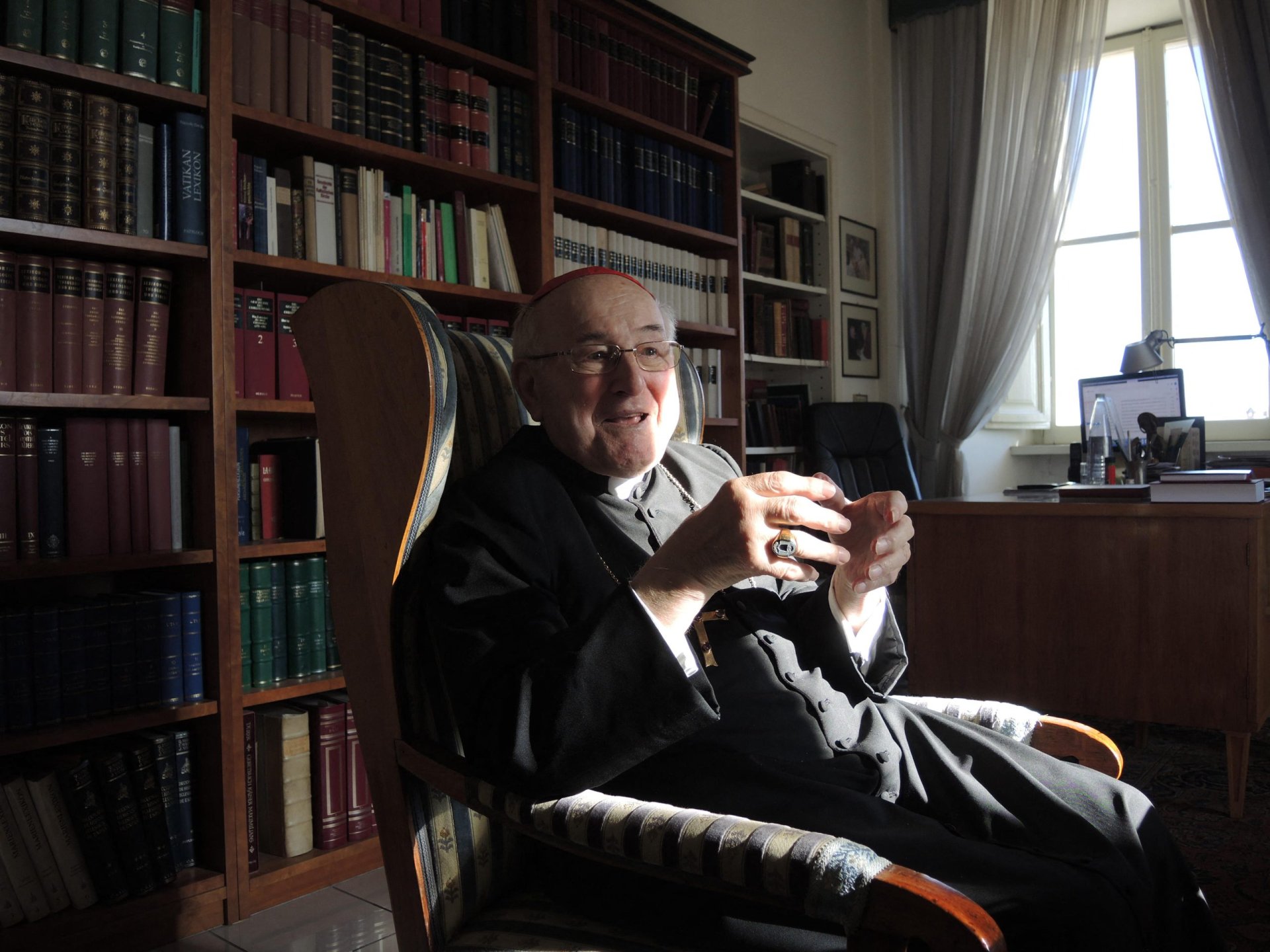
Cardinal Walter Brandmüller has accused the Catholic Church’s modern understanding of synodality of drawing partly on the Protestant model, warning that its use risks blurring the authority reserved to bishops by the sacrament of Holy Orders.
In a guest article published by Italian Vatican commentator Sandro Magister on September 8, the 97-year-old cardinal argued that there is still no “clear and unambiguous definition” of synodality, despite the term’s growing use since the pontificate of Pope Francis.
His Eminence begins by explaining the need to establish what is meant by a synod within the Catholic tradition. Cardinal Brandmüller invokes Goethe’s Faust, quoting Mephistopheles, appearing as a professor, telling a student: “All in all, keep to words! Then you will go through the secure gate to the temple of certainty.”
When the student responds that “a concept must accompany words”, Mephistopheles replies: “Fair enough! Only one mustn’t worry too much about it, for just where concepts are lacking, a word comes along in good time.”
“According to the classical Catholic understanding, the synod is a meeting of bishops for the purpose of jointly exercising their magisterial and pastoral service,” His Eminence writes.
Cardinal Brandmüller then explains that a general or “ecumenical” council, involving all the bishops of the Church and meeting under the presidency of the Pope or his delegates, possesses the highest magisterial and pastoral authority. Acting “cum et sub Petro”, with and under Peter, such a council can proclaim definitive and infallible doctrines which must be accepted in obedience of faith.
A particular council, meanwhile, consists of bishops from a group of particular Churches, such as an ecclesiastical province or ecclesiastical region. Such a council exercises only the “magisterium ordinarium”, with its decrees requiring confirmation by the Holy See. In both cases, Cardinal Brandmüller emphasises that the bishops act through the magisterial and pastoral power received through sacramental ordination.
His Eminence then turns to the Synod of Bishops established by Pope Paul VI through the 1965 motu proprio Apostolica Sollicitudo. Cardinal Brandmüller does not question the need or appropriateness of such a body, but argues that its consultative character makes the terminology potentially misleading. The Synodus Episcoporum was established as a consultative body for the Pope. Its participants are individually convened by the Pope and their role is to advise the pontiff, rather than to proclaim doctrine, make decisions or legislate.
“For the sake of conceptual clarity it would be appropriate not to use the term ‘synod’ – which in this context can lend itself to misunderstandings – but to find a different and more appropriate name,” Cardinal Brandmüller writes.
Cardinal Brandmüller argues that bodies involving priests and lay people cannot properly be called synods because priests and laity do not exercise the magisterial and pastoral ministry conferred on bishops through the sacrament of Holy Orders.
That position does not mean a rejection of lay consultation. “It is possible to entrust a consultative role to competent laypeople,” His Eminence writes. However, wherever such collaboration takes place, Cardinal Brandmüller argues that the Church should avoid “any misleading use of the terms ‘synod,’ ‘synodality,’ and the like” and instead use terminology which accurately reflects the nature of the body.
The cardinal then connects the development of these structures with what His Eminence regards as an uncritical adoption of secular structures and democratic procedures within the life of the Church. “It is evident that the establishment of bodies of the type just mentioned arises from the effort to more or less acritically adopt secular structures and democratic procedures in ecclesial life, in order to stay in step with the times,” Cardinal Brandmüller writes.
The most direct criticism concerns the Protestant model of synodality which, according to His Eminence, is now being proposed within Catholicism.
“What is being proposed in the Catholic sphere,” Cardinal Brandmüller writes, “is a type of synod” inspired in part by a Protestant model in which members are democratically elected from among pastors and men and women of different professional expertise and cultural backgrounds, with all possessing an equal say.
His Eminence traces the principle to Martin Luther’s polemical writings of 1520. According to Cardinal Brandmüller, Luther sharply rejected the institution of the sacrament of Holy Orders by Jesus Christ, maintaining that baptism alone was sufficient to make a man or woman a priest, bishop or pope. “It is clear that such a concept of synodality is incompatible with Catholic ecclesiology,” Cardinal Brandmüller writes.
The argument then moves to the history of episcopal conferences, which His Eminence places within the same wider development. Cardinal Brandmüller links their emergence to the end of the Ancien Régime and the European system of “throne and altar”, followed by the rise of the modern secular state.
When episcopal conferences emerged in Europe during the first half of the 19th century, their frame of reference, according to His Eminence, was the state rather than the hierarchical structure of the Church. Their consultative and decision-making activity consequently concerned the Church’s position and action within the modern secular state, rather than doctrine, liturgy or the sacraments.
The principal exception was marriage, since secular states also claimed authority over its legal regulation according to the Napoleonic model. Against this historical background, Cardinal Brandmüller questions the authority attributed to episcopal conferences by Pope Francis in Evangelii Gaudium, beyond the provisions of the 1983 Code of Canon Law.
His Eminence calls it “highly problematic” that episcopal conferences were attributed “also some authentic doctrinal authority”.
“Also in doctrinal matters the episcopal conference is not an intermediate hierarchical body, nor an organ of the national Church that can enter into competition with the magisterium of the universal Church or even endanger the doctrinal primacy of the pope,” Cardinal Brandmüller writes.
From the end of the 19th century, particularly in Europe, His Eminence argues that episcopal conferences increasingly took the place of synods, adopting forms and procedures influenced by political models.
Cardinal Brandmüller links this to the “growing secularization of the understanding of the Church”, referring to an ecclesiological “neo-Arianism” which, without explicitly denying the supernatural character of the Church, tends instead to ignore it and understand the Church primarily as a social entity.
His Eminence argues that the response should be a restoration of the importance of synods of particular Churches, which conform to what Cardinal Brandmüller calls “authentically ecclesial hierarchical structures”.
“In the face of these episcopal conferences corresponding to political boundaries,” Cardinal Brandmüller writes, “it would be necessary to restore to the synods of the particular Churches, as conforming to authentically ecclesial hierarchical structures, their original importance.”
The cardinal proposes that such assemblies could become still more effective if held according to renewed liturgical forms. His Eminence points to evidence from the sixth century onwards and to the liturgical forms contained in the 1986 Pontifical.
Cardinal Brandmüller ends by arguing that restoring the traditional importance of particular synods would also provide a means of resisting the secularisation of Church structures and advancing what His Eminence calls the “de-secularization” of the Church. He concludes by recalling the need for such “de-secularization”, a necessity strongly reiterated by Pope Benedict XVI.
Previously, in a March 2022 essay entitled “Quo vadis, Germania?” for KathNet, Cardinal Brandmüller described the German process as being “on the wrong track that is lost in nothingness” and rooted in the heresy of modernism. He argued that its demands, including same-sex blessings, changes to teaching on homosexuality, women’s ordination, optional celibacy and lay involvement in the election of bishops, “clearly contradict the authentic Catholic faith, the Church’s hierarchical-sacramental constitution and her binding moral teaching”.
In July 2023, Cardinal Brandmüller co-signed five dubia with Cardinals Raymond Burke, Robert Sarah, Joseph Zen and Juan Sandoval Íñiguez, which were sent to Pope Francis ahead of the Synod on Synodality. One question asked whether synodality could be treated as a “constitutive element of the Church” and become “the supreme regulative criterion of the permanent government of the Church” without distorting the structure willed by Christ. The other questions concerned the development of doctrine, blessings of same-sex unions, women’s ordination and the necessity of repentance for absolution.