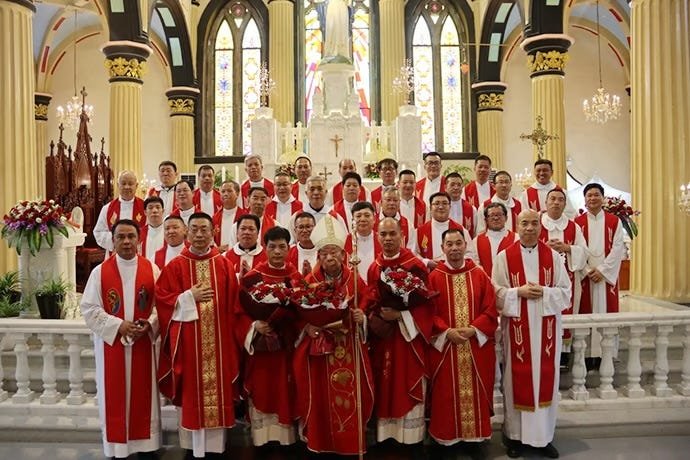
Somewhere in Fujian, episcopal consecrations have reportedly taken place behind locked doors.
The men have no public names. Their consecrators remain unidentified. We have no dates, photographs, or programs printed on heavy Vatican stationery. That is the point. An underground bishop told historian Anthony Clark that Fujian’s Catholics now live in a “state of emergency” and have secretly consecrated “at least ten” bishops to assure the Church’s survival.
Ten bishops. In one province.
Clark’s report for Catholic World Report describes Catholics who fear that bishops increasingly dependent upon the Communist government will eventually surrender the integrity of the Faith. They have watched Rome approve candidates selected through the state’s machinery. They have watched loyal underground clergy harassed while Patriotic Association prelates gain legitimacy. In their judgment, episcopal succession itself now has to be hidden.
This is the most consequential Catholic story of the week. It goes to the bone: Who sends a bishop? What happens when Roman diplomacy helps an atheist government tighten its grip upon the men who are supposed to guard the Faith? And how can the same Vatican that declared the entire clergy of the Society of Saint Pius X schismatic over four episcopal consecrations handle ten secret bishops in Fujian without exposing a spectacular double standard?
The Agreement That Produced an Emergency
Francis signed the provisional agreement with Beijing in 2018. Its text remains secret. Rome renewed it three times, most recently for four years in October 2024, while claiming that it had ended the era of episcopal consecrations without papal consent. Vatican News even celebrated roughly ten appointments under the agreement.
Now an underground bishop says Fujian alone has produced at least ten secret consecrations.
That symmetry is almost too perfect. The agreement was sold as the cure for rival hierarchies. Eight years later, Catholics driven further underground are quietly rebuilding one.
This spring, Human Rights Watch found that the Vatican agreement had helped Beijing pressure underground Catholics into the state-controlled church. Its investigators documented ideological training, surveillance, arbitrary detention, disappearances, house arrest, restrictions on children, and the forced submission of clergy travel documents. One interviewee called the agreement an “intelligent weapon” for destroying underground communities. As of April, HRW reported that Leo had approved five Beijing appointments and that no papal veto had yet been exercised.
Fujian already supplied the warning. Bishop Vincent Guo Xijin, recognized by Rome and repeatedly detained by the state, was demoted after the 2018 deal so that Vincent Zhan Silu, a government-backed bishop whose excommunication Francis lifted, could take the see of Mindong. Guo later endured eviction and relentless pressure to join the Patriotic Association.
The message reached every underground sacristy: decades of suffering could be traded away at the negotiating table, and the men who cooperated with the regime might inherit the cathedral.
The Missing Mandate and Rome’s Chinese Dilemma
One correction is necessary before outrage outruns the evidence. The Gloria.tv headline says the Fujian bishops were consecrated “without papal mandate.” Clark’s report establishes secrecy, number, place, and stated necessity. It never establishes the absence of a hidden mandate. Even the SSPX news service flagged that gap.
That uncertainty hardly rescues Rome. It traps Rome between two answers.
Perhaps these men possess secret faculties. The Holy See would then be conceding that faithful Catholics require an emergency episcopal structure beyond the public hierarchy tolerated by Beijing. Extraordinary provision for the survival of the Church would be a present fact, rather than some medieval legend that traditional clergy must prove by producing miracles on demand.
Perhaps they possess no mandate. In that case, underground bishops have made the elemental claim Archbishop Lefebvre made at Écône: a crisis threatens the transmission of Catholic priesthood and sacraments, so the positive law governing episcopal consecration yields to the salvation of souls.
The circumstances differ greatly. Chinese clergy risk prisons, forced disappearance, and physical abuse. The SSPX dispute concerns doctrine, worship, and the survival of Tradition under pressure from churchmen. Still, both cases raise the canonical category of necessity. Rome cannot make that category vanish whenever the accused wears a cassock it dislikes.
Canon 1387 attaches automatic excommunication to episcopal consecration without pontifical mandate. The same code says in Canons 1323 and 1324 that grave fear and necessity can excuse or diminish penalties; under the specified mitigating circumstances, a latae sententiae penalty is not incurred.
Yet on July 2, one day after the SSPX consecrated four bishops, the Dicastery for the Doctrine of the Faith declared the act schismatic, pronounced all SSPX clergy schismatics, and declared their confessions and marriages invalid. The accompanying note asserted the crime and penalty. It offered no serious analysis of the Society’s necessity defense.
What will Cardinal Fernández call the men in Fujian if their consecrations lacked mandates? Schismatics? If Rome recognizes fear and necessity in China, why did its July decree treat those concepts as though canon law had never heard of them? If Rome condemns the Chinese bishops too, it will punish persecuted Catholics for trying to survive a disaster Vatican diplomacy helped deepen.
Protestants Receive a “Shared Mission” at the Door
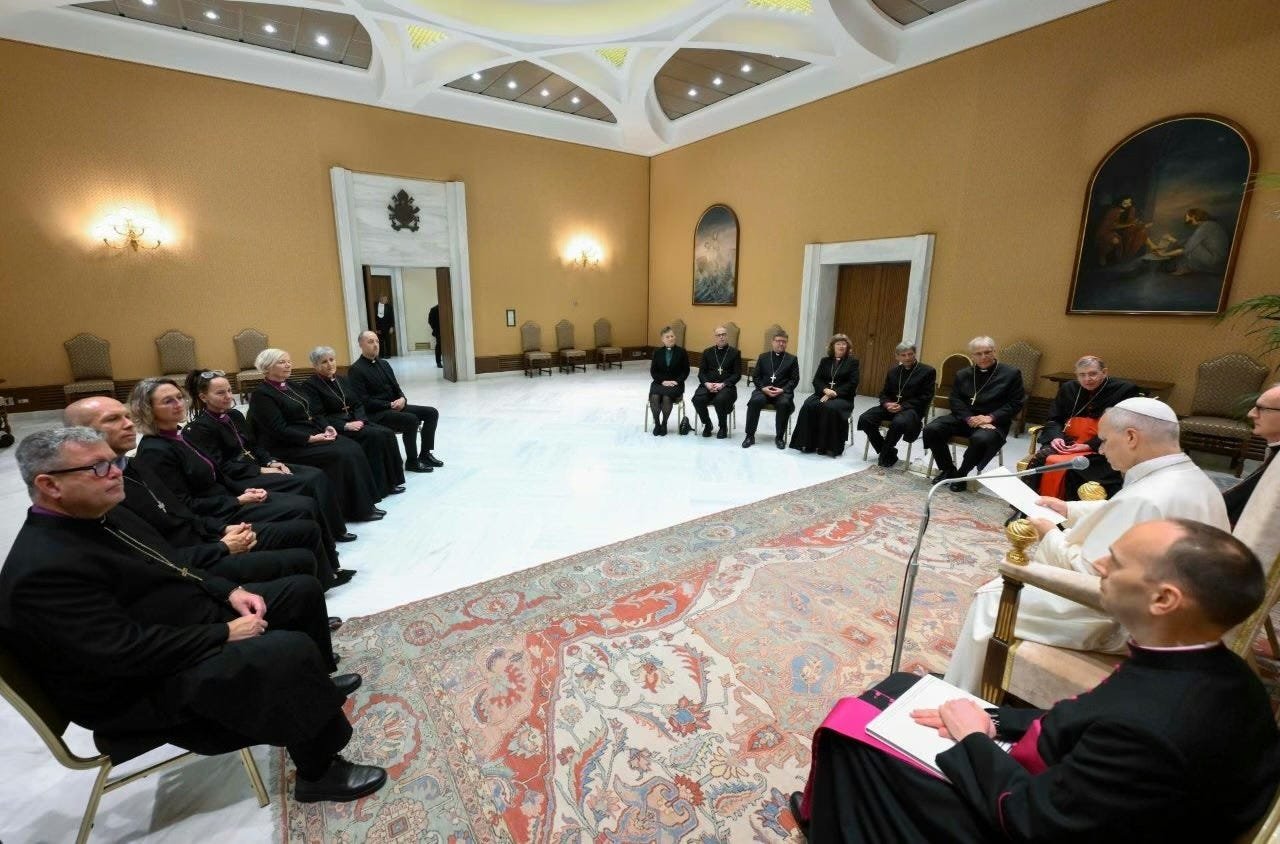
Leo made the jurisdictional farce worse on Wednesday.
He welcomed leaders of the Lutheran Church of Norway to the Apostolic Palace and grounded Catholic-Lutheran cooperation in “our common Baptism and our shared mission in the world.” That mission, he explained, consists in growing together through the promotion of peace and justice. The address is brief and unmistakable.
These Lutheran officials possess no Catholic jurisdiction. Their ecclesial body created a liturgy for same-sex weddings and has ordained women for decades. Still, they arrived in Rome as “bishops” engaged in a “shared mission.”
A chancery lawyer can dispose of the objection quickly. Leo meant common baptismal witness in temporal affairs. He conferred no canonical office. True enough, and that defense reveals the whole revolution.
Mission has been flattened. Christ sent the Apostles to teach all nations, baptize them, and command observance of everything He revealed. The ecumenical version begins with a lowest common denominator and moves immediately toward peace, justice, dialogue, and fraternity. Once mission means respectable humanitarian cooperation, a Lutheran institution that solemnizes same-sex unions qualifies with ease.
Traditional priests get another catechism. Where is your canonical mission? Who sent you? Sedevacantist clergy are told that an extraordinary mission would require extraordinary signs. The Norwegian delegation had to prove nothing. Leo supplied the word at the door.
The categories differ in canon law. Their pastoral deployment exposes Rome’s priorities. “Mission” becomes warm and expansive around Protestants; it becomes a weapon when Catholic traditionalists approach the altar.
The Gay Press Can Read an Appointment
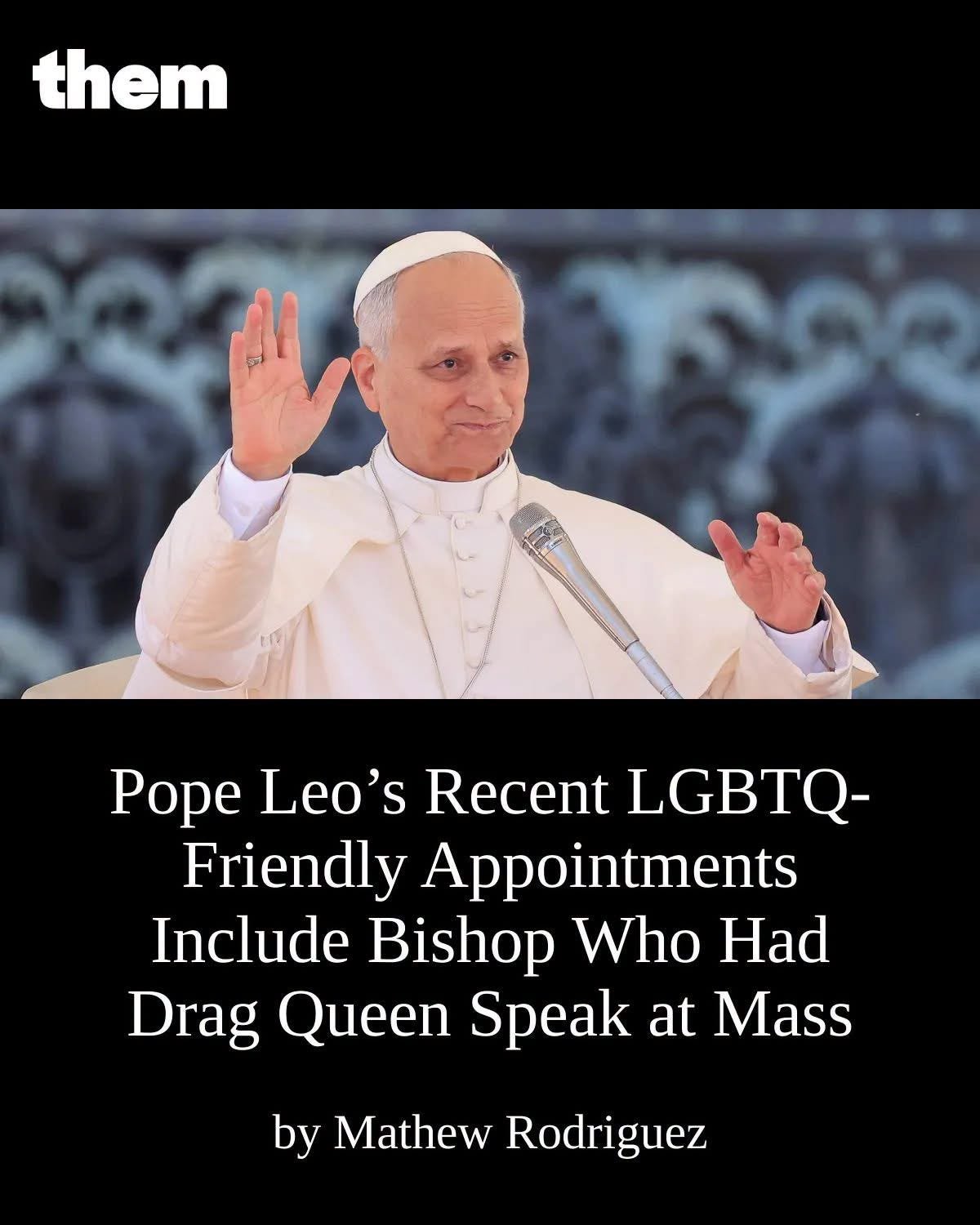
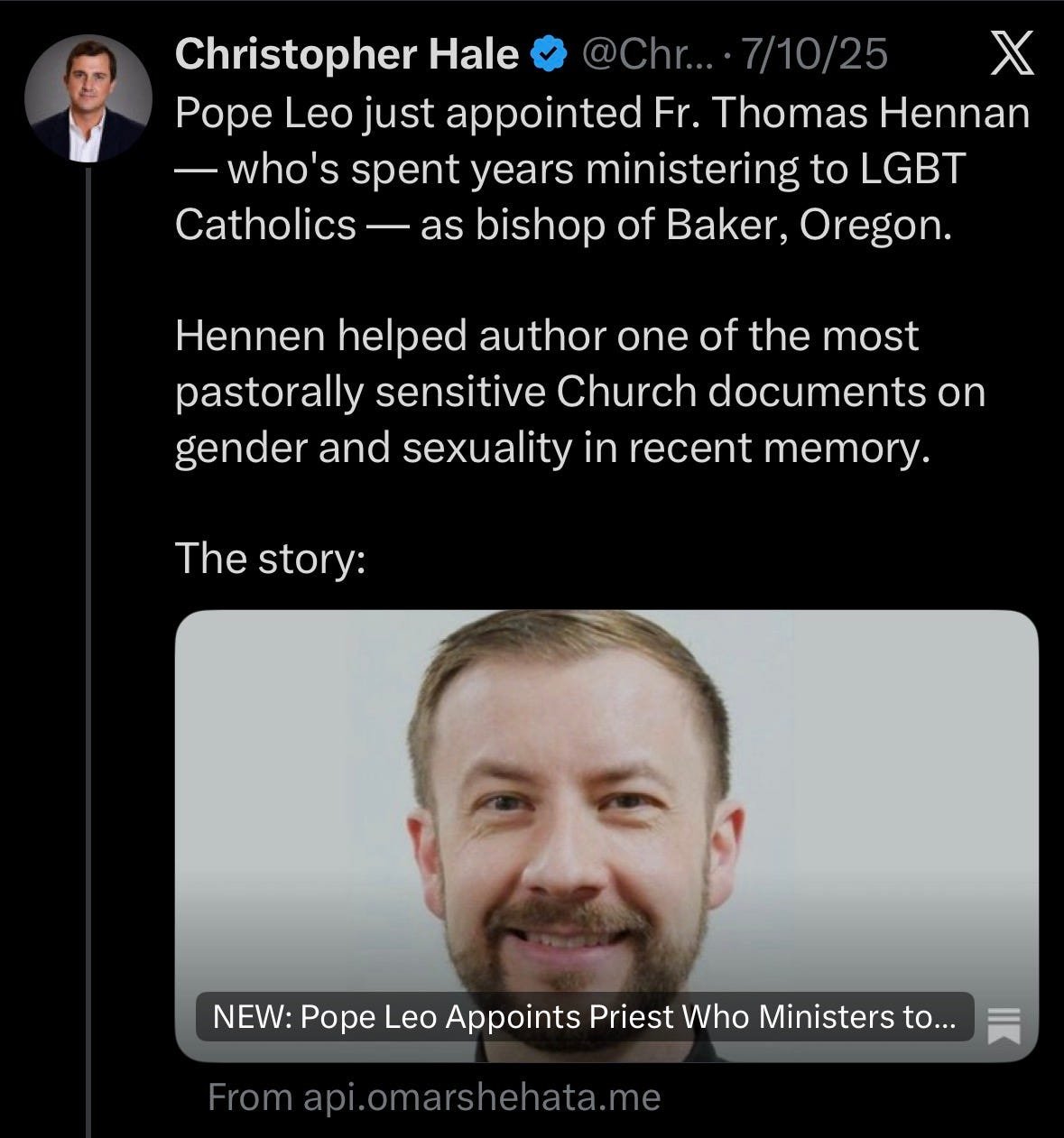
Two days earlier, the homosexual magazine Them published a cheerful survey of Leo’s episcopal appointments. Its writers identified four men: James Checchio in New Orleans, Ramón Bejarano in Monterey, Christian Würtz in Eichstätt, and Thomas Hennen in Baker.
The cases vary. Checchio attended an LGBT ministry gathering. Hennen helped draft Davenport guidelines encouraging accommodations involving pronouns, clothing, and restrooms. Bejarano presided at an “All Are Welcome” LGBT Mass, apologized for the Church’s alleged stigmatization, and invited drag activist Nicole Murray-Ramirez to speak. Leo appointed him to Monterey in December.
Würtz supported the German Synodal Way’s calls for same-sex blessings, reconsideration of women’s ordination, and a doctrinal text denying that homosexual acts are intrinsically evil. Leo appointed him to Eichstätt in July.
Progressive Catholics grasp patronage better than the professional optimists at conservative Catholic outlets. Christopher Hale, a former Obama staffer whose analysis supplied the Them article, made the essential point: Rome shapes future decisions by choosing who enters the room years earlier.
Exactly.
Doctrine can remain formally unchanged while episcopal practice migrates. A bishop blesses the relationship, another apologizes for the moral teaching without quite naming it, guidelines reorganize Catholic institutions around gender identity, and Rome rewards the men involved. By the time a synod studies the “lived experience,” the conclusion has already acquired miters.
Leo’s appointments are his theology with faces.
“Silent and Passive” Pre-Vatican II Catholics
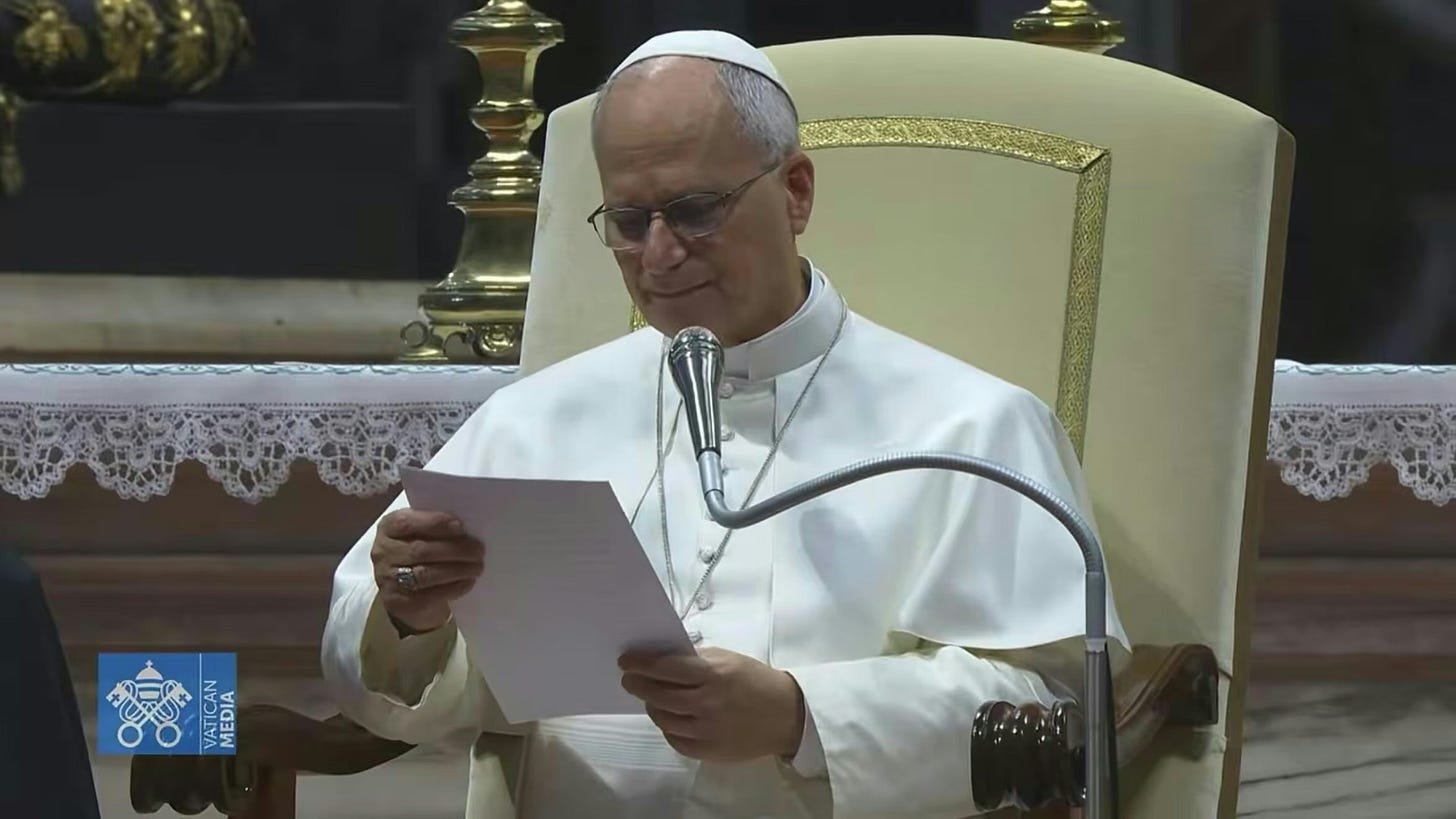
That same Wednesday, Leo delivered his final catechesis on Sacrosanctum Concilium. He reached back to a 1962 letter from Cardinal Montini, the future Paul VI, which said that the faithful could no longer remain “silent and passive.” Leo then defended the revision and streamlining of the old books and declared the postconciliar reform “firmly rooted in the living tradition of the Church”.
The phrase “silent and passive” carries an accusation. It turns generations of Catholics into spiritually absent spectators because they did not constantly speak, answer, process, carry, greet, or perform.
Silence can be intensely active. A laborer following the Canon in his hand missal, a mother praying the sorrowful mysteries while the priest offers the Sacrifice, and a nun absorbed in the words of consecration were doing more than occupying a pew. Pius XII had already encouraged intelligent participation while insisting in Mediator Dei that the chief element of divine worship is interior.
The Council itself ordered that Latin be preserved in the Latin rites, expected the faithful to sing parts of the Ordinary in Latin, and gave Gregorian chant pride of place. Read Sacrosanctum Concilium, then visit the average suburban parish. The distance between the text and the product cannot be dismissed as a few extremists misunderstanding an otherwise pristine reform.
Results deserve a hearing too. A 2025 economics study using data across 66 countries found a worldwide decline in Catholic service attendance totaling roughly twenty percentage points between 1965 and 2010. Harvard’s account of the study properly stops short of assigning every lost soul to one reform. The numbers still make triumphal talk about renewed participation sound grotesque.
Leo’s catechesis also explains the ferocity toward the SSPX. The DDF’s procedure for an SSPX priest seeking regularization now requires acceptance of Vatican II and the legitimacy of the Novus Ordo. The new liturgy functions as a constitutional oath. Lutheran moral rupture permits shared mission; attachment to the unreformed Roman Rite, joined to a doctrinal indictment of the Council, places a Catholic priest outside communion.
“Living tradition” has become a solvent. Whatever survived for centuries may be dissolved by the latest authority, while the dissolution itself inherits the name Tradition.
A Freemason’s Funeral Becomes a State Ceremony
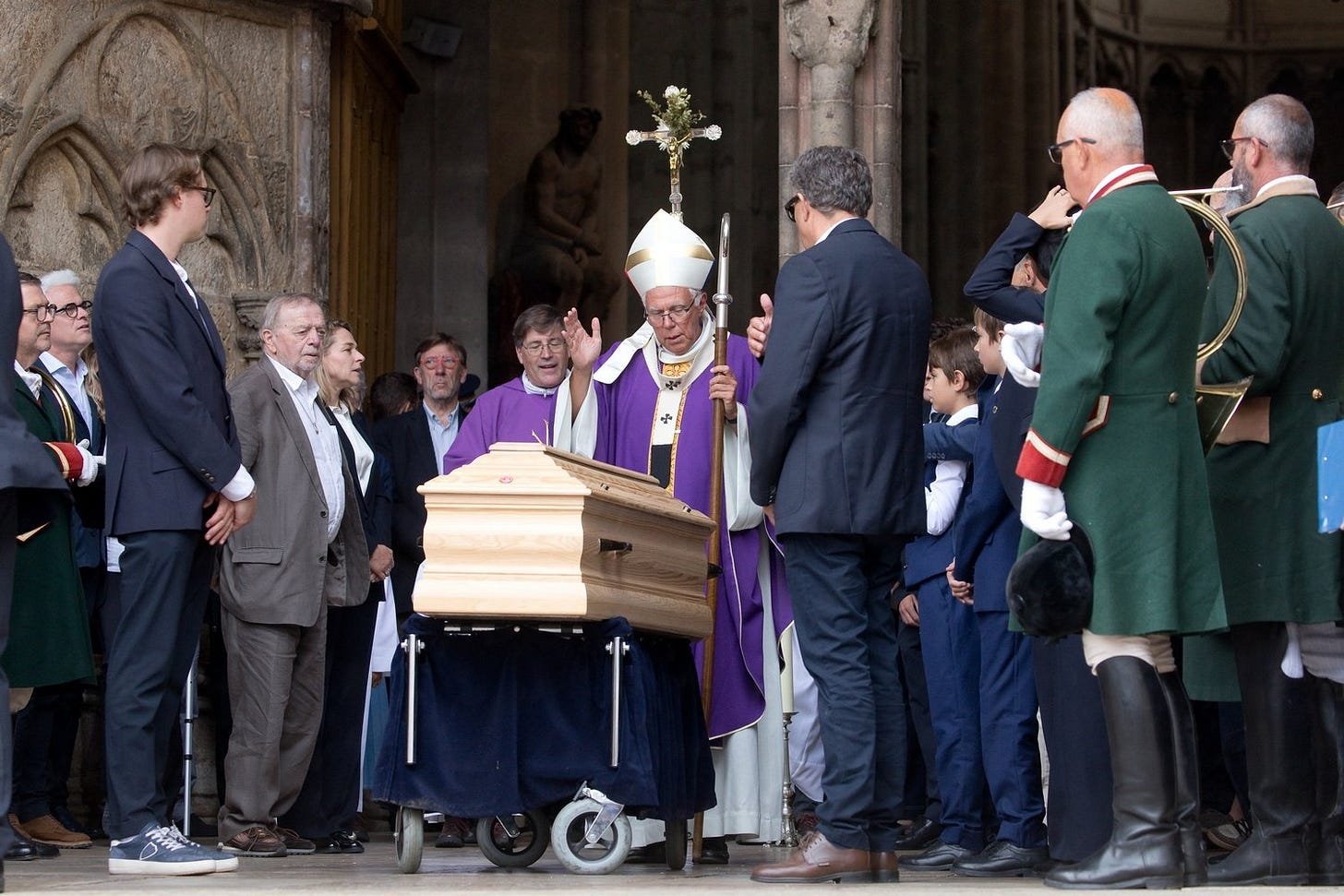
France supplied the week’s final image.
Archbishop Antoine Hérouard of Dijon presided over the Catholic funeral of Senator François Patriat at Notre-Dame in Semur-en-Auxois. Emmanuel Macron delivered a political tribute inside the church to one of his earliest allies. More than 700 people attended, including the highest officers of the French state. A Masonic publication, 450.fm, identified the deceased senator as “Brother François Patriat”.
Charity requires one qualification. The public lacks knowledge of Patriat’s final dispositions. A local report said his relationship to Catholicism had been changing in recent years. Canon 1184 turns upon signs of repentance and the danger of public scandal. A genuine reconciliation before death would change the case profoundly.
That possibility makes an explanation more urgent. The Church still teaches that Masonic principles are irreconcilable with Catholic doctrine and that enrolled Catholics are in grave sin. The CDF said so plainly in 1983. Hérouard offered no public account of repentance or renunciation. The visible event became a grand civic canonization, with Macron using a Catholic sanctuary to praise political fidelity.
French laïcité becomes remarkably flexible when the Republic wants stained glass behind its eulogies.
Communion According to the New Religion
These stories belong together. They reveal an operative hierarchy of loyalties.
A bishop emerging from Communist selection can receive Leo’s approval. Lutheran leaders from a same-sex-marrying ecclesial body share a mission. Prelates who make Catholic moral teaching negotiable move into better sees. A publicly identified Freemason receives an archbishop’s funeral, with any private reconciliation left unexplained. Then four bishops are consecrated to preserve traditional priesthood, and Rome needs twenty-four hours to declare every SSPX cleric a schismatic.
The qualifying act is acceptance of the conciliar regime as the mediator of Catholic identity. A man may contradict settled teaching and remain a partner in dialogue. He may cooperate with atheist political machinery and later be regularized. Catholic Tradition creates a different danger when it claims the right to judge the regime that displaced it.
Rome’s own conduct now generates an interesting question. Catholic authority exists to guard a received deposit, preserve sacramental order, and send missionaries to convert the world. When the visible apparatus repeatedly protects doctrinal rupture, calls Protestants partners in mission, and turns the manufactured liturgy of the 1960s into a test of communion, Catholics eventually ask whether the office and its divine purpose have come apart.
A collection of scandals cannot, by itself, settle every theological argument about a vacant or materially occupied see. It can destroy the lazy premise that the institution’s identity answers every objection. Authority must remain recognizable through its acts. Canonical seals offer little assurance when their strictest use falls upon men handing down the old Faith and their broadest mercy falls upon nearly everyone willing to revise it.
Chinese Catholics now bear the consequences in prison cells, demolished chapels, and secret rooms where bishops are reportedly being consecrated for survival. Rome owes them publication of the agreement and a direct answer about those consecrations. It owes the SSPX faithful a real judgment on necessity rather than a decree constructed from assertion. Leo owes the whole Church an explanation for how Norway’s same-sex-marrying establishment acquired a “shared mission” while Catholic clergy preserving the old Mass were told that their absolutions and marriages are void. Until those answers arrive, every appeal to “communion” sounds less like Catholic theology and more like the house rule of an ecclesiastical system that has changed its religion while keeping the keys.