
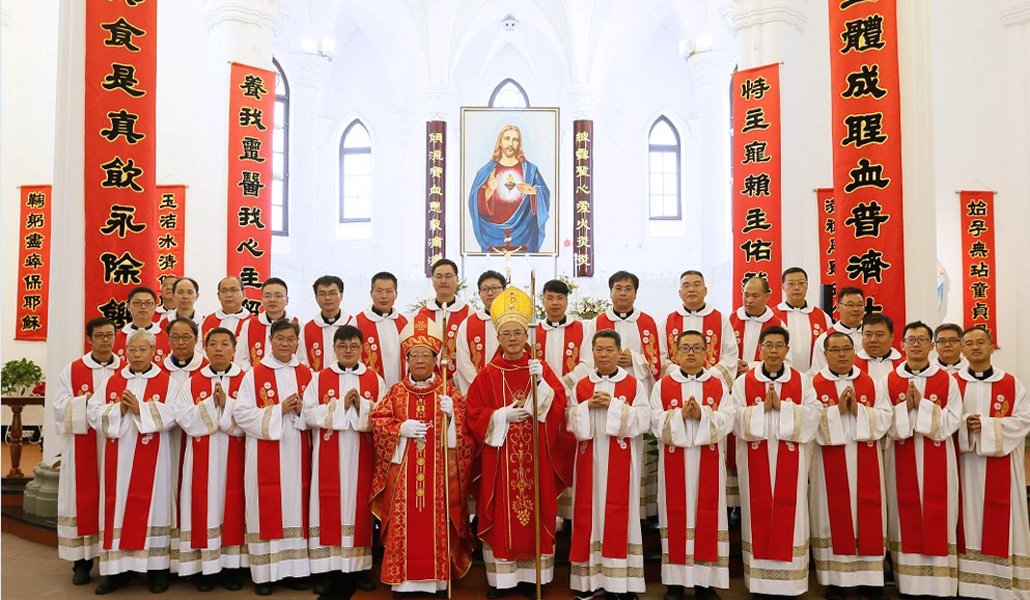
The Holy See yesterday announced the consecration of Andrea Ding Yang as archbishop of Chongqing with a biographical notice of one hundred and twenty-seven words charting his path through the seminary, the parish of San José de Yuzhong, Macao, Rome, and four parish assignments. The curriculum ends in Jiulongpo. It does not state that the new archbishop is sub-secretary general of the Council of Bishops of the Catholic Church in China, vice-president of the «two associations» of Chongqing, and general secretary of its Committee on Ecclesiastical Affairs. The official Chinese information does state as much.
The detail is important because the Council to which Ding belongs is not an episcopal conference recognized by the Holy See. Benedict XVI wrote in 2007 that it could not be recognized as such because it did not include clandestine bishops, included illegitimate prelates, and operated under statutes containing elements incompatible with Catholic doctrine. Nineteen years later, no public document has revoked that judgment. What has changed is the episcopate comprising the body: several of its current leaders are bishops recognized by Rome, and some reached the mitre after holding offices within the Council itself.
Ding is not starting this trajectory. Francis Cui Qingqi, now bishop of Wuhan and vice-president of the Council, was elected sub-secretary general in December 2016 and received episcopal consecration on 8 September 2021 after being named by Francis. Peter Luo Xuegang, bishop of Yibin with pontifical approval since 2011, also passed through the sub-secretary role before being elected vice-president in 2022. The official structure published by the Chinese Church itself allows one to track these ascents without resorting to clandestine sources.
The paradox is simple: Rome does not recognize the Council as an episcopal conference, yet it recognizes the bishops who lead it. And now it has raised one of the nation’s most prominent sees to another of its sub-secretaries.
The ceremony in Chongqing reveals further layers. The six bishops who laid hands on Ding all belong to the Council’s leadership. Joseph Li Shan, bishop of Beijing and president of the Chinese Catholic Patriotic Association, serves as vice-president. Also included are He Zeqing, bishop of Wanzhou; Luo Xuegang, of Yibin; and Cui Qingqi, of Wuhan. Xiao Zejiang and Zhen Xuebin appear among the general sub-secretaries. The official Chinese chronicle of the consecration identifies each by these offices.
We are thus not dealing with an archbishop drawn from the periphery of official structures, accompanied by happenstance officials. The new archbishop is a leader of the Council, and those who consecrated him form part of the Council’s own leadership.
The body subjected to Beijing’s religious policy
It is worth translating the nomenclature. The so-called «two associations» are the Chinese Catholic Patriotic Association, founded in 1957, and the Council of Bishops, established in 1980. Together they constitute the national structure of the Catholic Church recognized by the state and function within a system of religious administration subordinate since 2018 to the United Front Work Department of the Communist Party.
The current statutes of the Council of Bishops leave no doubt. The body declares its support for the leadership of the Chinese Communist Party and the socialist system, applies Xi Jinping’s thought on socialism with Chinese characteristics, upholds the principle of independence and self-management of the Church, and promotes the adaptation of Catholicism to socialist society.
The Council moreover participates directly in the Chinese episcopal mechanism: its statutes assign it responsibilities in the election, approval, and consecration of bishops.
That helps explain what it meant for Ding to serve as sub-secretary general before receiving the mitre. He was not merely a parish priest enrolled in a civil association in order to exercise his ministry publicly. He belonged to the leadership of the very body tasked with selecting episcopal candidates.
Nor was he alone in wielding authority within official structures. In Chongqing he served as vice-president of the «two associations» and general secretary of the Committee on Ecclesiastical Affairs.
In late June, barely two months before his consecration, Ding took part as a responsible figure in reviewing a campaign of political and administrative formation for local clergy. The meeting was chaired by He Zeqing, bishop of Wanzhou, vice-president of the Council, and president of the Committee on Ecclesiastical Affairs of Chongqing. United Front officials attended the proceedings. The guidance issued to the clergy included deeper study of decisions from the CCP’s 20th Congress, reinforcement of national and legal consciousness, maintenance of the principle of independence and self-management, and progress in adapting Catholicism to socialist society.
Ding was inside the machinery before Rome approved his candidacy.
From the national seminary to the mitre
The Holy See’s biography does mention that Ding served as a formator at the National Theological Seminary of Beijing from 2012 to 2014. Yet even this detail cannot be fully grasped without knowing the organizational chart.
The National Seminary, founded in 1983 and now located in Beijing’s Daxing district, is run by the national Catholic structures. Its board is chaired by Li Shan, bishop of Beijing, current president of the Patriotic Association and vice-president of the Council of Bishops.
When Ding arrived there as a formator, the rector was Ma Yinglin, bishop of Kunming. Ma had been consecrated without pontifical mandate on 30 April 2006 and stood excommunicated. In 2010 he was elected president of the Council of Bishops, a post he held during the two years Ding formed seminarians. Francis lifted his excommunication on 22 September 2018, the very day Rome and Beijing signed the Provisional Agreement.
The present rector, Guo Jincai, offers a similar trajectory. He was ordained bishop of Chengde in November 2010 without pontifical mandate, incurred excommunication, and was rehabilitated by Francis in 2018. For twelve years he served as general secretary of the Council, and now ranks among its vice-presidents.
In January 2024, already rector of the National Seminary, Guo opened the semester’s closing meeting by reading an initiative tied to the Patriotic Education Law and calling for unity between loving the country, loving the Party, and loving socialism.
It was this seminary that formed Ding for two academic years. In March 2014 he left for Rome, where he studied for one year at the Pontifical University of the Holy Cross.
A structure that has already elevated other leaders to the mitre
Ding’s case assumes clearer meaning when compared with the men now at the helm of the Council.
Cui Qingqi had attained the post of general sub-secretary in 2016. In 2021 Francis named him bishop of Wuhan. A year later, the Tenth National Assembly of Chinese Catholicism promoted him to vice-president of the Council.
Luo Xuegang pursued a different path. He was consecrated coadjutor of Yibin in November 2011 with the approval of the Holy See. In 2016 he was elected general sub-secretary of the Council and in 2022 advanced to the vice-presidency.
Zhen Xuebin, now auxiliary bishop of Beijing, also features among the Council’s current leadership. Francis named him coadjutor of Beijing in August 2024 after approving his candidacy within the Provisional Agreement and consecrated him in October of that year. Currently he figures among the Council’s general sub-secretaries.
Now Ding holds the same institutional rung from which other prelates have ascended within the official structure. At forty-four he has just been named archbishop of Chongqing, a see vacant since March 2001.
No public documentation shows the Council’s sub-secretariat to be formally a prelude to the episcopate. Yet the career ladder makes plain a repeated crossing of personnel through the same body.
Cui: sub-secretary, bishop, then vice-president.
Luo: bishop, sub-secretary, and vice-president.
Zhen: Council leader and bishop of Beijing.
Ding: sub-secretary and now archbishop of Chongqing.
Four consecrations in seven weeks
Ding’s arrival in Chongqing takes place amid a surge of episcopal appointments under the Provisional Agreement. He is the fourth Chinese bishop consecrated in barely seven weeks.
On 22 July Giuseppe Chang Yanfeng was ordained bishop of Chifeng after Leo XIV approved his candidacy on 15 June. A week later, on 29 July, Francis Xavier Duan Yongkun received consecration as coadjutor of Bameng, likewise following a 15 June approval by Leo XIV within the Agreement.
Read also: Msgr. Duan Yongkun, the new episcopal appointment in China under the Sino-Vatican agreement
On 31 August, in Datong, Paolo Liu Honggang was consecrated after Leo XIV approved his candidacy on 10 August and appointed him to the diocese. Chinese communications reported that Yang Yu, general secretary of the Council of Bishops, read during the ceremony the document of approval issued by the official body.
Read also: A new bishop for China with the approval of Leo XIV
A week later came Chongqing.
The Holy See announced that on 28 July Leo XIV had named Ding Yang «having approved his candidacy within the framework of the Provisional Agreement between the Holy See and the People’s Republic of China.» Rome thus set forth the papal half of the procedure.
The official Chinese communication showed the other half: Ding had been elected candidate on 15 April, Yang Yu read during the ceremony the Council’s letter of approval, and the new archbishop was already general sub-secretary of that same body.
What Rome did not publish was precisely that final portion of the curriculum.
The Council that Rome does not recognize is filled with bishops that Rome does recognize
The deeper question is no longer who named Ding.
The Provisional Agreement has produced a new institutional reality. In 2007, when Benedict XVI explained why Rome could not recognize the Council of Bishops as an episcopal conference, one reason was that it enrolled illegitimate prelates and excluded clandestine bishops recognized by Rome.
In 2018 Francis lifted the excommunications of seven bishops ordained without pontifical mandate. Since then, the appointments negotiated under the Agreement have added new prelates recognized both by Rome and by the Chinese authorities.
The result can be seen today in the Council’s leadership.
Li Shan lives in communion with Rome and serves as vice-president. He Zeqing is recognized by Rome and is vice-president. Luo Xuegang was consecrated with pontifical approval and is vice-president. Cui Qingqi was named by Francis and is vice-president. Zhen Xuebin was named by Francis and is general sub-secretary. Ding Yang has just been named by Leo XIV and is a sub-secretary.
The body itself remains unrecognized by the Vatican.
Yet its leaders, one after another, are.
And as this transformation advances, the document that should show exactly what role belongs to Beijing, to the Council of Bishops, and to the Pope in candidate selection remains beyond the reach of Catholics.
The Provisional Agreement stays secret. The career ladder, however, does not.