
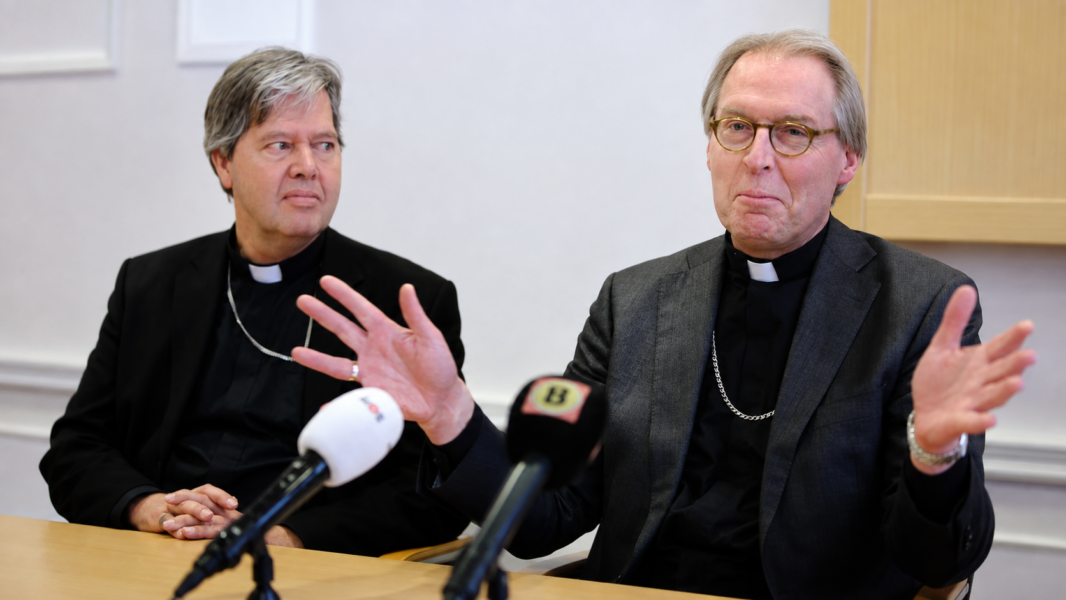
The Bishop of ’s-Hertogenbosch (Bois-le-Duc), Gerard de Korte, has publicly criticized his auxiliary bishop, Rob Mutsaerts, for addressing an open letter to Leo XIV in which he questions the fruits of the synodal process and demands greater doctrinal and missionary clarity from the Pope. De Korte does not undertake to refute the content of the objections raised by Mutsaerts, but rather censures the manner chosen by his auxiliary, maintaining that he ought to have conveyed his concerns to the Pontiff privately.
De Korte's statements were reported by the Dutch newspaper Nederlands Dagblad, after Mutsaerts published his letter to Leo XIV on August 14, warning of the risk of turning synodality into a permanent mode of functioning for the Church.
De Korte Questions Mutsaerts's Resort to an Open Letter
The response of the Bishop of Bois-le-Duc focuses particularly on the public nature of Mutsaerts's initiative.
According to De Korte, his auxiliary «did not consult with the Pope regarding this lengthy open letter» before making it public. The bishop considers that, if Mutsaerts intended to raise his reservations without causing division, he ought to have utilized the internal channels of communication available to him as a member of the episcopate.
«A personal letter to the Pope would have been appropriate» if his intention, as Mutsaerts himself maintains, was not to sow discord, De Korte stated. «After all, an (auxiliary) bishop, in particular, possesses his own means to communicate with the Bishop of Rome».
Long-Standing Differences
The disagreements between De Korte and Mutsaerts did not begin with this letter. In 2020, the auxiliary relinquished virtually all his administrative responsibilities within the diocese owing to his differences with the diocesan bishop.
Mutsaerts has since maintained his own public presence and has on numerous occasions expressed critical stances regarding the direction of certain ecclesial processes. The Synod on Synodality has been one of the matters upon which he has spoken with the greatest clarity.
In the letter published on August 14, the auxiliary posed a question to Leo XIV regarding the concrete results obtained after years of consultations, meetings, and synodal reports. Among other matters, he asked whether faith had been strengthened, conversions increased, Mass attendance improved, priestly vocations grown, or reverence toward the Eucharist reinforced. His conclusion was that, considering these criteria, «it is impossible to consider the Synod a success».
Mutsaerts also warned that the process initiated for the 2021–2024 period currently continues in its implementation phase and is set to culminate in an Ecclesial Assembly in Rome in October 2028. In his view, this extension poses the danger that synodality will shift from being an instrument to becoming «a permanent form of Church governance».
The Dutch Episcopate Reaffirms Its Commitment to Synodality
The discrepancy between the two bishops also manifests itself in their approach to the next stage of the synodal process. While Mutsaerts demands an examination of its fruits and a return of the focus of ecclesial life to conversion, holiness, the Eucharist, and evangelization, the Dutch Church continues to prepare initiatives aimed at developing synodality.
De Korte has announced that the bishops and religious of the Netherlands will hold a national day dedicated to synodality on October 16 at the Sint-Janscentrum in Bois-le-Duc.
The initiative falls within the implementation phase continuing under the pontificate of Leo XIV. Precisely this extension is one of the central points of Mutsaerts's warning: the auxiliary maintains that the faithful «do not expect a permanent process from their Church, but rather clarity on the path toward God», and he has directly appealed to the Pope that, in the face of doctrinal confusion and the wear of Western ecclesial structures, «Peter speak clearly».