
The biblical precedent is the assembly at Jerusalem, recorded in Acts 15. A dispute had arisen over whether Gentile converts were obliged to observe the Mosaic law, particularly circumcision. Paul and Barnabas traveled to Jerusalem, where the apostles and presbyters considered the matter. Peter spoke, Paul and Barnabas recounted their experiences among the Gentiles, and James proposed the decision. The resulting letter declared: “For it hath seemed good to the Holy Ghost and to us, to lay no further burden upon you than these necessary things” (Acts 15:28).
The assembly established an enduring precedent for the Church’s conciliar practice. Yet its authority rested upon the apostolic office, not simply upon the fact that a group of believers had gathered to deliberate. The distinction between participation in an assembly and the authority to render a binding judgment would remain important throughout the subsequent history of synods.
As the Church expanded, bishops began meeting in local and regional councils to address controversies extending beyond individual communities. By the second and third centuries, these assemblies addressed questions of doctrine, penitential discipline, and the celebration of Easter. Their decisions reflected the authority of the bishops involved and the ecclesiastical jurisdiction within which they acted.
The Council of Nicaea in 325 represented a further development. Convened under Emperor Constantine, it brought bishops together from across the Christian world to address the Arian controversy and other matters affecting the Church. Its doctrinal decisions became foundational to subsequent Catholic teaching.
Over time, the Church developed different forms of ecclesiastical assembly. Ecumenical councils addressed questions concerning the universal Church; provincial and regional councils dealt with matters affecting particular territories; and diocesan synods helped individual bishops govern their dioceses. These assemblies differed in composition, scope, and authority, although the terms synod and council were not always used with the precision they later acquired.
What they shared was a recognizable institutional purpose: considering ecclesiastical matters within an established structure of authority.
The Diocesan Synod
The diocesan synod became one of the Church’s established instruments of local governance. Convened by the bishop, it gave clergy an occasion to consider questions of discipline, pastoral administration, and ecclesiastical law affecting the diocese. Its composition and frequency changed over time, but its relationship to episcopal authority remained a defining feature.
The Council of Trent paid particular attention to diocesan synods as part of its reform of ecclesiastical discipline. In 1563, Session XXIV, Chapter II of its Decree on Reformation required diocesan synods to be celebrated annually and provincial councils at least every three years. These assemblies were intended to provide regular opportunities to correct abuses, maintain discipline, and address problems within the Church’s established hierarchy.
The requirement was significant. Trent treated the synod as an ordinary instrument of episcopal governance, sufficiently important to warrant regular convocation. The diocesan bishop convened the assembly and exercised legislative authority within his diocese. Others participated in considering ecclesiastical matters, but their participation did not transform the synod into a legislative body independent of the bishop.
When the Church promulgated the first comprehensive Code of Canon Law in 1917, the diocesan synod received more detailed juridical regulation. Canon 356 required its celebration at least once every ten years, a considerably less frequent schedule than Trent had prescribed. The Code also identified those who were to participate, principally members of the diocesan clergy and others holding specified ecclesiastical offices.
The Code made the distinction between deliberation and legislation explicit. Canon 361 provided for the free discussion of proposed questions, while Canon 362 stated:
Unicus est in Synodo legislator Episcopus, ceteris votum tantum consultivum habentibus.
In English: the bishop is the sole legislator in the synod, while the others possess only a consultative vote.
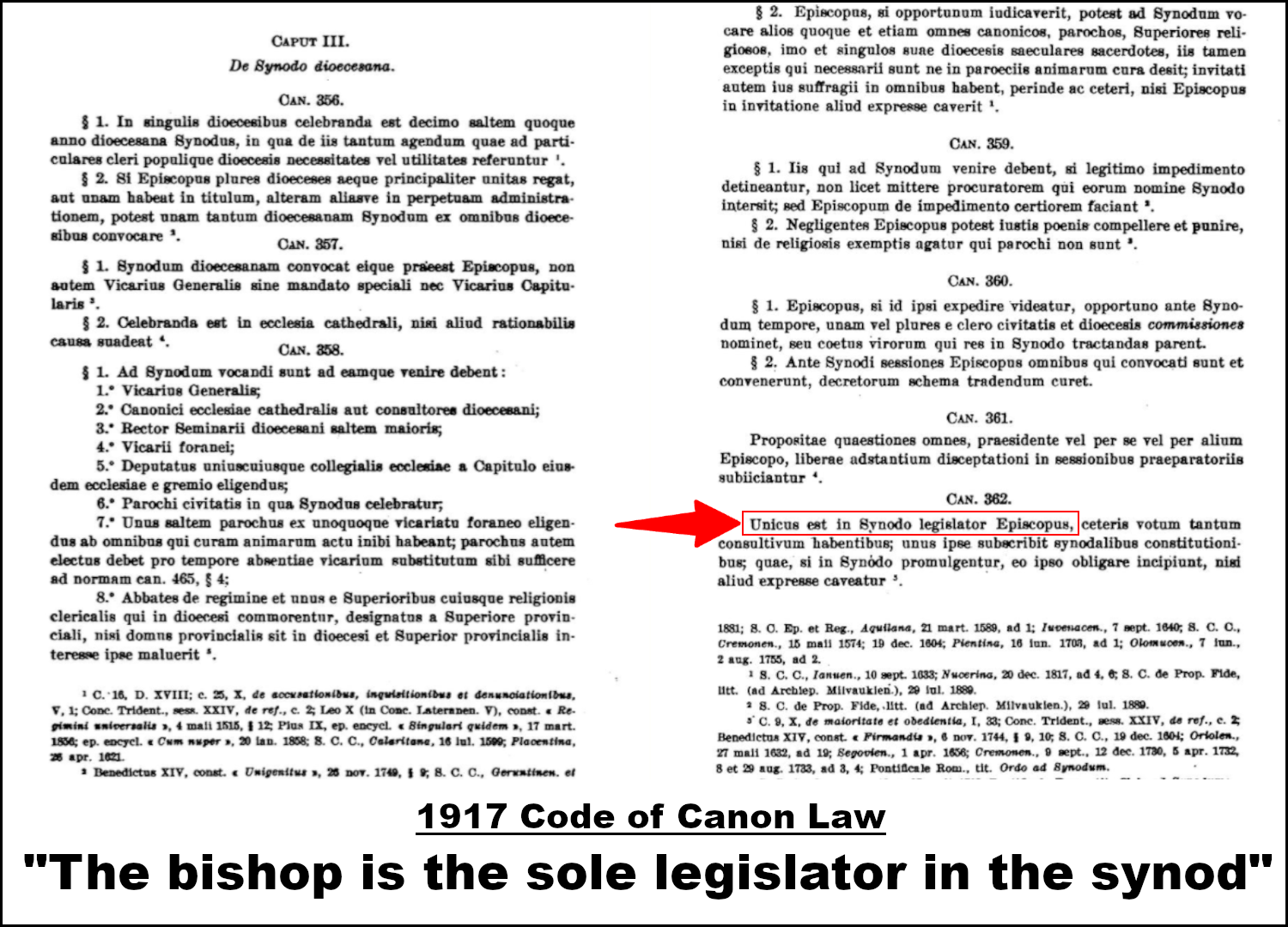
The provision left no ambiguity about the source of legislative authority. Participants could examine proposals, express judgments, and offer counsel, but only the bishop could enact diocesan legislation. The synod helped him exercise an authority he already possessed by virtue of his office.
The revised Code of Canon Law promulgated in 1983 retained this principle while changing other aspects of the institution.
Canon 463 provides for a wider range of participants. Among those who must be called are lay members of the faithful, chosen by the pastoral council in a manner and number determined by the bishop; the bishop may also call others, including laity, as members. The synod was therefore no longer composed solely of clerics and holders of ecclesiastical office.
The obligation to convene a synod also changed. Under Canon 461, a diocesan synod is to be celebrated when circumstances suggest it, according to the bishop’s judgment after consultation with his presbyteral council. The fixed ten-year interval prescribed by the 1917 Code was therefore replaced by a determination based upon the needs of the diocese.
Yet the legislative distinction remained. Canon 465 requires that proposed questions be open to free discussion by the members of the synod. Canon 466 then specifies that the diocesan bishop is the sole legislator, while the other members possess only a consultative vote. He alone signs the synodal declarations and decrees, which he may publish only by his authority.
These provisions are contained in Canons 460–468 of the 1983 Code.
The comparison reveals both continuity and change. Trent required regular diocesan synods as instruments of ecclesiastical discipline. The 1917 Code regulated their composition and procedures while expressly reserving legislative authority to the bishop. The 1983 Code broadened participation and altered the conditions for convocation, but preserved the same distinction between consultation and legislation. These were changes in ecclesiastical discipline, not doctrine; the underlying principle of episcopal authority remained intact.
The diocesan synod thus provides a clear historical example of an ecclesiastical assembly in which participation could change without a corresponding transfer of governing authority. That distinction becomes especially important when examining the institution Paul VI established in 1965: the Synod of Bishops, which, despite sharing the name, had a different scope, structure, and relationship to ecclesiastical authority.
The Synod of Bishops
The diocesan synod was an established institution of local ecclesiastical governance long before the Second Vatican Council. In 1965, however, Pope Paul VI established a different institution bearing the same name: the Synod of Bishops, a permanent body intended to assist the Roman Pontiff in his governance of the universal Church.
The new institution emerged during the closing months of the Second Vatican Council. On September 15, 1965, Paul VI promulgated the apostolic letter Apostolica Sollicitudo, explaining his desire to strengthen cooperation between the Pope and bishops worldwide. The Council had emphasized the importance of such consultation, and the new institution provided a way to carry it forward after the Council concluded.
The Synod of Bishops was therefore established as a central institution representing the Catholic episcopate, permanent in its existence but convened for particular sessions. Unlike a diocesan synod, which operated within an individual bishop’s jurisdiction, this new body addressed matters affecting the universal Church and was directly subject to the authority of the Roman Pontiff.
Paul VI defined its authority in unmistakable terms. Under Article II of Apostolica Sollicitudo, the Synod possessed, by its nature, the function of providing information and offering advice. It could also exercise decision-making power when the Roman Pontiff conferred it, in which case it belonged to him to ratify the decisions.
The distinction was fundamental to the institution’s design. The Synod could discuss questions of doctrine, discipline, and pastoral practice, but its ordinary function was consultative. It lacked independent authority to govern the universal Church or issue binding decrees.
Its membership reflected its episcopal character. Ordinary general assemblies included bishops elected by episcopal conferences, representatives of the Eastern Catholic Churches, certain members of the Roman Curia, and representatives of clerical religious institutes. Paul VI also provided for extraordinary and special assemblies, allowing the Synod’s composition to vary according to the circumstances and questions under consideration.
The Pope retained authority to convene the Synod, determine its subjects and agenda, approve the election of members, appoint others, and preside personally or through delegates. Thus, while the institution expanded the opportunities for bishops to participate in deliberations concerning the universal Church, its proceedings remained under papal authority.
The 1983 Code of Canon Law incorporated the Synod of Bishops into the Church’s universal legislation. Canon 342 described it as an assembly of bishops selected from different regions of the world who meet at designated times to foster closer unity between the Roman Pontiff and the bishops, assist him through their counsel, and consider questions affecting the Church.
Canon 343 preserved the distinction established in 1965: the Synod could discuss questions and express its wishes, but it could not resolve those questions or issue decrees unless the Roman Pontiff granted it deliberative power and ratified its decisions.
The Code also distinguished the Synod of Bishops from an ecumenical council. An ecumenical council exercises the authority of the college of bishops together with its head, the Roman Pontiff. The Synod of Bishops, by contrast, was established as an institution through which selected bishops ordinarily offered counsel to the Pope. The two assemblies were therefore distinct in both their juridical character and their ordinary exercise of authority.
The Ordo Synodi Episcoporum provided further procedural regulations, first issued in 1966 and subsequently revised. The edition approved by Benedict XVI in 2006 regulated membership, preparation, discussion, voting, and the submission of proposals to the Roman Pontiff.
Under these procedures, members considered the designated subjects, participated in general discussions and smaller working groups, and formulated proposals for submission to the Pope. Voting expressed the assembly’s judgment on those proposals. It did not, by itself, transform the proposals into binding legislation.
The 2006 Ordo also reiterated the distinction between consultation and deliberation. Its preface explained that the Synod’s ordinarily consultative character did not diminish its importance, while emphasizing that ecclesiastical consensus, particularly in matters of faith, could not be determined simply by counting votes.
By this point, the Church possessed two distinct institutions called synods. The diocesan synod assisted the bishop in governing his particular church, while the Synod of Bishops assisted the Roman Pontiff in matters concerning the universal Church. Both provided for consultation within an established structure of ecclesiastical authority, although their composition, procedures, and jurisdiction differed.
Pope Francis inherited this institutional framework. In 2018, his apostolic constitution Episcopalis Communio introduced a significant change, extending the Synod’s procedures beyond the assembly itself into a broader process of consultation, discernment, and implementation.
The Synod Reconfigured
In 2018, Pope Francis promulgated Episcopalis Communio, an apostolic constitution that substantially revised the Synod of Bishops’ procedures. The institution Paul VI established remained in place, and Article 1 §1 kept it directly subject to the Roman Pontiff. Article 27, however, abrogated all contrary provisions, expressly naming the articles of Apostolica Sollicitudo and the 2006 Ordo Synodi Episcoporum. The Synod’s operation was now situated within a broader process of consulting the faithful before the assembly and implementing its conclusions afterward.
The constitution formally organized each Synod Assembly into three phases: preparation, discussion, and implementation. The assembly of bishops was no longer treated simply as the central event for which preparatory materials were gathered. It became one stage within an extended process involving the wider Church.
Articles 5–7 established procedures for consulting the People of God through the particular Churches, episcopal conferences, Eastern Catholic ecclesiastical structures, religious institutes, and other recognized bodies. Local bishops were to conduct consultations using existing participatory institutions, without excluding other methods they considered appropriate. They would then gather, summarize, and transmit contributions through the appropriate ecclesiastical bodies to the General Secretariat of the Synod.
Consultation before the assembly was not itself new. John Paul II noted in 1983 that local Churches were already consulted during preparation. Article 23 of the 2006 Ordo required synodal subjects to be studied beforehand by the relevant ecclesiastical bodies, while the Secretariat’s explanatory notes acknowledged that bishops were free to broaden their consultation. The constitution made consultation of the People of God a defined phase of every assembly, and Article 7 §2 preserved the right of individual faithful to submit contributions directly to the General Secretariat. Their contributions became an expressly organized part of the preparatory process, intended to inform the questions and materials the assembly would later consider.
Francis also supplied a theological explanation for this change. In the constitution’s introductory discussion, he introduced a conception of the bishop as both teacher and disciple: a teacher by virtue of his office, and a disciple insofar as he must listen to the voice of Christ speaking through the People of God. He connected this listening to the sensus fidei, the supernatural sense of faith possessed by the faithful.
At the same time, the constitution expressly distinguished the sensus fidei from changing currents of public opinion. It retained the principle that the bishops assembled in Synod offer their judgment to the Roman Pontiff and that the Synod ordinarily exercises a consultative function.
The changes therefore did not amount to a straightforward transfer of governing authority from the Pope or bishops to the faithful. They did, however, give the consultation of the faithful a more formally defined place in the process through which questions are prepared, considered, and presented for ecclesiastical judgment.
The constitution also clarified the possible status of the Synod’s final document. Under Article 18 §1, once the members have approved the Final Document, it is presented to the Roman Pontiff, who decides on its publication; if he expressly approves it, the document participates in the ordinary Magisterium of the Successor of Peter. Article 18 §2 addresses the case in which the Pope has granted deliberative power to the assembly: the document participates in that Magisterium once he has ratified and promulgated it, and it is published with his signature together with that of the members.

These provisions require careful distinction. A document produced through consultation does not become an act of the papal Magisterium merely because the assembly has voted to approve it. Its authoritative status depends upon the action of the Roman Pontiff. Nevertheless, the constitution established a juridical means by which the assembly’s final document itself, rather than a separate papal exhortation, could receive magisterial standing.
The practical significance of these developments became more apparent during the XVI Ordinary General Assembly of the Synod of Bishops, devoted to synodality itself. Beginning in 2021, the process included diocesan consultations, national and continental stages, and two assembly sessions in Rome, held in October 2023 and October 2024.
The assembly’s composition also changed. In April 2023, the Holy See announced that seventy additional members who were not bishops, including laymen and women, clergy, and consecrated persons, would participate with voting rights. The provisions also replaced ten clerical representatives of religious institutes with five women and five men from institutes of consecrated life, likewise possessing voting rights.
The Secretariat’s letter stated that no existing regulations had been repealed and that Episcopalis Communio already provided for non-bishops to be summoned (Vatican News). Even so, the change in composition was evident. Non-bishop clerical religious had sat as members since 1965, when Apostolica Sollicitudo provided for ten religious chosen from the Union of Superiors General and allowed the Pope to add up to fifteen percent more members, including expert clerics. What was new in 2023 was that laypeople, including women, voted as members of the Synod of Bishops.
Their votes did not confer independent legislative authority upon the assembly. But they did help determine which proposals and formulations the assembly approved. This made the question of how consultation contributes to ecclesiastical judgment more concrete than under the earlier arrangements.
The concluding developments of 2024 were equally significant. On October 26, the assembly approved its Final Document. Francis approved its publication and announced that he would not issue the customary post-synodal apostolic exhortation. Instead, he entrusted the document itself to the Church for reception and implementation.
In an accompanying note published the following month, Francis explicitly identified the Final Document as part of the ordinary Magisterium of the Successor of Peter, citing Article 18 §1 of Episcopalis Communio. He also clarified that the document was not strictly normative and that its application would require further mediation.
The distinction is important. The document’s magisterial status derived from papal approval, while its implementation remained subject to the appropriate ecclesiastical authorities and procedures. The assembly had not officially acquired independent governing power. Yet the process through which the document was produced, approved, and entrusted to the Church differed substantially from the consultative model established in 1965.
By 2024, the Synod of Bishops had become the central assembly within a much wider institutional process. Consultation began among the faithful, contributions passed through successive ecclesiastical structures, members of the assembly included laymen and women with voting rights, and the resulting document could be adopted directly into the papal Magisterium.
The formal distinction between consultation and governing authority remained. What had changed was the organization of the process leading to the exercise of that authority, and the theological significance attributed to participation within it.
Continuity and Change
The history of ecclesiastical synods reveals considerable variation in their composition, frequency, procedures, and scope. Local councils, diocesan synods, ecumenical councils, and the modern Synod of Bishops arose under different circumstances and served different purposes. They are not interchangeable expressions of a single institution, nor does their common designation establish an unbroken institutional continuity.
Yet a consistent distinction runs through this history: participation in ecclesiastical deliberation does not, by itself, confer authority to govern the Church.
The diocesan synod provides a particularly clear example. Its membership expanded under the 1983 Code of Canon Law, but the bishop remained its sole legislator. Consultation could inform the exercise of episcopal authority without becoming its source. The same juridical distinction was preserved in the Synod of Bishops established by Paul VI, whose ordinary function was to advise the Roman Pontiff rather than exercise independent governing authority.
Nevertheless, the Synod of Bishops’ establishment in 1965 marked a significant institutional change. Paul VI created a permanent body representing the worldwide episcopate, directly subject to the Roman Pontiff and convened periodically to assist him through consultation. Although grounded in the Church’s longstanding practice of episcopal consultation, the institution itself was new. Its establishment marked a change in ecclesiastical organization and discipline, not in the doctrine governing episcopal or papal authority.
This distinction is essential. Ecclesiastical disciplines and institutions may be modified by competent authority, provided such changes remain consistent with the Church’s divine constitution and teaching. Doctrine, particularly that which the Church has definitively proposed, cannot be altered. Moreover, disciplinary changes cannot be evaluated solely by their juridical validity. Their relationship to the Church’s doctrinal principles and the practical exercise of ecclesiastical authority must also be considered.
The reforms introduced under Francis brought further substantial changes to the institution established in 1965. Consultation expanded beyond the assembly into a process involving the wider Church, voting membership in the assembly was extended to laymen and women, and the final document gained a more direct relationship to the exercise of the papal Magisterium. These changes retained the formal distinction between consultation and governing authority while significantly altering the institutional procedures through which consultation takes place and its results are presented.
The historical progression is therefore important. The Synod of Bishops was not an ancient institution subsequently modified by Francis. It was a new institution established by Paul VI during the Second Vatican Council, whose composition, procedures, and relationship to the exercise of papal authority underwent further substantial changes beginning in 2018. Francis himself describes it in Episcopalis Communio as “new as an institution but ancient in its inspiration” (para. 1). Appeals to the Church’s ancient synodal tradition cannot, by themselves, establish the theological or institutional continuity of these successive changes.
Nor can the significance of contemporary synodality be determined solely by asking whether the Synod possesses legislative authority. The canonical answer remains important, but it does not exhaust the question. An institution may preserve the formal location of authority while changing the procedures through which questions are identified, judgments are formulated, and decisions are presented for approval. When those results are subsequently incorporated into the exercise of the papal Magisterium, the process’s significance extends beyond ecclesiastical administration.
The central question, therefore, concerns the place occupied by consultation and discernment within the exercise of ecclesiastical authority. Who participates? How are their contributions gathered and evaluated? What determines which judgments emerge from the process? And how do those judgments acquire significance for the Church’s teaching and governance?
The historical record establishes the framework within which these questions must be considered. Answering them requires examining the contemporary synodal process itself: its structures, procedures, terminology, and the practical mechanisms by which participation becomes an institutional outcome.