
The Miracle Leo Keeps Explaining Away
We already saw this pattern in my June 23, 2025 piece, Bread Without Doctrine: Leo XIV’s Corpus Christi and the Vanishing Reality of the Eucharist, where I reported that Leo had been turning Eucharistic theology into a language of solidarity, distribution, and communal sharing rather than sacrifice and supernatural reality. What happened in Douala on April 17, 2026 was a second offense, cleaner and blunter than the first.
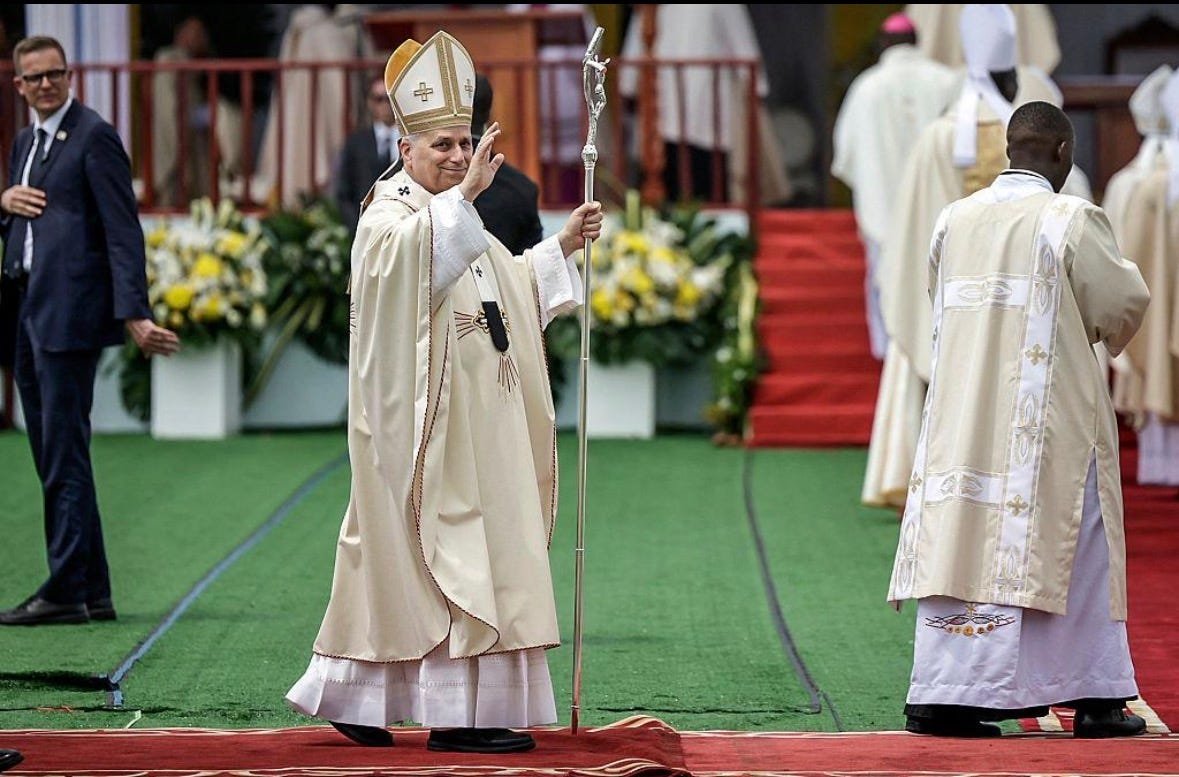
In his homily at Japoma Stadium, Leo said that “the multiplication of the loaves and the fish happened while sharing: that is the miracle.” That sentence does not merely stress charity flowing from the miracle. It relocates the miracle itself. The wonder is no longer Christ’s sovereign act over nature. The wonder becomes the crowd’s social behavior. Bread appears, in effect, because people finally learn to stop clutching and start sharing. Christ becomes less the divine Lord who multiplies and more the moral facilitator who teaches redistribution.
This was not a one-off improvisation. On June 30, 2025, in his message to the FAO, Leo had already said that “the real miracle” in the multiplication narratives was to show that hunger is overcome by sharing rather than hoarding. So now the line has been spoken twice, once in an international social setting and once in a liturgical homily on John 6. At that point defenders can stop pretending this is a clumsy phrase. It is a theological habit.
Why This Is Not a Catholic Reading of John 6
The problem is not that Christians should share bread. Of course they should. The problem is that John 6 is not narrated as a lesson in crowd ethics. It is narrated as a miracle of Christ. The text says the people received “as much as they wanted,” and the fragments filled twelve baskets afterward. The Church’s catechetical tradition has treated the multiplication of the loaves as a true miracle and as a prefiguration of the Eucharist’s superabundance. The Catechism does not say the crowd’s generosity is the miracle. It says the miracles of the multiplication of the loaves prefigure the Eucharist. The miracle is the sign. The sign points beyond itself.
Leo’s reading inverts the whole order of the passage. In Scripture, Christ acts first and charity follows. Grace descends and abundance results. The disciples distribute because the Lord has already made provision. Leo reverses the sequence. Sharing becomes the cause and abundance the result. That is ideological ventriloquism. It reads a modern social ethic back into a text whose force lies precisely in the divine intervention of Christ.
Even Leo’s own conciliar Compendium of the Catechism says Jesus performed signs and miracles “to bear witness” that the Kingdom is present in him. Vatican I likewise taught that divine revelation is made credible by “external signs,” and Pascendi restated that condemnation against those who would reduce faith to internal experience and subjective religious sentiment. Once the miracle is no longer an external sign wrought by Christ, but a symbol generated by human sharing, the whole Catholic structure of miracle begins to collapse.
Why the Error Is Modernist
This is exactly where modernism lives. Modernism does not always stride into the sanctuary waving a banner that says, “I deny the supernatural.” It often works more elegantly. It keeps the biblical scene, keeps the religious language, keeps the pastoral application, and quietly evacuates the miracle. The event remains in the text, but its supernatural content is drained away and replaced with a humane message palatable to modern ears.
St. Pius X described the modernist method with unnerving precision. The divine fact is pushed out of history and into the realm of faith language, symbolism, sentiment, and interior meaning. The critic, he says, strips away whatever surpasses man in his natural condition. That is exactly what Leo’s formulation does to John 6. The miraculous multiplication is no longer the stubborn fact that forces you to reckon with Christ’s divinity. It becomes a pious emblem of fraternity. The bread still circulates. The divine vanishes.
The old Catholic instinct looked at the miracle and said: behold the Lord who commands creation, the same Lord who gives His flesh as food and whose sacrifice alone saves. The new instinct looks at the miracle and says: behold the community organizing itself around a moral insight. One approach ends at adoration. The other ends at an NGO.
The Eucharistic Damage
The damage does not stop at biblical interpretation. John 6 is not just any chapter. It is one of the Church’s great Eucharistic texts. The Catechism explicitly links the multiplication miracle to the Eucharist’s superabundance and then moves directly into Christ’s Bread of Life discourse and the institution of the Eucharist as the memorial of His death and Resurrection. When Leo reduces the sign to social sharing, he weakens the very bridge the Church has always used to lead souls from the miracle of the loaves to the mystery of the altar.
This is a doctrinal deformation. Once John 6 is domesticated into a sermon about equitable distribution, the Eucharist itself slides toward symbolism. The altar becomes a table of inclusion. The sacrificial character recedes. The supernatural abundance of grace is translated into human fellowship. My June 2025 article saw that trajectory already. Douala confirms it. The same Leo who once wrapped Corpus Christi in the language of sharing has now taken the biblical miracle itself and done the same surgery to it
Did Benedict XVI Legally Resign?
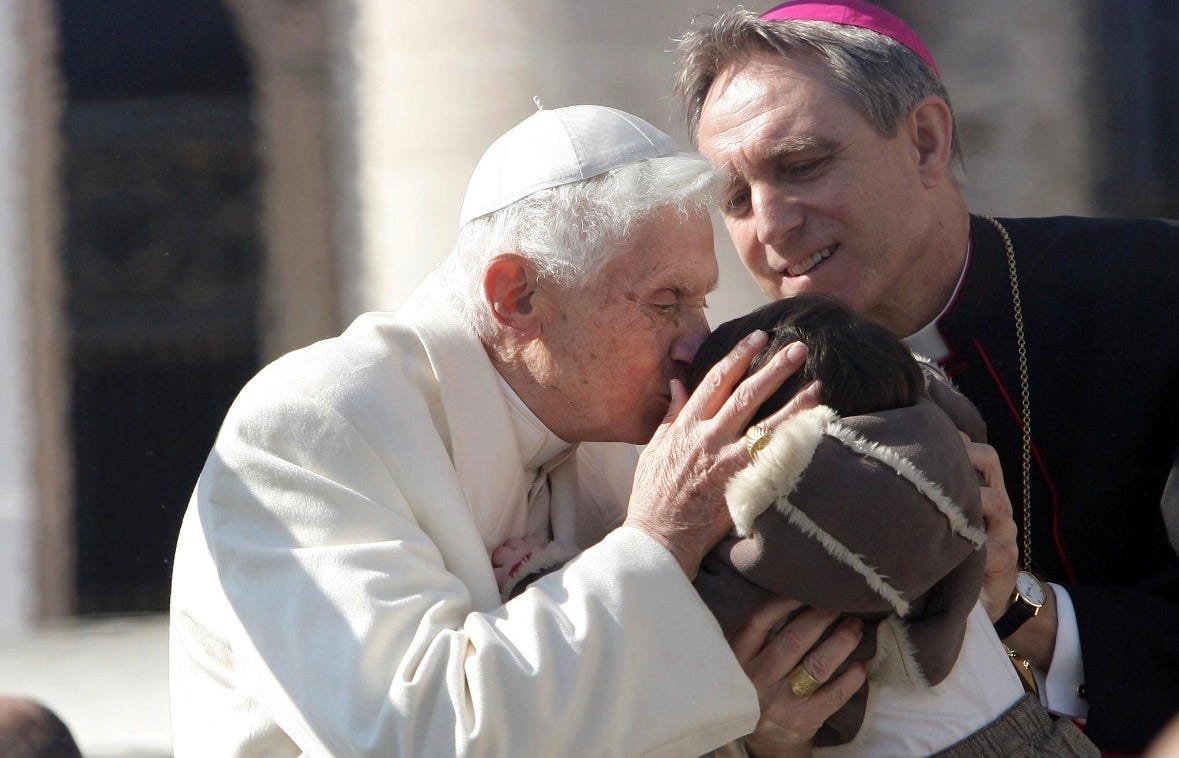
The rest of this week’s reporting sharpens the picture in a different way. LifeSite reported on April 14 that the Vatican’s Promoter of Justice has confirmed an active investigation into the validity of Benedict XVI’s resignation. That does not prove the resignation was invalid. It does mean the issue is serious enough that Rome is no longer treating it as a joke fit only for dismissal and mockery. There is an open file, an ongoing inquiry, and no announced end date.
The argument itself is not hard to understand, even if one does not follow Andrea Cionci all the way to his conclusions. Canon 332 §2 says that for a papal resignation to be valid, the Roman Pontiff must renounce his office freely and properly manifest that renunciation. In the canonical debate, the key point is the distinction between munus and ministerium. Benedict’s February 11, 2013 Declaratio says he had concluded that his strength was no longer suited to administer the Petrine munus, but when he stated what he was renouncing, he said he renounced the ministerium of the Bishop of Rome. Then, in his final general audience on February 27, he said he was resigning the “active exercise of the ministry,” while insisting that this decision did not revoke the “always” of his acceptance and that he remained in a new way at the side of the crucified Lord. The argument, then, is that Benedict did not legally renounce the papal office itself, but only its active exercise, which would mean the See was not truly vacant even if normal governance had ceased.
The question is whether Benedict intentionally or at least materially failed to renounce what canon law requires him to renounce. If he gave up administration while retaining the office, then the entire post-2013 structure sits under a cloud no amount of media ridicule can dissolve. Rome is now investigating beneath that cloud while Leo travels abroad turning one of Christ’s great miracles into a sermon about sharing. The juxtaposition says more about the condition of the conciliar church than a dozen apologetics panels ever could.
Synodality as a Control Mechanism
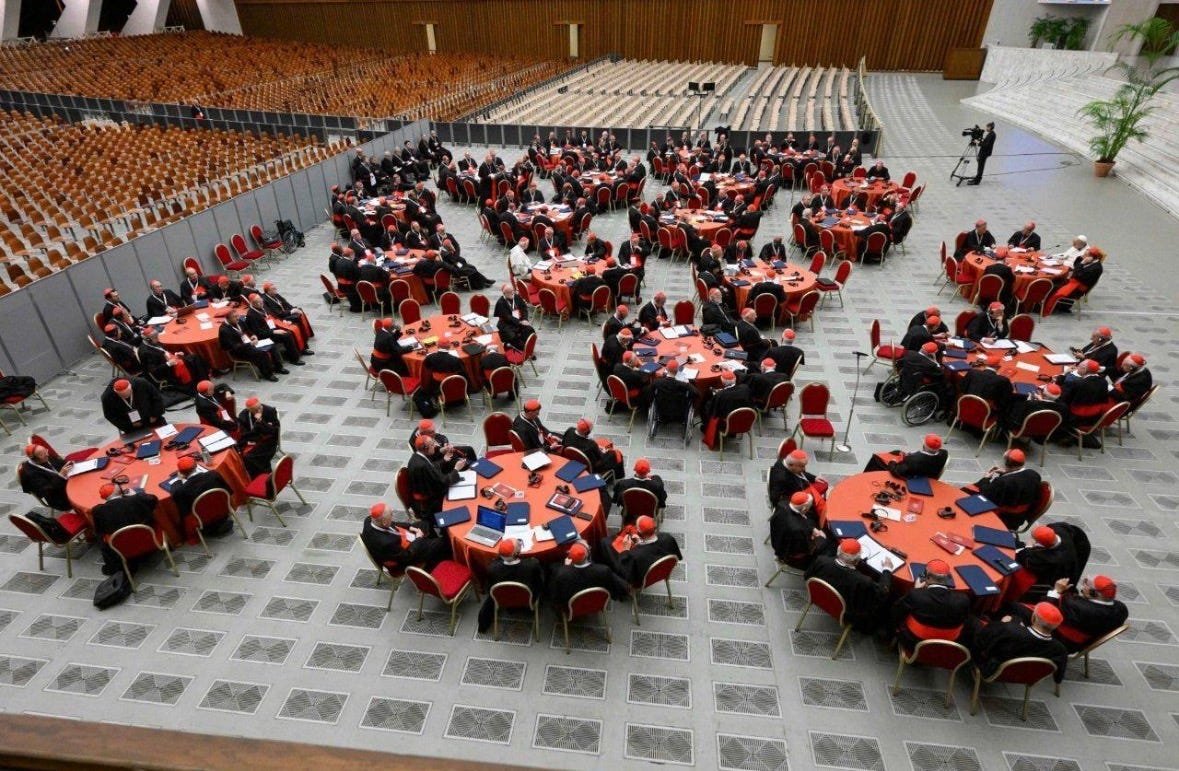
Diane Montagna reports that the January 2026 consistory was reengineered in a way that naturally favored Leo and the liberal bloc around him. The original plan, sent by Cardinal Re in November, pointed toward the classical format, where the cardinals would gather for sustained common discussion. Then, on January 5, a revised agenda was sent through the Secretariat of State’s Office for the Coordination of Dicasteries, and several cardinals reportedly never received it at all. What followed was the now familiar synodal setup: small language-based tables, designated presidents and secretaries, tightly limited free interventions, and filtered reports instead of broad, open debate. Montagna reports that this change was never clearly explained, while Cardinal Burke later said there had certainly been an organizational problem.
Why does that matter? Because the classical procedure gives a conservative cardinal his best chance to make a difference. In the older format, a man like Burke or Brandmüller could rise before the whole college, lay out a clear objection, force everyone in the room to hear it, and oblige the pope and the liberal cardinals to reckon with it in public. Other cardinals could then build on the point, sharpen it, or rally around it. A real opposition can form that way. Momentum can form that way. Clarity can form that way. The synodal format breaks that dynamic apart. It atomizes the cardinals into small circles, cuts off spontaneous exchange, restricts speaking time, and channels everything through moderators and secretaries. Instead of one conservative intervention shaping the room, you get twenty small conversations, twenty summaries, and a bureaucracy deciding what counts as the takeaway.
That kind of structure does not have to be rigged in some crude conspiratorial sense to produce a liberal result. The structure itself already tilts the field. It favors managed consensus over open contest and preselected themes over disruptive objections. It also favors bland synthesis over pointed resistance. Montagna notes that only the reports from the nine tables of voting cardinals and nuncios were presented to the full assembly, while the reports from the eleven tables of non-voting cardinals and curial officials went directly to the pope. That arrangement gives the center even more power to shape what emerges, what gets emphasized, and what gets buried. A conservative cardinal can speak for three minutes in a noisy room. A liberal apparatus can frame the entire discussion. That is how you keep opposition from becoming consequential while still calling the whole exercise “listening.”
So the issue is bigger than bad logistics. This is about method. A traditional consistory lets the pope hear the cardinals and lets the cardinals hear one another. The new synodal method makes both processes less direct, less public, and less dangerous to the men already steering the ship. That is why the last-minute format change gave Leo and the liberal cardinals a much easier path to control tone, control emphasis, and control outcome, while making it far harder for any conservative voice to alter the direction of the meeting in a meaningful way.
Trump’s DOJ Is Finally Pulling Back the Curtain

One of the most important stories in the roundup is not in Rome at all, but in Washington. The Trump administration’s Justice Department has now released a massive report exposing what many pro-lifers had been saying for years: the Biden DOJ weaponized federal power against peaceful pro-life rescuers while working in concert with the abortion regime and the organizations that profit from it. Elderly women, men praying the rosary, and longtime pro-life activists were treated like dangerous criminals, while the people overseeing the daily destruction of children were treated as the injured party. That was always obscene. Now it is becoming documented.
What makes this report so explosive is that it reportedly shows coordination with abortion lobby groups and an effort to target pro-lifers through FACE Act enforcement. In other words, this was a system. The state, the abortion industry, and the cultural left were all pushing in the same direction. The goal was obvious: crush resistance, terrify activists, and make public witness outside abortion mills so costly that only the reckless or the saintly would continue. That is how a dying regime behaves when it knows its moral case is indefensible. It stops arguing and starts punishing.
Now there is at least the possibility of justice. Trump already pardoned imprisoned pro-lifers. But pardons alone are not enough. The country deserves names, accountability, exposure, and a public reckoning with the people who turned the machinery of federal law into a bludgeon for child killing. The rescuers are right to demand more than sentimental closure. They are right to speak of repentance and reparation. A government that collaborated in the persecution of those trying to save unborn children should not be allowed to shrug, turn the page, and move on as though this were just another partisan disagreement. It was moral persecution in service of mass murder.
That is what makes the contrast so sharp. While pro-lifers speak with blunt moral clarity about murder, guilt, repentance, and justice, the men running the conciliar church keep retreating into the mushy vocabulary of process, dialogue, sharing, and accompaniment. The state may finally be forced to account for its war on the unborn and those who defended them. Rome, meanwhile, still cannot even speak plainly about a miracle without turning it into a lesson in social ethics.
The Common Thread
What ties these stories together is the triumph of management over truth. The miracle must be softened into a moral lesson, the cardinals must be funneled into controlled discussion, the deepest legal questions must be contained rather than confronted, and the people who still speak with moral clarity must be treated as the problem. In every case, the instinct is the same: keep the system stable, keep the language vague, keep the consequences manageable.
They are different expressions of one postconciliar mentality that distrusts clear doctrine, fears open conflict, and prefers process, symbolism, and institutional control to plain truth. Once you see that pattern, the separate stories stop looking random. They become variations on the same theme: a church and a ruling class that no longer want to be bound by the full weight of reality, whether supernatural, moral, or juridical.