To the liberal Catholic Lord Acton (1834–1902) is attributed the maxim: « Power corrupts, absolute power corrupts absolutely ». In democracies it has been concluded that power must be distrusted and that it must be limited. It is therefore restrained, among other things, by the recognition of fundamental rights, by the separation of powers (legislative, executive, judicial), by subsidiarity and federalism, by referendums and term limits. Through a « social contract » of all citizens, the Constitution, there is agreement to share political power in this manner. Yet even this does not always keep it sufficiently in check.
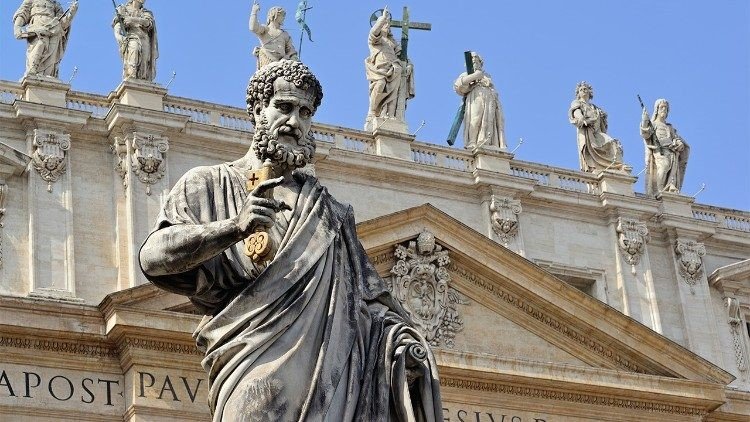
In the Church the problem of power is even more acute. Indeed, all the means cited for the fragmentation of power do not exist there. Rather, according to the doctrine of faith and the Code of Canon Law (CIC/1983), the pope « in virtue of his office, holds ordinary supreme, full, immediate and universal power over the Church » (c. 331).
The pope thus holds absolute power. Does absolute power in the Church lead to absolute corruption? If one looks at the Church with human eyes alone, one should answer: yes, it does. But if one regards it with the eyes of faith, this is not true. There exists indeed a single « instrument » for limiting papal omnipotence: it is unconditional obedience to Sacred Tradition and to Sacred Scripture, to which the pope is bound in conscience. Only because the Church as a whole and the pope in particular are bound by this limitation of power is it possible that absolute power be entrusted within it to a single man. In the Church, distrust of power is thus overcome by confidence that the pope, through unconditional obedience to the faith, knows himself bound in the exercise of his power which is in itself unlimited.
This confidence, however, has been shaken within the Church and, for many, is now destroyed. We think of Pope Francis, who with « Amoris laetitia » has transformed the indissolubility of marriage into a farce, now valid only in theory. In practice, with some « pastoral discernment » one can live in adultery with a clear conscience. The extra-liturgical Vatican blessing of a few seconds for same-sex and non-conjugal couples (« Fiducia supplicans ») represents a further departure from Christian marriage. Ambiguous gestures such as the cult of Pachamama in the Vatican and the « Document on Human Fraternity » (Abu Dhabi Declaration) of 2019 have effectively denied the universalism of Christian salvation. The appointment of laypeople to Vatican leadership positions linked to the exercise of governmental authority signifies a break with Vatican II (LG 21; Nota explicativa praevia 2). It undermines the sacramental-hierarchical order of the Church.
This situation persists under Pope Leo XIV. Within the framework of « synodality », the Holy See has published a document that seeks to justify the rejection of Vatican II (Final Report of Study Group 5 regarding the sacrament of order and « potestas sacra »). Without comment – and irresponsibly – the Holy See has furthermore published a heretical text that relativizes the Church's doctrine on marriage and the family (final report of study group 9 concerning « complex issues »).
Even grave liturgical abuses are ignored or minimized by bishops and the Holy See. But the faithful who follow the extraordinary form are harassed. Priests are made it difficult or impossible to celebrate the Eucharist in this manner. The laity are humiliated by forbidding this form of Eucharist in parish churches. These are faithful who are driven into clandestinity or toward the Fraternity of Saint Pius X, whose very existence is then lamented.
The pope allows German bishops to do as they wish, as they have for years, with their « synodal path », undermining the sacramental order of the Church and institutionalizing the blessing of same-sex couples. It is said that there has been dialogue with them. The Fraternity of Saint Pius X, instead, is threatened with excommunication with the aid of absolute papal power. The pope ignores the dogmatic Constitution « Lumen Gentium » (n. 21) concerning the sacrament of order and demands acceptance of the liturgical Constitution « Sacrosanctum Concilium ». Both are documents of the same Council. This double standard destroys the confidence of many of the faithful.
The announcement by the Fraternity of Saint Pius X of its intention to consecrate bishops on its own initiative is an expression of a loss of confidence in the pope. And the understanding of this gesture, which extends far beyond the Fraternity's supporters, demonstrates that for many, confidence has given way to distrust. Too much has happened and the consequences are devastating. Indeed, an ever-increasing number of the faithful are becoming aware that the doctrine of the Church no longer constitutes the limit for the actions of the hierarchy. This is the illness from which the Church truly suffers. And it cannot be cured by exercising papal omnipotence through threats and excommunications. Because if in the Church what is decisive is the unchecked power of the strongest, then there too is but one conclusion: this power must be limited. The consecration of bishops against the pope's will is ultimately an attempt – undoubtedly problematic – to limit papal omnipotence, when its limit no longer seems to be the doctrine of the Church.
If further schisms are not to limit papal omnipotence, there is but one way: the pope must heal the violations of the Church's doctrine. Only thus will he be able to counter distrust and restore confidence. Through impositions, threats and double standards he will not succeed. The Fraternity of Saint Pius X is not the illness, but a symptom. One can combat this symptom with excommunication, which papal omnipotence certainly permits from a juridical standpoint. But the illness is not thus healed. It will continue to worsen and to divide and weaken the Body of Christ, the Church. The pope holds the key to curing the illness. He must use it and cannot ignore the problem. Because not to govern also means to govern. And this is another consequence that flows from papal omnipotence.