Leo XIV’s homily for the Feast of Saints Peter and Paul, was the most recent example of how the destroyers, drunk on synodality, so desperately try to impose it on everything that it became diabolically comical.
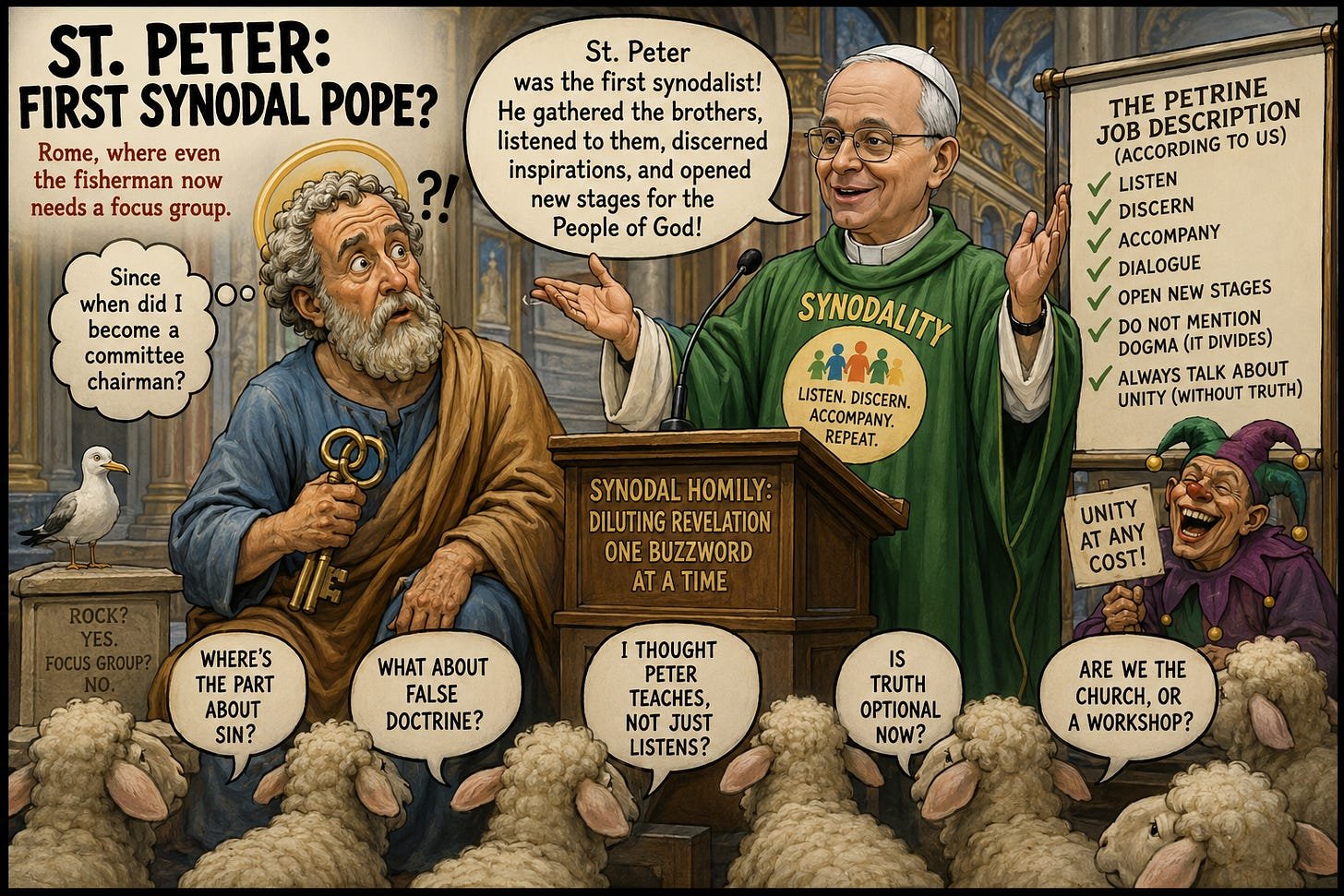
In his homily on said occasion, Leo XIV presented the Apostle Peter as the first synodalist. Prevost’s St. Peter is primarily a figure of communion, dialogue, and ecclesial accompaniment. The central emphasis fell not on Peter’s authority to teach, govern, and defend the deposit of faith, but on his role as one who, and I quote, “gathers the brothers,” “listens to them,” and discerns their various inspirations before guiding the Church forward.
God have mercy on us. Not even the first pope is beyond the synodal sacrilege of Pope Bob and his henchmen.
Quite apart from the fact that he is desperately trying to retrospectively portray the Church as having been ‘synodal all along,’ this interpretation raises important theological questions regarding the nature of the Petrine office and the relationship between primacy and synodality.
In Leo XIV’s “version” of the Council of Jerusalem in Acts 15, St. Peter “gathers the brothers, listens to them, and, in the end, guided by the Holy Spirit, makes the decision, preserving communion and inaugurating a new stage for all the People of God.”
I kid you not. He stops short of calling St. Peter the first synodal pope with this perversion of the fisherman’s role in Christ’s Church.
One must be comatose not to notice that this language reflects the nauseating contemporary ecclesiological vocabulary associated with the modern synodal project: listening, communal discernment, accompaniment, and opening “new stages” in ecclesial life.
The biblical text itself, though, presents a somewhat different picture.
Acts 15 records considerable debate before Peter rises and settles the question:
“And when there had been much disputing, Peter rising up, said to them...” (Acts 15:7). After Peter speaks, the assembly falls silent: “And all the multitude held their peace...” (Acts 15:12).
Hardly Prevost’s little fantasy rendition.
The Fathers of the Church traditionally saw this moment as an exercise of Petrine authority rather than a model of collective discernment culminating in consensus. Peter does not only facilitate discussion but authoritatively recalls divine revelation and declares the matter settled on the basis of God’s prior action among the Gentiles.
The famous conciliar formula, “It has seemed good to the Holy Ghost and to us” (Acts 15:28), follows Peter’s intervention rather than preceding it. The emphasis in the traditional interpretation falls upon Peter confirming the brethren in the faith, precisely as Christ had commanded him: “And thou, being once converted, confirm thy brethren.” (Luke 22:32)
The role is therefore judicial and doctrinal before it is consultative. But Synodal heretics will be Synodal heretics.
An even clearer attempt appears later in Leo’s homily:
“To listen, with his help, to the voices of each one; to discern inspirations; to guide the paths; to correct errors; to instruct, encourage, exhort, and accompany our brothers and sisters...”
For any Catholic who loves the Church and the truth, this twisting of Peter’s office to fit their Luciferian agenda will make you want to throw up.
Historically, Catholic theology described the papal office primarily in terms of preserving and transmitting the apostolic deposit of faith. Vatican I defined the Roman Pontiff’s task as faithfully guarding and expounding revelation handed down from the Apostles. But along came the postconciliar usurpers, who inverted and perverted it.
Leo XIV’s formulation begins instead with listening to “the voices of each one” and discerning “inspirations.” The question naturally arises: is Peter’s successor fundamentally a guardian of a received revelation, or a facilitator of an ongoing process of communal discernment?
The New Testament consistently emphasizes the former. Peter commands, teaches, rebukes, and warns against false doctrine. Paul describes bishops as men who must be able both to teach sound doctrine and to refute those who contradict it (Titus 1:9). The apostolic office is repeatedly associated with preserving what has already been received: “O Timothy, keep that which is committed to thy trust.” (1 Timothy 6:20)
The language of listening to diverse voices and discerning inspirations obscures this fundamentally custodial dimension of the Petrine office.
And, of course, no synodal homily would be complete without endless returns to the theme of unity. Pope Bob did not disappoint and returned to the theme of unity ad nauseum.
Yes, Christ Himself prayed that His disciples might be one, but the theological question concerns the foundation of that unity.
For the Fathers and the classical magisterium, unity was not produced by dialogue but by fidelity to revelation. Charity and truth were inseparable, but truth remained logically prior because one cannot be united in Christ while divided over what Christ taught. And that is exactly what Synodal Rome wants: unity around error.
How do they want to achieve this? Or should I say, how are they achieving this? By a continued emphasis on process, accompaniment, and consensus, they hope to gradually replace doctrine, conversion, and teaching.
Only the spiritually blind can any longer believe that this demonic clown show is Catholic. Pray that those caught in the synodal deception will wake up.