The report of the meeting between the Dicastery for Divine Worship and the bishops of Panama —“pa na má?”— warns of the danger of extremes and mentions groups that sow division by wishing to receive Communion kneeling or in the hand and to wear the Pauline veil. So much so that our pious, feminine, elegant, discreet, and wise grandmothers might have recalled with bewilderment the little verse:
Woman who knows how to pray
in the tongue of Castile:
when you go to the temple to pray,
do not leave at home
your mantilla forgotten.
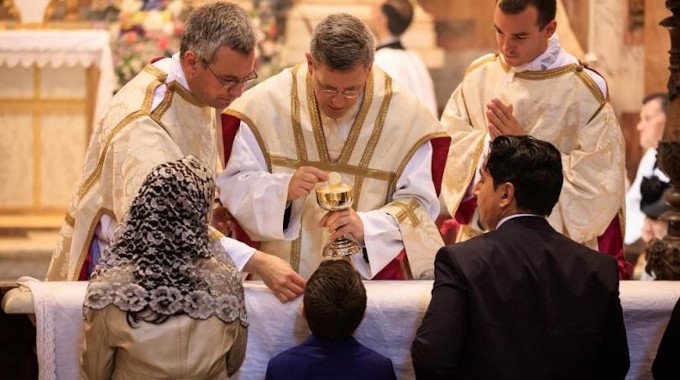
Oh, our divisive grandmothers! All their lives believing themselves Catholic, only to find that today they would be almost anathematized by Rome for… being polarizing! I can still recall how those women I saw as a child receiving the Lord on their knees, hands joined and a seriousness that did not exclude joy, their faces framed by the becoming lace veil, moved me. They were not posing a question: they believed they were receiving Jesus Christ; with a formation far less rudimentary than that of so many modern-day fray Gerundios, they distinguished between the bread of the table and the Bread of the altar, and let their bodies express the difference.
Saint Francis of Assisi would have been a complicated case. In his Letter to the Superiors he asked that chalices, corporals, and vestments be precious, that the Blessed Sacrament be worthily guarded, and that the people kneel to honor the Lord. This man, so detached when it came to clothing himself, became singularly demanding when it concerned God. His “highest poverty” had an alarming eucharistic exception.
Saint Teresa of Jesus would not have made things much easier either. Accustomed to calling the Lord “His Majesty,” she would have needed some explanation to understand why familiarity had to be expressed by reducing reverences. One can imagine her raised eyebrow, beneath her double communion veil, before a pastoral approach concerned that no one should exceed in bowing. The Saint knew intimacy with God well, but she did not confuse trust with the coarseness of cheap post-conciliar clericalism, so ridiculous.
The Curé of Ars had a catechetical method of scant administrative complexity: he pointed to the tabernacle and repeated, “He is there.” He spent long hours in adoration and, poor as he was, spent no little on beautifying the church. His parishioners learned the eucharistic Presence by watching their pastor kneeling before the Tabernacle and administering Holy Communion on the tongue of the faithful, all well confessed, and the women veiled. Apparently, back then it was not divisive for a priest to be so old-fashioned.
And Saint Carlo Acutis, who called the Eucharist his “highway to Heaven,” what would he have said of the “Sacrament exaggerators”? Not long ago some poor Grillo—I don’t know if onion-seller—called him “eucharistically rude.” And the fact is, it is hard to imagine that the eucharistic enthusiasm of that cheerful, contemporary teenager would find a kneeler dangerously polarizing. Perhaps he would have been surprised that, with so much traffic going nowhere, such careful scrutiny should be given to those seeking to reach the tabernacle.
The matter of the hands deserves more than a smile. The Church does allow receiving Holy Communion in the hand, yes, but the unforgettable Benedict XVI taught us not to make too much of that. When contact between unconsecrated hands and the Host becomes routine, with no precautions regarding particles nor the slightest visible sign of adoration, the practice reveals a desacralizing familiarity. The real Presence is still affirmed, but the manner of treating it diminishes it.
By the way, Redemptionis Sacramentum protects the faithful who wish to receive Communion kneeling and always recognizes their right to receive on the tongue. It is a small documentary consolation: knees still have some backing in the house archives. Because today, in a Church gone mad with delights and confidences, what hurts most is the label. From those who guard the liturgy one would expect not only understanding but sympathy toward those “excesses of respect” that have accompanied the saints and our elders. If pride and factions must be corrected, let them be corrected, but with a precise diagnosis:
Before God you are worth as much as you humble yourself:
never is man greater than when on his knees.
Our parents knelt and opened their mouths without knowing, poor things, that this was expressive of division, confusion, opposition, and manipulation.