“Now Jesus learned that the Pharisees had heard that he was gaining and baptizing more disciples than John— although in fact it was not Jesus who baptized, but his disciples. So he left Judea and went back once more to Galilee.” (John 4:1-3)
The preoccupation of the Pharisees had to do with numbers. They did not exactly like John the Baptist but the last thing they needed was someone who made even more disciples than him. Jealousy moves political focus sometimes. That reminds me of the brothers of Joseph. In this chapter, John is going to develop a story that unfolds near a field that was given to Joseph son of Jacob. In ancient times there Jacob dug a water well for the benefit of those living near the field. Remember that Jacob’s son Joseph was thrown into a dry well and then was lifted out and sold into slavery by his jealous brothers. (See Genesis 37)
Here is Jesus —a descendant of Jacob through Mary of Nazareth— returning to that territory many centuries later.
Jesus meets the woman from Sychar
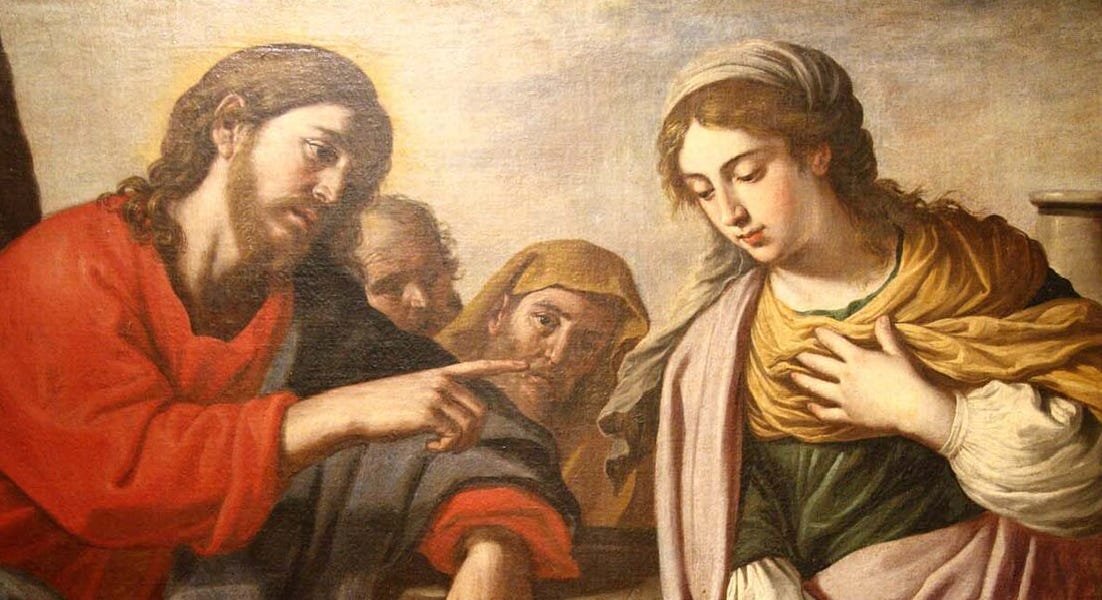
“Now he had to go through Samaria. So he came to a town in Samaria called Sychar, near the plot of ground Jacob had given to his son Joseph. Jacob’s well was there, and Jesus, tired as he was from the journey, sat down by the well. It was about noon. When a Samaritan woman came to draw water, Jesus said to her, “Will you give me a drink?” (His disciples had gone into the town to buy food.) The Samaritan woman said to him, “You are a Jew and I am a Samaritan woman. How can you ask me for a drink?” (For Jews do not associate with Samaritans.)”
St. John is telling us about this dialogue although Jesus and the Samaritan woman are there alone and apparently there are no other people with them. It is possible that young John (who was about 16 to 17 years old at a time) may have been within earshot. The other older disciples could have left him behind resulting in John remaining a witness of that unusual dialog. I tend to believe that Jesus told the disciples about the woman (organizing the story as a lesson about the Gospel reaching nations other than Israel, etc.) In any case, the dialog with the woman takes place and John got to know about it.
Samaritans in the teaching of Jesus
The meeting happens at noon with the sun high in the sky upon Jesus and the woman. A moment of maximum illumination. Jesus asks the woman for a drink. She is surprised to see a male Jew addressing her. We see something important is about to happen. Jesus was accused of being a Samaritan himself, someone under a curse or even worse: someone possessed by an evil spirit. Jesus often includes Samaritans in these parables but not as evil people but representing virtue. The Good Samaritan helps a Jewish victim of a crime, the only Samaritan among the ten lepers comes back to thank Jesus and adores Him because he cannot even enter the Temple to present himself clean before God. But he instinctively sees in Jesus a sign of divinity and gratefully returns to Him. Now Jesus asks the Samaritan woman for a drink … and the scene explodes with meaning.

Parable of the Good Samaritan by Balthasar van Cortbemde (1647) shows the Good Samaritan tending the injured man while the Levite and priest are also shown in the distance. (Detail)
Jesus answered her, “If you knew the gift of God and who it is that asks you for a drink, you would have asked him and he would have given you living water.” “Sir,” the woman said, “you have nothing to draw with and the well is deep. Where can you get this living water? Are you greater than our father Jacob, who gave us the well and drank from it himself, as did also his sons and his livestock?”
That woman has a name Photinè according to the Orthodox Syriac tradition. The Spirit is working in her when she tries to assess the situation through pure common sense. She observes the Jew without a bucket who talks to her (unusual) and then promises her “living water” (“running water” like the water of a spring). Her intuition moves her closer to the truth: this man could be someone even greater than Jacob who dug the well in ancient times to save his family and livestock. She stays and hears more …
Jesus answered, “Everyone who drinks this water will be thirsty again, but whoever drinks the water I give them will never thirst. Indeed, the water I give them will become in them a spring of water welling up to eternal life.” The woman said to him, “Sir, give me this water so that I won’t get thirsty and have to keep coming here to draw water.” He told her, “Go, call your husband and come back.” “I have no husband,” she replied. Jesus said to her, “You are right when you say you have no husband. The fact is, you have had five husbands, and the man you now have is not your husband. What you have just said is quite true.”
The promise expands: the water Jesus is willing to give is miraculous like the water that flowed from the Rock following the Hebrews in the wilderness of Negev. She asks for it but her intentions may be tainted. She may have had other interests because she concealed her being married. Soon Jesus uncovers her buddying scheme revealing to her that He is up to her way of life and her present invalid union with a man she shares her life with.
“Woman,” Jesus replied, “believe me, a time is coming when you will worship the Father neither on this mountain nor in Jerusalem. You Samaritans worship what you do not know; we worship what we do know, for salvation is from the Jews. Yet a time is coming and has now come when the true worshipers will worship the Father in the Spirit and in truth, for they are the kind of worshipers the Father seeks. God is spirit, and his worshipers must worship in the Spirit and in truth.” The woman said, “I know that Messiah” (called Christ) “is coming. When he comes, he will explain everything to us.” Then Jesus declared, “I, the one speaking to you—I am he.” (John 4: 4-26)
Here Jesus directs the woman’s attention to the point from which salvation flows. St Paul in 1Corinthians 10 explains the meaning of water flowing from the Rock in the wilderness:
“They all ate the same spiritual food and drank the same spiritual drink; for they drank from the spiritual rock that accompanied them, and that rock was Christ.”
Again, the real Rock was now in front of a woman of no importance, a foreigner despised by the Jews. To her Jesus reveals the importance of His message, to her He discloses the sacred secret: He is the Christ. He is the source of all living water. He is the Rock that followed Israel in the wilderness. The Jews are the means by whom the water of life, the living Gospel is going to reach the whole world. Samaria is the first nation to know and accept—through Photinè—the message of Christ. Then all the nations of the world would follow but there, sitting by the well this woman of dubious reputation, a member of a despised race was honored with the light of sacred knowledge under the high noon sun of Samaria. (cf. Isaiah 56:7, Jeremiah 7:11, Matthew 21:13, Mark 11:17)
The disciples come back to the well
“Just then his disciples returned and were surprised to find him talking with a woman. But no one asked, “What do you want?” or “Why are you talking with her?” Then, leaving her water jar, the woman went back to the town and said to the people, “Come, see a man who told me everything I ever did. Could this be the Messiah?” They came out of the town and made their way toward him.”
It took Photinè only a few seconds to become a communicator, and agent of the Gospel of Christ. True followers of Christ avail themselves of the truth and allow it to flow through them and become “a spring of water welling up to eternal life.” A simple traveler helped an injured victim; a former leper showed generations of Christians the value of gratefulness; and now a despised woman of a despised race received the most important message that Israel has ever received. She made the Gospel available to her nation and with that to all the nations of the world. Salvation came from the Jews and entered into the unbelieving part of the world through Photinè, the most unlikely apostle of all time.
“Meanwhile his disciples urged him, “Rabbi, eat something.” But he said to them, “I have food to eat that you know nothing about.” Then his disciples said to each other, “Could someone have brought him food?” “My food,” said Jesus, “is to do the will of him who sent me and to finish his work. Don’t you have a saying, ‘It’s still four months until harvest’? I tell you, open your eyes and look at the fields! They are ripe for harvest. Even now the one who reaps draws a wage and harvests a crop for eternal life, so that the sower and the reaper may be glad together. Thus the saying ‘One sows and another reaps’ is true. I sent you to reap what you have not worked for. Others have done the hard work, and you have reaped the benefits of their labor.”” (4: 27-38)
The disciples, perhaps twelve of the most literal men in the world fail to grasp the meaning once again. The feeding of the five thousand was food from Heaven flowing through Jesus. The Samaritans believing the Gospel were the water of Jesus’ message flowing through the woman at the well.
Many Samaritans become believers
“Many of the Samaritans from that town believed in Him because of the woman’s testimony, “He told me everything I ever did.” So when the Samaritans came to Him, they urged Him to stay with them, and He stayed two days. And because of His words many more became believers. They said to the woman, “We no longer believe just because of what you said; now we have heard for ourselves, and we know that this man really is the Savior of the world.”
A stay of two days in Samaria before returning to Israel.
Is that an obscure allusion to His residence for two millennia among the nations? (cf. 2 Peter 3: 8)