
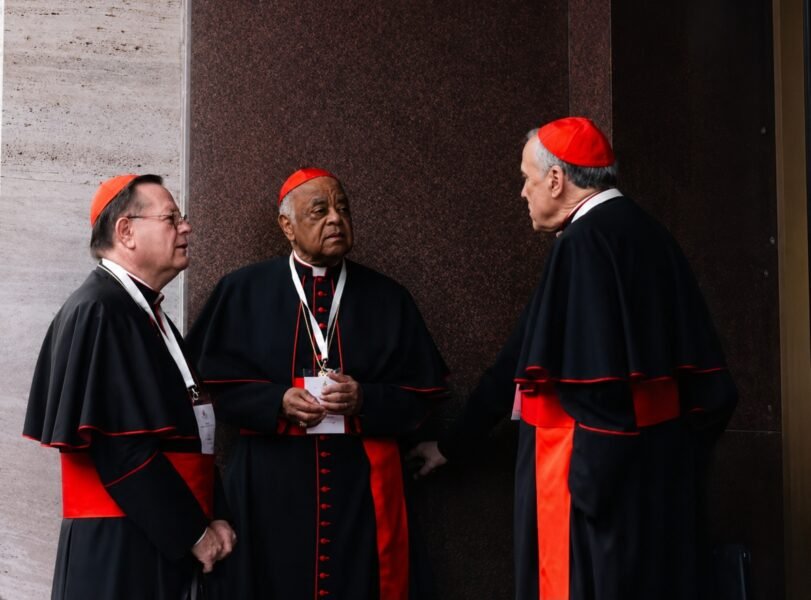
We reproduce for your interest this article by David Berger, originally published in German in the blog Philosophia Perennis, in which the German theologian reflects on the consequences of a revealing finding: according to research by Vaticanist Francesco Capozza, over two thirds of cardinals no longer have a firm grasp of Latin, the Church’s official language. Translation by InfoVaticana.
Over two thirds of cardinals barely master Latin any longer. What at first glance might seem like a marginal note for classical philologists could in fact reveal one of the most profound crises within the Catholic Church. For he who loses the language in which, for centuries, faith, liturgy, and canon law have been formulated, ultimately loses immediate access to his own tradition.
The Italian Vaticanist of the newspaper Il Tempo, Francesco Capozza, has concluded after months of research that more than 65 percent of the current College of Cardinals lacks any appreciable knowledge of Latin. Those who know Capozza realise that he does not indulge in sensational statements lightly. For many years he has been regarded as one of Italy’s best-informed Vatican observers, whose assessments have often proven correct. His diagnosis points to a problem that has been gestating within the Church for decades, one whose consequences can no longer be ignored.
This is not at all a matter of romantic nostalgia for a supposedly glorious past, nor the preference of lovers of the classical liturgy. Far deeper issues are at stake: can a Church preserve its unity when its highest representatives no longer master the language in which its theology, canon law, and magisterium were formulated over centuries?
A timeless truth safeguarded by a timeless language
For the Catholic Church, Latin has never been a mere historical relic. It is, in truth, its official language. For nearly two thousand years, papal legislative texts, canon law, and numerous magisterial documents have been promulgated in binding form in Latin. And for good reason: a language that no longer changes preserves the precision of theological concepts better than any modern vehicular tongue. Its words are not subject to the ideological and social shifts to which living languages are constantly exposed. It is precisely for this reason that Latin is eminently suited to expressing truths with precision and durability.
Pope John XXIII formulated this with notable clarity in his Apostolic Constitution Veterum Sapientia. Latin, he stated, is a language whose dignity, stability, and universality make it particularly apt for rendering visible the unity of the Church. One might say that it is, in itself, essential to a universal Church, for it privileges no nation and is equally open to all the faithful. It is noteworthy that this conviction was in no way abrogated by the Second Vatican Council. On the contrary, in the Constitution on the Sacred Liturgy, Sacrosanctum Concilium, it is expressly stated that the use of the Latin language in the Latin rites should be preserved. At the same time, the Council required that clerics be fully capable of understanding Latin texts properly and using them appropriately. The Council Fathers, therefore, had no intention of banishing Latin from the life of the Church. Rather, they took it for granted that every priest and bishop would master this language.
The virtually impossible direct access to the sources of the faith
How remarkable, then, is the evolution of recent decades. In many seminaries, Latin today plays but a marginal rôle. Most candidates for the priesthood encounter this language, at best, in introductory courses, never acquiring the ability to read ecclesiastical documents or the Church Fathers in their original tongue. Nor is simply a portion of classical formation lost; foremost, immediate access to the sources of the Catholic faith vanishes.
For theology depends upon precise concepts. Already Saint Thomas Aquinas knew that a small shift in a concept could have far-reaching consequences for the understanding of a doctrine. Concepts such as gratia, persona, substantia, natura, or caritas can only be rendered approximately in modern languages. Every translation necessarily contains an interpretation already. This is why the Church has always drawn up its binding texts in a language whose meanings remain stable across centuries.
The urgency of this problem became evident precisely with the first encyclical of Pope Leo XIV. For the first time, a magisterial document of such importance was not issued from an original Latin text, but appeared directly in various modern-language versions. This may appear practical, but raises considerable questions. Almost immediately after publication, discussions arose concerning central concepts—such as where reference is made to «humanity». What precisely is meant? The biological species? The human family? The whole of mankind? Or the common human nature upon which natural law is founded? The differing linguistic versions suggest varied emphases. A binding original Latin text would at least have provided an unequivocal hermeneutic point of reference.
An expression of the Church’s catholicity
Precisely in an age in which the most fundamental anthropological concepts are increasingly buffeted by gender ideologies, transhumanism, and technological developments, conceptual precision is no mere academic quibble. Upon it hinges how the Church’s teachings are understood and what conclusions are drawn from them. Pope Benedict XVI repeatedly insisted that the Church could preserve its identity only by keeping alive the memory of its own tradition. In his exhortation Sacramentum Caritatis, he expressly reminded priests and the faithful that the most important liturgical texts should also be known in Latin. For Benedict, Latin was not an end in itself, but an expression of the Church’s catholicity—of its unity across time, culture, and nation.
A language belonging to all Catholics
In this light, Capozza’s words take on the character of a wake-up call. A Church whose highest dignitaries no longer master their own official language loses an essential instrument of theological self-understanding. It becomes more dependent on translations, on national linguistic spheres, on diverse theological schools, and, in the end, on the currents of each epoch. And yet, within Latin resides a freedom all too often overlooked. Unlike English, it is not the language of a global political or economic power. It belongs to no people exclusively. An African, Asian, American, or European bishop stands on common linguistic ground with his peers. This is why Latin was never an expression of cultural superiority, but precisely the bond of a universal Church.
Perhaps the time has come to reread the warning of John XXIII. He was convinced that the Church does not forge its future by renouncing its traditions, but by rediscovering their permanent value. This applies to its language as well. For he who loses the language of the Church ultimately loses far more than vocabulary and grammar: he loses immediate access to a spiritual treasure that has shaped Western thought for nearly two thousand years. And a Church that knows its sources only secondhand runs the risk of one day being unable to raise its voice unmistakably.