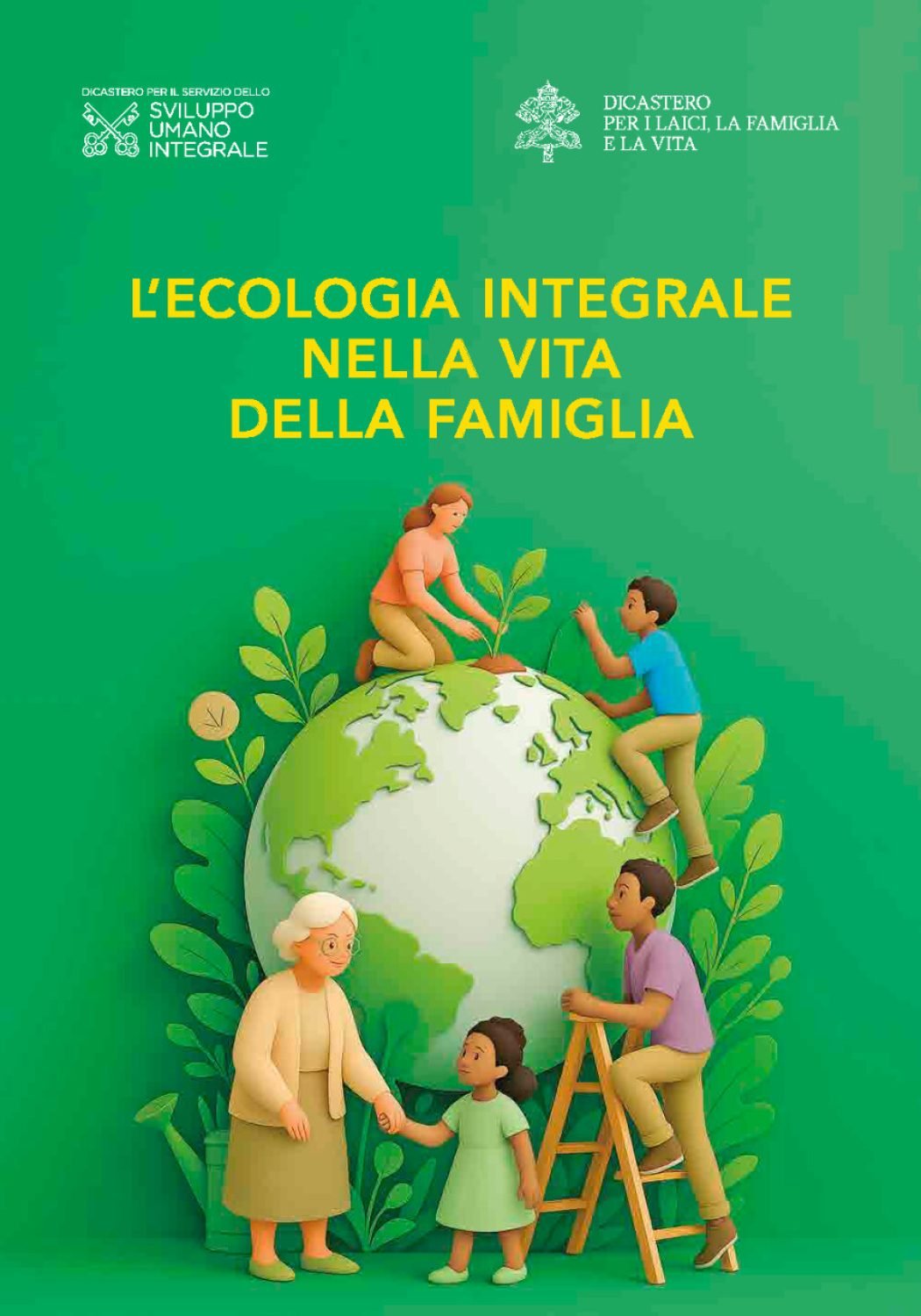
« Integral ecology in family life » is a new document to raise awareness of the protection of Creation and human life. This work is the fruit of a common commitment by two dicasteries of the Holy See : the Dicastery for Integral Human Development and the Dicastery for the Laity, Family and Life. They have responded to the calls of Pope Francis and Pope Leo XIV to hear the cry of the poor and of the Earth and to act accordingly. This document draws inspiration from the principles of the post-synodal exhortation Amoris Laetitia and the teachings of the encyclical Laudato si'. Theologians, advisors and married couples also participated in its preparation, sharing their experiences and expertise. This text was presented by Cardinals Michael Czerny and Kevin Joseph Farrell. It aims to be a practical guide intended to inspire and encourage families to adopt attitudes and practices that promote the teachings of the encyclical Laudato Si'.
Silere non possum raises serious reservations about this publication:
The stated intention is praiseworthy; the result, however, raises serious questions about the pastoral priorities of the Holy See at a time marked by a family crisis that is above all a crisis of faith, an economic crisis and a crisis of education.
A program disguised as Gospel
The structure of the document betrays its approach : after a brief section on « foundations », the manual devotes seven thematic chapters to objectives that, as explicitly stated in the introduction, are « drawn from Laudato si' ». Not from the Gospel. Not from the Catechism. Not from the Church's two-centuries-old tradition on the family. The seven pillars proposed to Catholic families are : listening to the cry of the Earth, listening to the cry of the poor, adopting an ecological economy, adopting ecological lifestyles, integral ecology and education, ecological spirituality and community participation.
The adjective « ecological » appears in virtually every chapter. The word « Christ » is far less frequent. Even the chapter on spirituality is titled « Ecological Spirituality in the Family », as if Christian spirituality, to be proposed to a family today, must necessarily be qualified by an environmentalist adjective.
The presumed reversal of priorities
In the foreword, the two cardinals (aged 78 and 79) write that « this volume, although primarily devoted to families, concerns us all ». Yet there is no mention here of the crisis in matrimonial vocations, the decline in birth rates affecting Catholic Europe, the numerous cases of child abuse within families, the growing mistrust of the Catholic Church, nor the disintegration of the conjugal bond. Instead, the focus is on the pandemic and the need for an « approach based on integral ecology ».
This is revealing. The Italian Ombudsman for Children and Adolescents has repeatedly emphasized that the family is today, statistically, the primary site of child abuse. « Real » families – those who should read this manual (and who will not even leaf through it) – face unsustainable bills, the impossibility of listening to their adolescents who take refuge on TikTok, and the near-impossibility of passing on the faith in a hostile cultural context. The document proposes to these families, among the « suggested actions », advice such as « create a compost bin or vermicomposter », « collect rainwater », « install solar panels », « obtain a rain gauge and monitor it ».
One might object that these are concrete recommendations and that detail is an integral part of the overall project. But when the « detail » occupies page after page while the « overall » — the transmission of faith, the fight against secularization, the defense of sacramental marriage — is relegated to the background, there is a problem.
Points of clear ideological coloration
1. Population growth as a « non-problem » and consumerism as the real enemy. Chapter 2 states: « Today there is a tendency to view population growth as the main threat to humanity. We should instead focus on extreme consumerism and pollution. » Certainly, the document then cites criticisms of abortion, forced contraception and sterilization. But the general framework translates, in ecclesiastical language, the typical framework of Western degrowth: the problem is not excessive numbers of inhabitants, but overconsumption. This is a respectable thesis, but not a doctrine of faith: it is one position among others in economic and demographic debate, yet presented as the only one compatible with the Gospel.
2. « Ascending multilateralism » and political pressure. The document, citing Laudate Deum, invites families to exercise « healthy pressure on leaders and governments, and to counterbalance the negative influence of marketing and misinformation ». Chapter 7 encourages families to « join forces for advocacy actions, awareness campaigns and the involvement of local authorities and decision-makers ». In the perspective of this manual, Christian families thus become above all an actor in politico-environmental mobilization. The specifically ecclesial dimension – the family as « domestic Church », place of prayer, catechesis and transmission of the deposit of faith – appears subordinate.
3. The pandemic invoked as an interpretive paradigm. The inclusion, in the Foreword, of the reference to the « effects of the recent pandemic » as a demonstration of the necessity of « integral ecology » is not innocuous. The pandemic has also been, for many within the Church, an occasion to consolidate a certain globalist lexicon – « everything is connected », « common home », « systemic fragility » – which has precise implications for global political and economic governance. To include it in a family manual amounts to accustoming the faithful to interpret their domestic life through this lexicon.
4. Sexuality relegated to the background, that of the environment. The most doctrinally solid section – the defense of life from conception to natural death, the rejection of abortion, surrogacy, euthanasia and artificial insemination – is indeed present, notably in Chapter 2. But it is embedded between considerations about « trafficking in endangered animals » and « the dignity of workers ». The rhetorical effect is inevitable: The defense of human life is presented as an ecological commitment among others, rather than as the anthropological foundation without which all other discourse on nature collapses. The hierarchy of values flattens out.
5. Language oscillating between catechesis and NGO. The document is riddled with expressions that would be found without equivocation in a Greenpeace or United Nations brochure: « transition », « sustainability », « resilience », « advocacy », « stakeholders » (in the form of « decision-makers »), « empowerment » (translated as « empower/strengthen »). At one point, among the proposed actions, one even reads: « Work fruitfully to support and strengthen (empower/strengthen?) women. » The parenthesis, retained in the final text, reveals an approximate translation of jargon that departs from Catholic tradition.
6. Citing Gandhi instead of saints. In Chapter 4, in a manual intended for Catholic families, the invitation to « live simply so that others can simply live » is attributed to « Mahatma Gandhi ». Citing Gandhi is not in itself an error. But in a eighty-page text on Christian family life, attributing a central formative principle to a Hindu spiritual master – when the Christian tradition of evangelical poverty, from Saint Francis to Saint Benedict Joseph Labre, from Charles de Foucauld to Mother Teresa, is so rich – reveals at least a sensibility that seeks its legitimacy beyond its own borders.
7. « Ecological conversion » as the distinctive mark of Christian life. The document states: « Living one's vocation as guardians of God's work is neither an option nor a secondary aspect of Christian experience. » And again: « the degradation of the environment can be a sin. » These statements, taken in isolation, can be defended. But the emphasis on ecological conversion ends up conflating with, and sometimes even replacing, conversion pure and simple: that from sin, from the world, from the old man to the new man in Christ. In the document, the vocabulary of conversion is almost always qualified as « ecological ».
What families truly need
Catholic families today face challenges of such gravity that the manual barely touches on them. The transmission of faith to children is in free fall throughout the West: the majority of children of practicing Catholics, in Italy as in France, abandon religious practice in adolescence. Pornography has become, according to numerous studies, the primary vector of sexual education for minors; the document mentions it only once, in two lines. The economic crisis has made the founding of a family a luxury: the document acknowledges the problem of the « three Ts » (work, wages, income), but offers no in-depth theological reflection on work, fair wages, the role of the State and the market. The number of religious marriages declines year after year: the document speaks of marriage almost exclusively to evoke « complementarity » as an ecological issue.
A pastoral guide for Christian families in 2026 should above all address the question of common prayer in the evening, of educating children in chastity who, at eleven years old, have already seen things their grandparents never saw, of explaining to a child why we go to Mass on Sunday when his friends go to the pool, of reacting when a child grown into adulthood ceases to believe without even having the decency to speak of it, of supporting a couple in crisis, of accompanying a parent who refuses to go to confession.
The manual of the two dicasteries barely touches on these subjects. Attention turns elsewhere: to the rain gauge, composting, the balcony garden. And we do not realize that in persisting in this direction, we dilute the message of the Gospel to the point of rendering it indiscernible from an environmental brochure. We justify ourselves with fallacious excuses – « let us begin at the beginning », « small daily habits », « everything is connected » – but the result is conclusive: we are not advancing.
One example among thousands suffices to illustrate the paradox. The municipality of Cernusco sul Naviglio recently published a video on Instagram announcing that, for couples marrying civilly, it will organize marriage preparation courses. The municipality. For civil couples. Preparation courses. And meanwhile, in the parish, one hears constantly that engaged couples « no longer have time », that meetings must be shortened, that one must « adapt to current needs », that marriage preparation of old was too demanding for the frenzied pace of young couples' lives. So let us reduce. Simplify. Make everything more accessible.
While the secular State rediscovers the importance of preparation, formation and reflection on entering into common life, the Church – the only institution legitimately positioned to have a relevant stance on marriage, since it considers it a sacrament – simplifies, rationalizes and publishes manuals explaining to families how to sort their waste. Let us be clear.
Ecology without Christ
The work « Integral Ecology in Family Life » is a poor text, not because it contains heresies – it does not – but because it defines its priorities in a way that the few faithful who read it will struggle to perceive as a pastoral urgency. At a time when Christian families feel besieged, isolated, economically strangled and culturally disparaged, the message of the two dicasteries is as follows: take care of compost, rain gauges, solar panels and citizen multilateralism, and do so as an « leading actor of integral ecology ».
Cardinals Czerny and Farrell entrust the dissemination of the work to the intercession of Saint Francis of Assisi and Saint Hildegard of Bingen, « known for their profound conception of nature as divine revelation ». It is good to recall that Saint Francis, before becoming the « saint of ecology » of contemporary folklore, was the man of the stigmata, of extreme poverty, who preached to the Sultan to convert him and who devoted true passion to the crucified Christ. Without this christological center, the Canticle of the Creatures is but naturalist poetry. The same holds true today for any ecology that claims to be integral: without the explicit, absolute and ardent primacy of Christ and the salvation of souls, it risks being merely one ecological voice among so many others, with one more crucifix hung on the wall. Better to ignore Saint Hildegard of Bingen and ask what Benedict XVI would say of these absurd words.