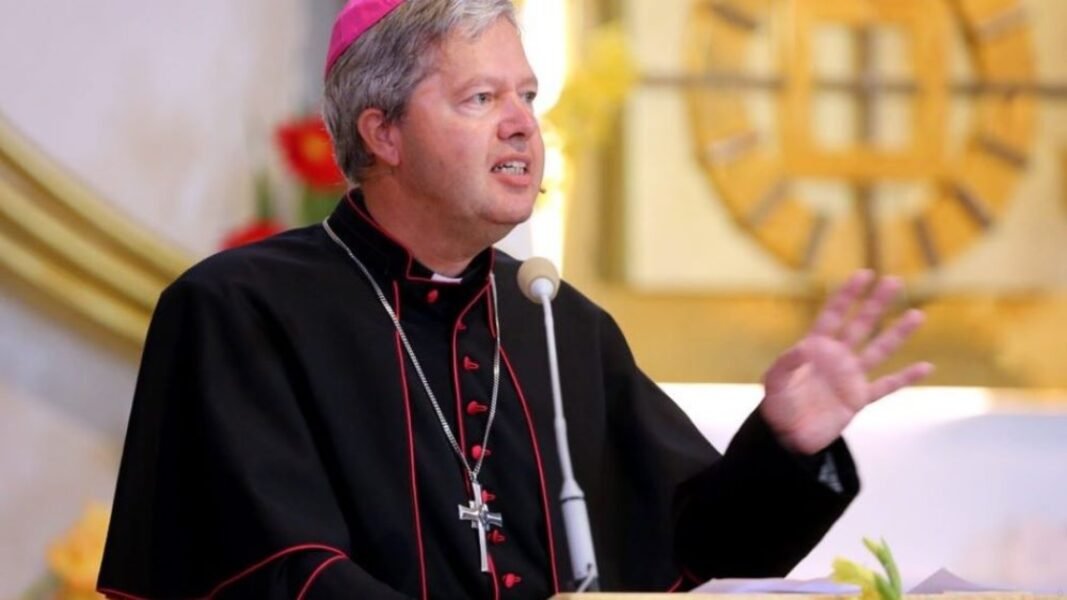
The auxiliary bishop of ’s-Hertogenbosch (Netherlands), Bishop Rob Mutsaerts, has published a new reflection on the crisis in the Church in which he questions the eagerness to constantly adapt ecclesiastical life to contemporary criteria and calls for a recovery of certainty regarding what the Church has received from Christ—and thus cannot be altered by her own hand.
In the text published on his blog, the Dutch prelate argues that the gravity of the current crisis does not lie primarily in the Church’s loss of popularity, influence, or «market share», but rather in the fact that within her, questions are being debated over which she should precisely provide certainties.
«What is truth? What is sin? What is marriage? What is priesthood? What is liturgy? What is obedience? What does mercy mean?», the bishop asks before delving into an even deeper issue:
«Do we truly believe that the Church has received something from Christ that she herself cannot change?».
«Revelation Is Not an iPhone»
Bishop Mutsaerts challenges the contemporary mindset that almost automatically equates any change with improvement, and when applied to the Church, ends up treating received doctrine as if it too required successive software updates.
«A phone from 2019 is old. A computer from 2012 is outdated. And so, we sometimes unconsciously think that a doctrine of faith from the year 325 urgently needs a software update», the bishop quips. Yet «Revelation is not an iPhone», and Christianity is not «a product that must have a new model every year».
The prelate does not deny that certain elements of Church life may change. Pastoral methods, some canonical disciplines, forms of governance, or specific liturgical practices may be modified. What he rejects, however, is the notion that this logic can be applied to revealed truth, for «truth cannot be true today and false tomorrow».
Thus, he considers that the criterion for judging ecclesiastical renewal should not be its novelty, its ability to conform to current language, or its cultural acceptance, but rather whether what is proposed truly helps the faithful to become more holy and draws them closer to Christ, the sacraments, and eternal life.
Synodality and the «Spirit of the Age»
The auxiliary bishop of ’s-Hertogenbosch also revisits synodality, one of the issues on which he has been most critical in recent years. Mutsaerts does not question synods as such—he notes that they have been part of the Church’s history—but rather the risk of turning synodality, as a working method, into «an almost autonomous theological ideal».
The Apostles, he points out, first received a faith entrusted to them and only then could deliberate about it. «That order is important». Hence, listening cannot become an end in itself, separate from the truth that the Church is duty-bound to safeguard.
«Whom should we listen to? To culture? To opinion polls? To interest groups? To ourselves? Or to Christ?» When conclusions predictably align with «the desires of modern secular culture», the bishop deems it legitimate to ask: «Are we truly listening to the Holy Spirit, or perhaps primarily to the spirit of the age?»
He likewise urges his fellow bishops not to abdicate the authority proper to their ministry by becoming «permanent facilitators of group processes». To be a successor of the Apostles is to teach, sanctify, and govern—and, when necessary, simply to affirm that certain things cannot be changed.
«Use synodality, but be bishops», Mutsaerts writes. He even reclaims a word little appreciated in some pastoral circles: «No. We cannot change this».
What Do Young People Find in Tradition?
Mutsaerts also addresses a phenomenon that challenges some of the assumptions of pastoral ministry in recent decades. Contrary to the idea that young people need few demands, brief celebrations, simplified texts, and minimal obligations, he observes that many who are discovering the faith are precisely seeking «truth, order, asceticism, identity, confession, adoration, the sacraments, intellectual depth, and a community that demands something of them».
«We have underestimated young people», he admits. The solution, in his view, does not lie in offering them a watered-down Christianity, but in teaching them the Catechism, prayer, fasting, and the reasons why the Church upholds what she teaches. «No one has ever been martyred for a vague sense of belonging», he quips.
This phenomenon extends to liturgy as well, when he explicitly asks bishops not to automatically interpret adherence to the traditional liturgy as a problem requiring correction.
«Not every young Catholic who likes Latin is a secret agent from 1957», he writes. If some young people are drawn to Gregorian chant, silence, incense, kneeling, the ad orientem celebration, or classical spirituality, he considers it more useful to ask: «What are they seeking here that they cannot find elsewhere?» than to react with suspicion toward their preferences.
The warning extends equally to traditionalists themselves. The ancient liturgy may sanctify, but it does not automatically make one holy simply by attending it. One can participate in «the most reverent Mass» and then proceed to «curse three bishops and the entire Vatican» in the parking lot.
«Tradition without charity becomes archaeology with a bad temper».
Less Management, More Priesthood
The recovery of Catholic identity that Mutsaerts proposes also pertains to priesthood and vocations. Faced with a shortage of priests, he notes that much of the ecclesiastical conversation ends up focusing on parish mergers, administrative models, reorganizations, or celibacy, while a fundamental question remains in the background: why would a young man want to dedicate his life to the priesthood?
Presenting it as the future administrator of eight parishes, burdened with meetings and strategic plans, hardly inspires vocations. Far different is the proposal to give one’s life to Christ, celebrate the Mass daily, forgive sins, baptize children, accompany the dying, proclaim the Gospel, and become a spiritual father.
For this reason, he asks bishops, when discerning vocations, not to seek primarily good managers, but rather men who pray. «A mediocre administrator can be aided by a good steward. No management course can save a priest who does not pray».
The same logic applies to the Church’s broader renewal. Mutsaerts calls for more confession, Eucharistic adoration, catechesis, preaching on sin and grace, solid priestly formation, families that transmit the faith, and bishops willing to teach even when doctrine proves unpopular.
At the same time, he warns the traditionalist world that defending orthodoxy can degenerate into ideology when the ecclesiastical battle displaces spiritual life. «We may be right and yet lack charity; we may be orthodox and proud; liturgically correct and spiritually cold; theologically sharp and humanly insufferable».
For Mutsaerts, the fruitfulness of Catholic renewal will be measured by the holiness it produces: families, vocations, intellectual life, beauty, charity, joy, and missionary zeal. The Church, he maintains, does not need to be reinvented or «saved» as if Christ had stopped sustaining her after the Ascension.
The task of Catholics is far less novel and far more demanding: to preserve the faith, transmit it to their children, receive the sacraments, form priests, foster vocations, serve the poor, and celebrate the liturgy with dignity. For, as the bishop concludes, «in the end, there are no traditional saints and progressive saints. There are only saints».