
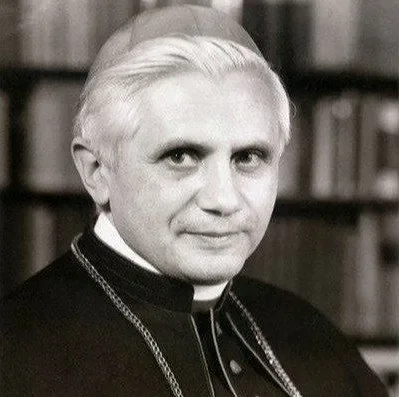
Cardinal Ratzinger was interviewed on pressing moral questions: abortion, euthanasia and capital punishment. His responses reflect the clarity with which he distinguished between the non-negotiable defense of innocent life and legitimate debates on criminal justice.
Cardinal Ratzinger:
"One cannot compare abortion with capital punishment"
ABORTION-EUTHANASIA-DEATH PENALTY
In 1993, during an international course held in El Escorial on the Catechism of the Catholic Church, Cardinal Joseph Ratzinger (then Prefect of the Congregation for the Doctrine of the Faith) was interviewed on pressing moral questions: abortion, euthanasia and capital punishment. His responses reflect the clarity with which he distinguished between the non-negotiable defense of innocent life and legitimate debates on criminal justice.
Abortion: crime against the innocent
Ratzinger was unequivocal in rejecting any attempt to equate abortion with other issues. "In abortion, a completely innocent person is manifestly killed, subordinating the right to life to one's own interests", he declared. The Prefect emphasized that there is no doubt here: human life from conception possesses an absolute dignity that no political or social power can relativize. In this vein, he explained that while some attempt to relativize abortion by placing it alongside other problems, the truth is that it always destroys the most defenseless: "The child has no possibility whatsoever of defense; he is the absolute victim, and therefore abortion is placed at a level entirely different from any other matter of public life".
Capital punishment: personal rejection, but without dogmatic condemnation
Regarding capital punishment, Ratzinger adopted a nuanced tone. "Personally I support the abolition of the death penalty and the corresponding political-social goal", he stated. However, he clarified with precision: "One cannot say that capital punishment is absolutely and forever excluded in all circumstances".
The Cardinal offered an extreme example: the Nuremberg trials and the case of Adolf Eichmann, the logistical architect of the Holocaust. "Can one really say that a state governed by law which, in such exceptional circumstances, resorts to capital punishment, is absolutely in error?", he posed.
For Ratzinger, the Church cannot elevate this discussion to a dogmatic level: "The demand for an absolute prohibition of capital punishment does not necessarily follow from Christian doctrine". It is a matter that belongs to the domain of criminal law and political prudence, not to the doctrine of faith.
Euthanasia: false compassion that kills

Regarding euthanasia, the then Prefect was equally clear: the Church cannot accept it under any circumstances. "Euthanasia is not an act of mercy, but a homicide that disguises itself under the appearance of compassion", he affirmed. Ratzinger explained that, although it may be presented as a relief from suffering, it is in reality a denial of the value of human life in its moments of fragility and vulnerability.
"Christian tradition teaches us that life does not belong to us, but is a gift from God. No one has the right to dispose of it either at the beginning or at the end", he clarified.
The Catechism as moral reference
Ratzinger defended that the Catechism of the Catholic Church does not propose novelties, but rather offers Christian people a guide that translates the faith of all time into language accessible to our age. "It is not a book of opinion; it is the organic presentation of the Church's perennial doctrine", he explained.

He insisted that the purpose of the Catechism is to illuminate the conscience of the faithful in the midst of a social context marked by relativism and ideologies. "The Church cannot remain silent in the face of attacks on life. It must offer clear criteria, grounded in faith and reason, so that Christians may know how to discern", he concluded.
I.V