A couple of decades ago, Religión Digital was a portal featuring profiles of all kinds. There were figures such as Francisco José Fernández de La Cigoña or our own Luis Fernando Pérez Bustamante, alongside the late homosexual priest José Mantero. Over time, however, the line imposed by its director, the former priest José Manuel Vidal, and his fellow Levite, Jesús Bastante, prevailed. Among its central figures remained Xabier Pikaza, Juan Masiá, José Arregi, Torres Queiruga, Antonio Piñero, and other relics of domestic ecclesiastical progressivism.
In some of the articles we have published, we warned that this portal featured a surprising number of sponsorships from ecclesiastical entities. It is difficult to know the exact amount paid for such advertising, though their rates can be found on the website itself. And we are not talking about pocket change: the site offers banners ranging from €400 to €2,000 per month, and section sponsorships from €20,000 per year, plus VAT. At first glance, these rates seem remarkably high for a medium of this nature.
Because, let us not fool ourselves, ecclesiastical progressivism is not, precisely, a mass phenomenon. Each year, Juanjo Romero compiles a summary of the figures from Spain’s religious media landscape, leaving little room for doubt. Religión Digital is a considerable distance from the most widely read Catholic media outlets, and according to 2025 data, the gap between Catholic and progressive publications continues to widen. Granted, perhaps its readership is not vast, but some of them must be quite influential, for they never cease to receive interviews from the Church’s highest hierarchs—especially those who seem intent on positioning themselves for more prominent roles.
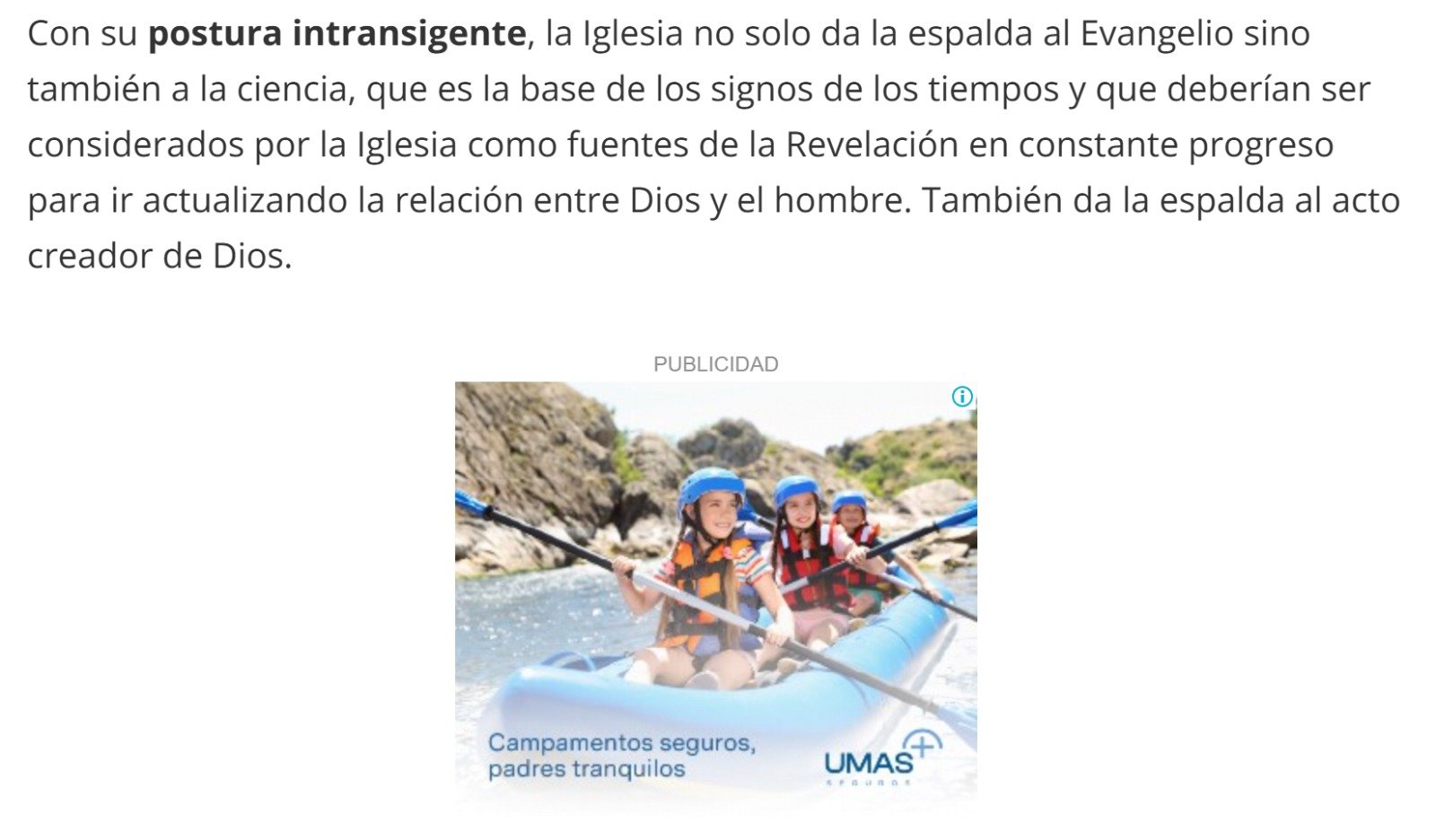
Why do I return to this topic once again? Because I recently came across an article that struck me as worth sharing, given the unpleasant sensation it left me with. The article catalogues the most hackneyed clichés against the Church’s doctrine on homosexuality. Its author, a certain José Melero Pérez, writes with that unmistakable tone of a renegade priest—a style that has yielded such abundant fruit in Spain’s religious journalism. He spouts phrases such as: «The Church does not permit the sacrament of marriage to be granted to homosexuals, considering them deviant and mentally ill beings before God and Nature, while fostering conversion therapies to turn them into heterosexuals». He claims that «with its intransigent stance, the Church not only turns its back on the Gospel but also on science». And to cap it all off, he concludes his diatribe with a quote from Juan José Tamayo, the ubiquitous figure among bitter ex-priests.
Of course, one might say there is nothing new in such discourse—it is older than the retirees who promote it. But what is truly unpleasant is to observe how, between paragraphs, advertisements for ecclesiastical institutions appear—many of which Religión Digital itself explicitly presents as entities that support or collaborate with the portal.
We begin with EDIBESA, the well-known Dominican publishing house, advertising its Gospel for each day, distributed in many Spanish parishes, seemingly contributing to Vidal’s friends’ unscrupulous insults against the Church. Further down, we find an advertisement for Banco Sabadell—because we are anticapitalist, but not excessively so. Next comes one of the most surprising: UMAS, a mutual society in which Spanish dioceses participate, whose operations we shall refrain from discussing today out of Christian charity and to stay on topic. Then there is an online theology school run by the Dominicans, who have already contributed twice to the mockery of the Holy Mother Church. Following that, we have the Pontifical University of Salamanca, which falls under the direct responsibility of the Spanish Episcopal Conference.
This appears at the start of the article in question. Elsewhere on the portal, one can find advertisements for the Catholic University of Valencia, one of its most recent additions; there is also a presence from Manos Unidas’ Campaign Against Hunger, which we imagine must be a voluntary contribution from José Manuel Vidal himself to such a noble cause. Also present are the La Salle brothers, in this case with their university centre, whose direction by laypeople we cannot confirm, given the scarcity of brothers willing to follow in the footsteps of the great St. John Baptist de La Salle.
The Jesuits of Comillas appear rather sidelined. The Dominicans make a third appearance with an advertisement for their WhatsApp group, and the Pontifical University of Salamanca, along with the Pablo VI Foundation, is promoting a Master’s in the Church’s Social Doctrine.
At the very end, after one has endured the usually blasphemous vignettes by Quique and Cortés, come the other Jesuits of Deusto, followed by yet another bank: CaixaBank. The Jesuits cannot be left behind, given their long-standing rivalry with the Dominicans, and they too advertise the Loyola University.
Rounding out the list are the Paulines, Mensajeros de la Paz, the Edelvives Foundation, and, in last place—perhaps fittingly, given their name, the Brothers of the Good Death—the Camillians. It surprises me that Mensajeros de la Paz, the charitable services company of the ineffable Father Ángel, should be so modest as to occupy such an obscure spot, especially considering that Religión Digital itself presents Mensajeros de la Paz as its «principal alliance» and claims that both entities «go hand in hand» in a communication project.
Thus, we have all these institutions providing resources, advertising, collaboration, or institutional support—in varying forms—to a portal that publishes this and many other expressions contrary to the Catholic faith, openly hostile to the Church’s doctrine, and scandalous to any believer. Money is fungible, and financially supporting a medium enables it to continue publishing what it does.
I shall not cease to denounce this, even if the bishops turn a deaf ear, as was the case during the press conference of the last Plenary Assembly of the Spanish Episcopal Conference, where I raised this issue with Bishop García Magán, only for him to direct me to ask someone from the X campaign. Yes, doubtless he and many others may laugh at me, but I would not like to be in their shoes when they must give account before the King of Kings for how they have used the talents entrusted to them. In this case, it seems some have chosen to invest them in funding those who insult the Church and work to lead souls away from the faith. May God forgive them.