Not only the missing red shoes. Prevost's coat of arms also echoes that of Bergoglio and signals his (authentic) canonical status, namely that of anti-pope. Another move by the institution to separate the wheat from the chaff?
There are some important absences in the list of pontifical prerogatives granted to Leo XIV. Among these, the Vatican Apostolic Apartment: Prevost was indeed sent to the attic, the so-called "soffiattoni", he does not sleep and does not pray in the environments of the true pope.
Also the apartments of Castel Gandolfo (the Augustinian prelate always stayed in Villa Barberini, traditionally used as a residence for the Secretary of State), the traditional papal red shoes and, as we said, the pontifical coat of arms.
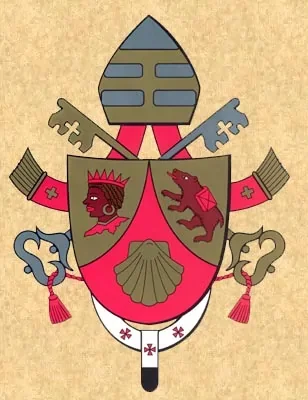
To have a comprehensive understanding of the issue, it must be remembered that papal heraldry was strongly innovated by Benedict XVI: the Bavarian pontiff, elected in actual minority thanks to a maneuver by the St. Gallen Mafia and, in all probability, aware of having to soon or late withdraw to an impeded see, removed the traditional tiregno (which all pontiffs up to John Paul II had inserted in his coat of arms) from his arms, replacing it with another element that indicated his office, namely the pallium with red crosses,
as shown in the following image.

This liturgical vestment is indeed an exclusive pontifical prerogative and indicates the divine mandate of the successor of Peter. Therefore, in papal heraldry the tiregno (or precisely the pallium with red crosses) indicates the munus petrinum and the keys instead stand for the ministerium.
After Bergoglio's election, the Argentine anti-pope was instead granted a coat of arms which, if well analyzed, reveals an absolute heterogeneity with respect to that of Benedict XVI: there were indeed the keys (which symbolize the ministerium abusively possessed by Bergoglio), but both the tiregno and the pallium with red crosses were missing. Thus, there was no sign of the munus petrinum in the coat of arms of the South American prelate, but only symbols of the ministerium irregularly possessed by him as he ascended to the pontifical throne following an irregular Conclave from the outset because convoked with a pope impeditus and not having abdicated.
A further detail present in Francis's heraldry instead reveals what his canonical status was: under the shield, we find a cartouche bearing the episcopal motto Miserando atque eligendo chosen by Bergoglio. The papal arms, in reality, never bear a specific motto, since the pope, as supreme head of the Catholic Church, summarizes all the ideals expressed by the Church.
The coat of arms that Bergoglio used between 2013 and 2025 was therefore the coat of arms of a bishop (since with the papacy – or the anti-papacy – one loses the status cardinalitius) outside communion with the Catholic Church, since bishops of the Catholic Church bear on their insignia the green galero.
Moreover, the insignia of the South American prelate were also erroneous from a graphic point of view: the faces of the cartouche, white, once curved, should have continued in the same color even below the part with the motto, but incredibly the color changes to red: there is therefore a blatant inversion of colors that contributes to signaling that the canonical status of the coat of arms's owner is irregular.
In all probability, all these details were purposely inserted by the Secretary of State, the institution responsible for governing the Church when the see is impeded, in order to help the faithful unmask the canonical reality. The same institution has gradually, and increasingly rapidly from 2020 onwards, deprived Bergoglio of those pontifical prerogatives that had been granted to him initially.
Even to bury him far from the Vatican Basilica (recall that Bergoglio had wished to rest in the same tomb that was John XXIII's and John Paul II's, now significantly occupied by Benedict XVI) and without any pontifical insignia: precisely, as an archbishop.
For his part, Prevost's coat of arms has taken up all the external elements that had adorned Bergoglio's coat of arms, none excluded, as evident from the following comparative image.

The two coats of arms are therefore identical from a symbolic point of view and signal in crystalline fashion the canonical continuity between the two: Bergoglio was indeed anti-pope since elected by an abusive Conclave, convoked when Benedict XVI was neither dead nor had abdicated, but was rather impeded. Prevost, for his part, is instead anti-pope since elected by a Conclave in which 108 false cardinals created by the usurping anti-pope Bergoglio participated; add the number of 133 cardinal electors (13 more than the maximum of 120 permitted by Universi Dominici Gregis). Furthermore, after the extra omnes, Vatican security devices detected a cell phone turned on in the pocket of a cardinal. The fourth reason for the irregularity of the 2025 Conclave (and thus of Prevost's election) was the brief departure of a conclabist from the Sistine Chapel before the end of the fourth scrutiny, as reported to Cronache Maceratesi by the Augustinian Fr. Bruno Silvestrini.
In the coats of arms of Bergoglio and Prevost, therefore, there is any reference to the munus petrinum, thus to the dignity of the papal office.
A move probably prepared once again by the Secretary of State, still called to perform the regency task while the see is impeded.
It is therefore of the utmost urgency to disseminate Urbi et orbi also the anti-papacy of Robert Francis Prevost, so as to urge the authentic cardinal electors appointed by John Paul II and Benedict XVI to declare that the last authentic Pope has died and that a Conclave should be convoked to elect his legitimate successor.
Davide De Vincentiis