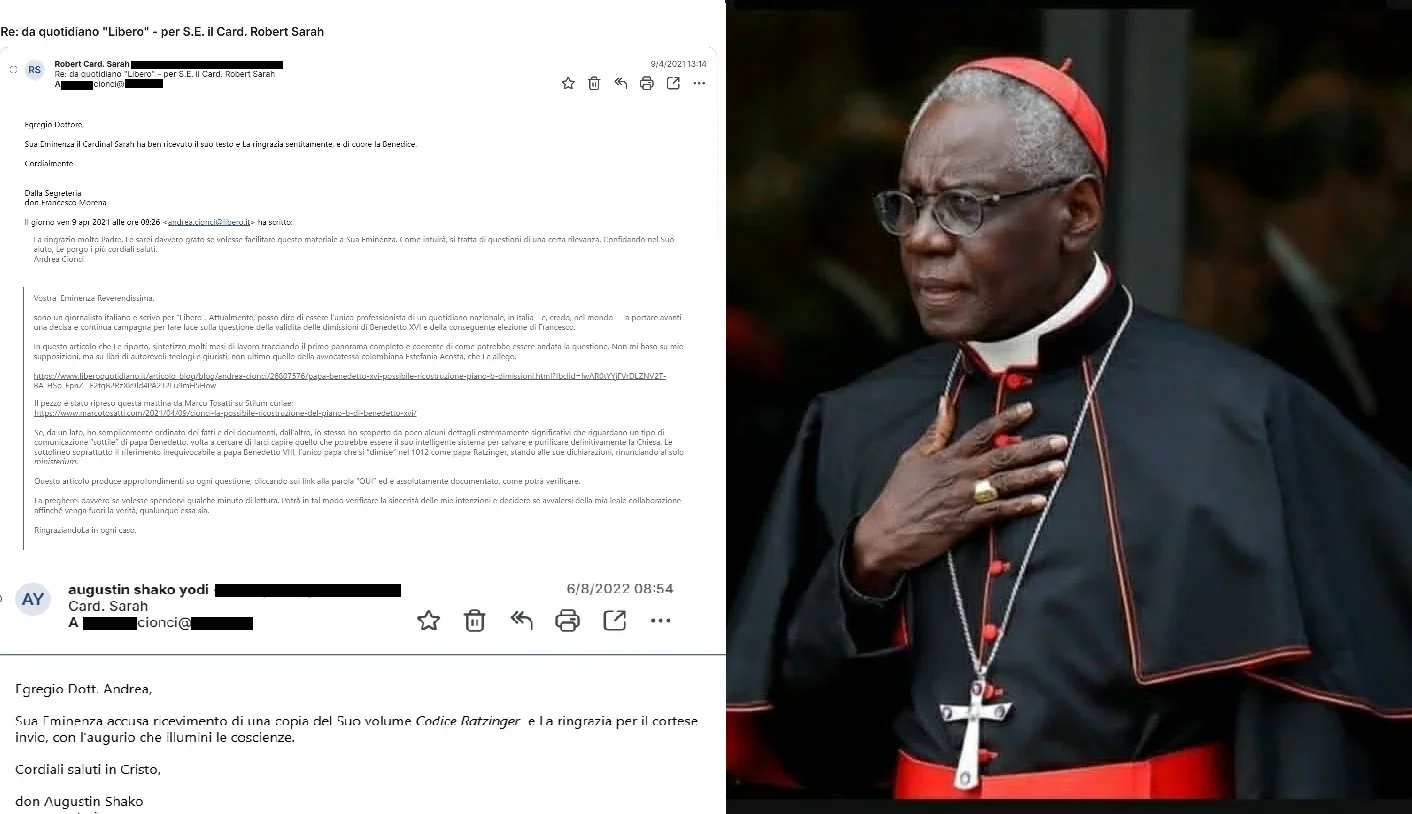
“A shadow hangs over the election of Ratzinger”: these are the words of an authoritative historian of Christianity – even a progressive one – like Alberto Melloni, explaining a crucial detail about the sede impedita of Benedict XVI, which made both Bergoglio and Prevost antipopes.
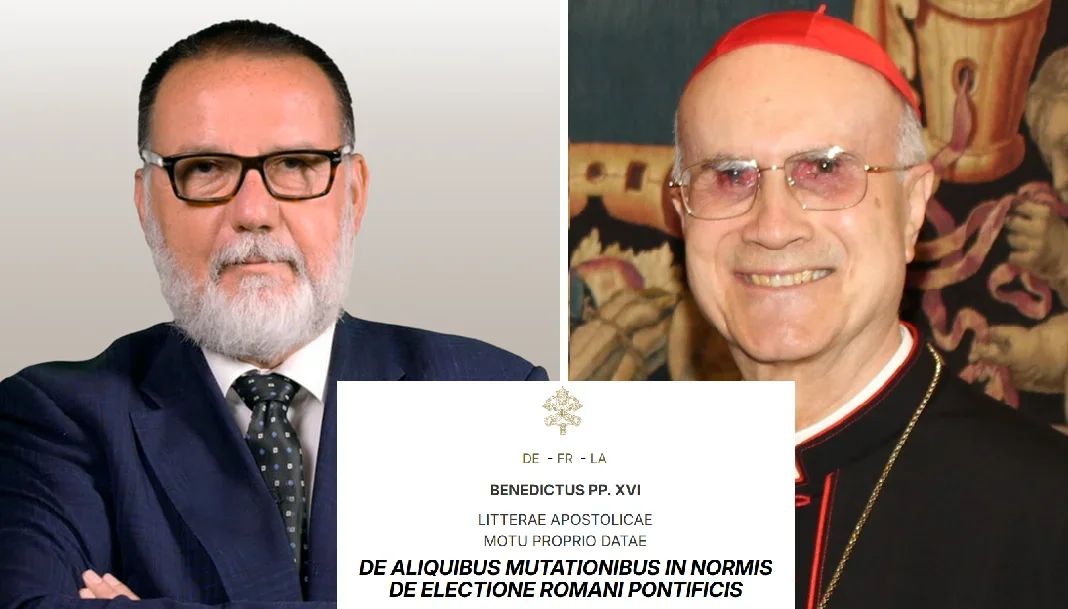
As we have already seen, https://www.youtube.com/watch?v=y_JKMlniHZg&t=2s in his Declaratio of 2013, Benedict XVI denounced, with “commissum”, a misdeed committed by a group of cardinals at his own election, in 2005. The word commissum was modified in the text proposed to the public by Card. Bertone and Mons. Giampiero Gloder in a clumsy attempt to pass off what was a decisio, a penal decree of sede impedita, as an abdication.
The two involved have not even denied a public petition with nearly 2000 signatures from the faithful in this regard
and have been the subject of a report by the undersigned https://www.youtube.com/watch?v=JMiQPQTUfFM to the Office of the Promoter of Justice, which, as is known, is conducting an investigation into the matter.
The same antipope Francis, in the 2024 volume “El Sucesor”, reports how, in the 2005 conclave, at the third scrutiny, a deadlock was created: Ratzinger with 72 votes and himself, Bergoglio, the candidate of the “St. Gallen Group”, with 40.
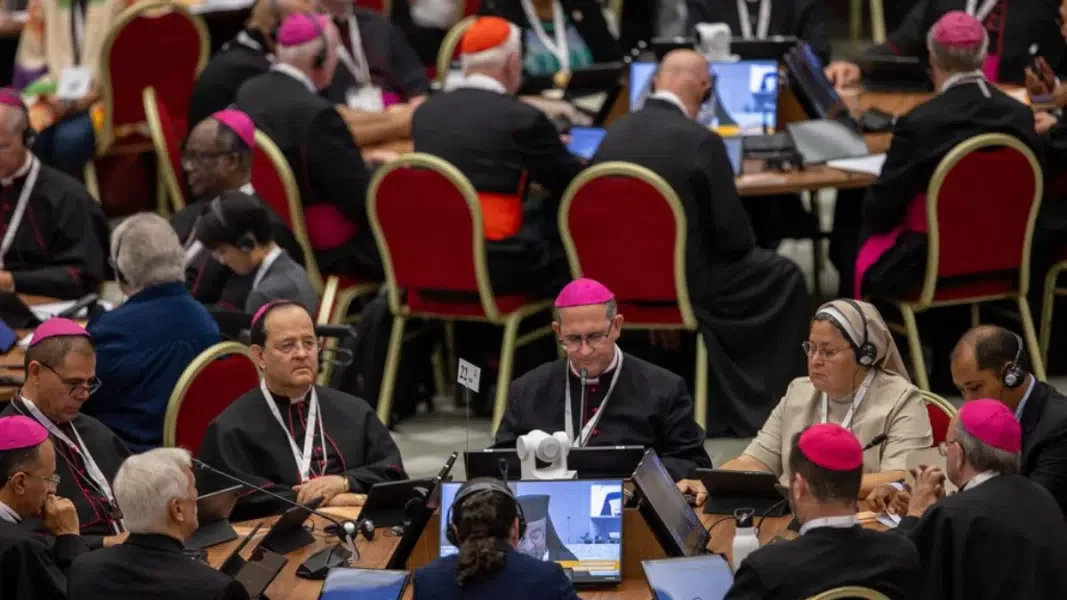
Neither of the two could break the two-thirds majority threshold to be elected pope. Thus, the risk was that both candidates would be disqualified and most of the votes would go to a compromise candidate who would enjoy a large majority.
As confirmed by Father Silvano Fausti, https://www.youtube.com/watch?v=D8fohQqCfj0&t=558s Card. Martini preferred to have Ratzinger elected by diverting the votes of his party to the German theologian: the inevitable goal was to make the government of Benedict XVI a “lame duck”, i.e., with a de facto minority. This lack of “forces” – political, of course – will lead Benedict in 2013 to withdraw, placing himself, with a brilliant Declaratio, in sede impedita by an abusive conclave, convened with a pope not dead and not abdicating from the munus petrine. Here is the complete study: www.codiceratzinger.eu/pdf
The electoral maneuver of the San Gallo mafiosi is hinted at by Prof. Melloni in an article in the Corriere on June 27, 2007, which is written by the Vaticanist Sandro Magister HERE: “The 40 votes that went to Bergoglio in the third scrutiny ‘in other times would have made Ratzinger’s candidacy fall’; if this did not happen, it is precisely because the cardinals knew that ‘even with a simple majority Ratzinger would ascend to the throne of Peter’. Melloni does not fully subscribe to this reading of the facts. He says it would be more important to know ‘who, how, and what shifted an additional package of votes to Ratzinger’ in the afternoon of April 19, 2005, allowing him to exceed the two-thirds. The implication is that this was done by the progressive cardinal Carlo Maria Martini, in order to avert ‘an even more dangerous politicized solution’: i.e., the election of Cardinal Camillo Ruini. In any case, Melloni argues, Ratzinger’s election as pope is overshadowed by ‘a shadow’: ‘It is evident from today’s reform that Benedict XVI wants to free his successor from this shadow and, in a certain way, himself as well’.
Melloni was right, and indeed we must return to a long-forgotten motu proprio of Benedict XVI of June 11, 2007.
As Magister writes, the media gave little attention to this important papal act, and Card. Bertone tried to divert attention from the issue, pretending with journalists not to remember the votes that the two candidates had received. It is amusing how, even today, on the Vatican website, this motu proprio, entitled De Aliquibus Mutationibus In Normis De Electione Romani Pontificis, https://www.vatican.va/content/benedict-xvi/la/motu_proprio/documents/hf_ben-xvi_motu-proprio_20070611_de-electione.html is present only in the Latin, German, and French versions and not, as is always the case, also in Italian and English.

A pathetic attempt by the 2007 Secretariat of State under Bertone to exclude the most attentive observers, the Italians and the Americans, from the easy reading of the motu proprio: someone would have noticed, sooner or later, that with this motu proprio, Benedict XVI wanted to spare his successor a maneuver similar to the one of which he had been a victim.
Here is the essence of Benedict XVI’s motu proprio.
With the constitution Universi Dominici Gregis of 1996, John Paul II had established that the pope must be elected with two-thirds of the majority. However, if after 34 ballots (about two weeks) no new pontiff had emerged, the quorum could drop to an absolute majority, i.e., 50% +1.
This was a truly damaging measure, for which we must thank the canonist Card. Mario Francesco Pompedda. Imagine a conservative cardinal who, out of 100 voters, receives 60 votes. He has an absolute majority, but not two-thirds. His supporters could hold out until the end of the 34 ballots, but it would be useless to resist. In fact, due to the media pressure on the conclave, no minority would hold out for two weeks knowing they would already lose. Thus, the possible solutions remain: 1) both candidates are disqualified and a third compromise name is voted on early with two-thirds of the majority.
2) vote for a “lame duck”: the leading candidate is elected with the votes of the opponents. Exactly what happened with Ratzinger: a fictitious majority that gave him eight years of hell.
Thus, Benedict XVI, just elected, both in consideration of his age and perhaps imagining that someone might have tried to harm him (as they attempted in Cuba in 2012), eliminated the shortcut of the quorum at 50%+1 and established that, after 34 ballots, the two most voted candidates should remain eligible in the runoff, always with two-thirds of the majority. In this way, in the conclave, the conscience of the cardinals would be “stressed” until the wheat was separated from the chaff, and the elected would enjoy a broad and honest majority, without lame ducks.

In summary: Prof. Melloni himself has confirmed with his considerations that Ratzinger’s election was obtained with a fictitious majority wanted by the San Gallo Mafia; Benedict XVI’s motu proprio confirms what he himself had suffered in the conclave; the hiding of the motu proprio by Bertone confirms once again that it was he who falsified the Declaratio to make it appear as an abdication. Finally: the correct translation of Prof. Gian Matteo Corrias of the Declaratio is entirely consistent with the Latin, with canon law, with the course of events, and with the authoritative opinion of an authoritative historian of Christianity.
After Benedict XVI, Bergoglio antipope and Prevost antipope. What to do?
Leo XIV is not the pope not only for the antipapacy of Bergoglio, but also for the 133 electors convened (13 more than allowed) and a series of other infractions that the faithful will find listed in the petition – collective injunction available for online signature here. https://www.petizioni.com/diffida_collettiva_e_istanza_formale_di_accertamento_canonico_su_elezione_leone_xiv
The Holy See knows everything, is perfectly informed. The true cardinals before 2013 must intervene, but they are waiting for the Catholic people to rise up to defend their rights.
Andrea Cionci