
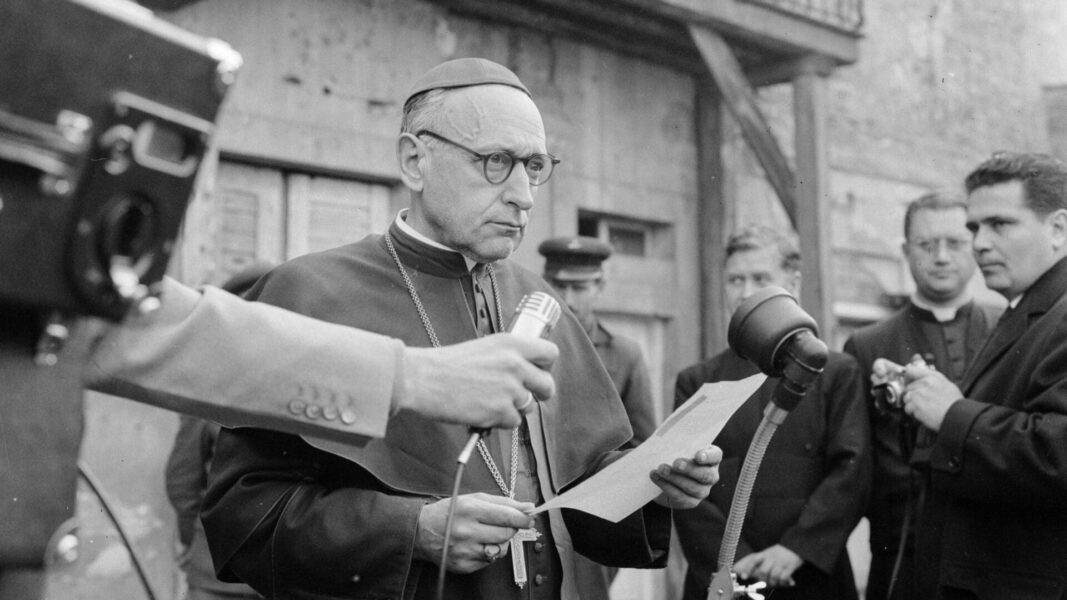
Primate of Hungary, imprisoned, tortured, subjected to a show trial by the communist regime in 1949, Mindszenty became a living symbol of resistance. He did not negotiate. He did not yield. He did not hedge. He represented a Church that preferred persecution to compromise. When he was liberated during the 1956 revolution, he had to take refuge in the United States embassy in Budapest, where he would remain for fifteen years, as an uncomfortable witness that the world did not know where to place.
And then Rome arrived.
Not the Rome of the martyrs, but that of diplomacy. That of the so-called Vatican Ostpolitik, promoted by Cardinal Agostino Casaroli under the pontificate of Paul VI. The objective was clear: to reach agreements with communist regimes to guarantee minimal institutional survival of the Church behind the Iron Curtain. The method was also clear: concessions, silences, calculated gestures.
Mindszenty did not fit into that scheme.
In 1971, the Vatican pressured him to abandon the embassy. In 1974, Paul VI declared him deposed as Archbishop of Esztergom, despite the fact that the cardinal never voluntarily resigned. The man who had endured prison and humiliation for fidelity to the Church was set aside by the Church itself in the name of a diplomatic strategy. It was not an interpretation: it was a fact.
The image is difficult to escape. A confessor of the faith, reduced to an obstacle. A symbol of resistance, converted into a political problem. The logic of martyrdom replaced by the logic of balance.
Decades later, the paradox becomes even more acute. Mindszenty is neither saint nor blessed. His cause advances slowly, as if his figure continued to be uncomfortable. In contrast, Paul VI, the Pope who executed that policy and made the decision to set him aside, was canonized in 2018.
This is not about judging internal intentions or denying the complexity of the context. It is about noting an uncomfortable fact: the Church that elevated to the altars the one who practiced realpolitik with communism has not yet elevated to the altars the one who refused to yield to it.
That contrast is not anecdotal. It is a symptom.
After the Second Vatican Council, the Church faced a dilemma that it did not always know how to resolve: to maintain the radicality of testimony or to adapt to the conditions of the modern world to survive. Mindszenty represents the first option in its purest form. Casaroli and Paul VI, the second in its most effective form.
The problem is not that both lines existed. The problem is which one ended up prevailing in practice and what price was paid for it.
Because when a Church begins to consider excessive the testimony of its own confessors of the faith, something essential has shifted. And when that same system elevates to the altars those who opted for negotiation, the message that is transmitted—whether intended or not—is unequivocal.
Mindszenty continues to wait. And his waiting is not only that of a cause for beatification. It is that of a question that remains without clear answer: what model of fidelity does the Church really wish to honor.