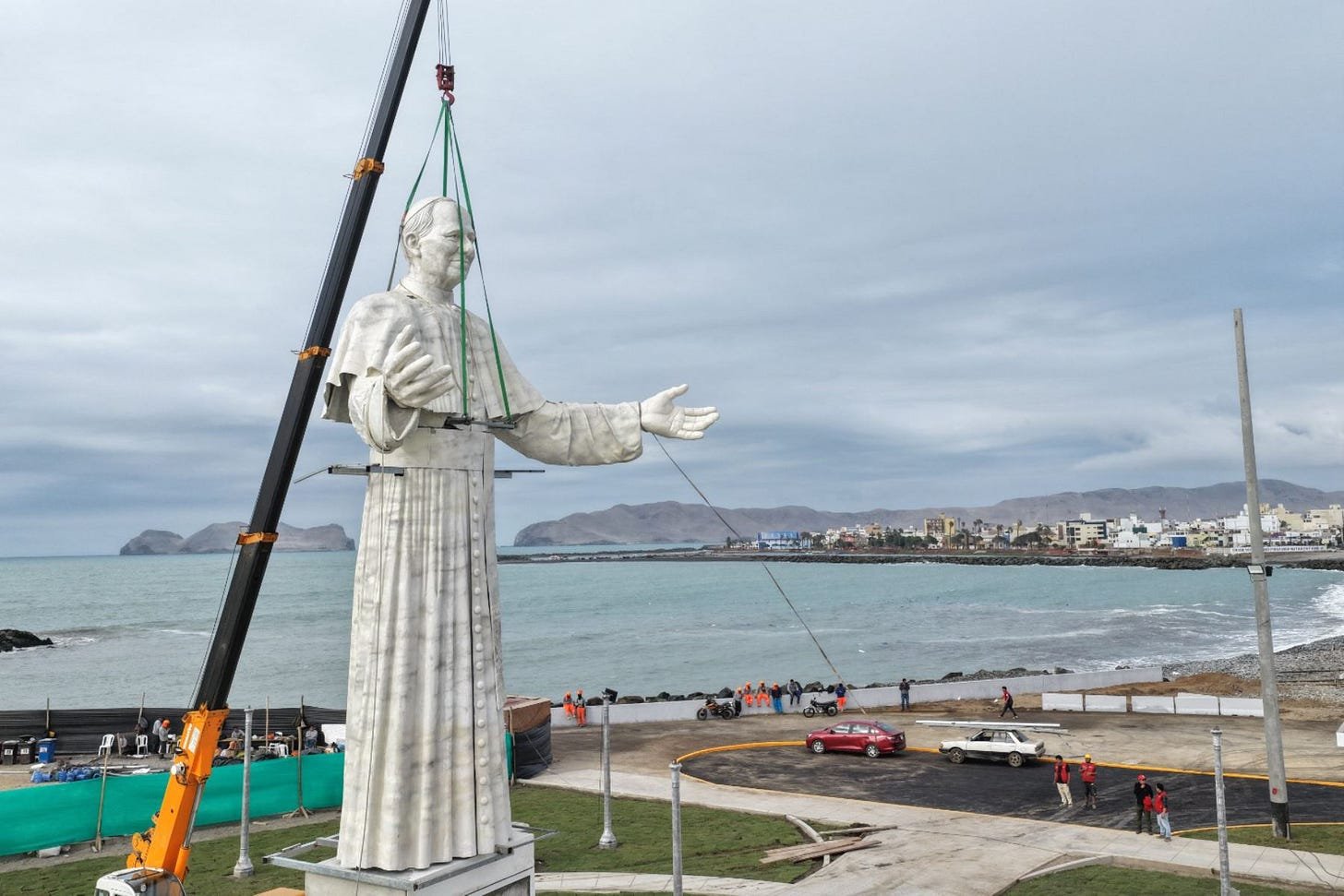
The accounts of the pope’s visit to Peru read like a homecoming, at the heart of a Catholicism brimming with warmth that contrasts with the somewhat bureaucratic image of the Vatican and the Roman Curia. In Peru, Prevost joked with the faithful, displaying—according to many—a tenderness he had not yet revealed in Rome, stifled by protocols and the inevitable comparison with his predecessor’s communicative prowess. In short, a salutary immersion in the crowd (according to the Holy See, local authorities estimated up to one and a half million people at the pope’s final Mass in Lima on 16 November), a return to the primordial broth of faith at a personally delicate moment for Prevost, following major lung surgery.
Preferisco i giorni feriali is a reader-supported publication. To receive new Posts and support my work, consider becoming a free or paid subscriber.
It was thus a grand image-building exercise, from which all controversy over abuses in the Church and the handling of victims was carefully excised—just as two months earlier in France. Leone XIV first publicly uttered a few words on the abuse issue before the bishops, then privately met with some victims. Here are the few words from his address to the bishops gathered at the Archbishop’s Palace in Lima on the morning of 12 November:
(…) allow me to address a reality that has caused us so much pain: the abuses perpetrated by members of the clergy or within the Church. We must respond as Jesus would, with truth, justice, forgiveness, reparation, and an ever stronger commitment to a culture of prevention and protection of the most vulnerable against such crimes.
Truth, justice, prevention (an evergreen slogan), forgiveness (a concept dear to Leone XIV, especially when extended to abusive priests), reparation (a word less familiar in ecclesiastical circles, particularly when it comes to translating into monetary compensation). A terse communiqué from the Holy See Bulletin then announced that in the afternoon, the pope had personally met with six abuse victims, some of whom came from the Sodalicio de Vida Cristiana, a Catholic organization founded in Peru in 1971 by Luis Fernando Figari and dissolved in April 2025 following decades of reports of sexual, psychological, and power abuses.
This afternoon, at the Apostolic Nunciature, shortly after 4:30 p.m., Pope Leone XIV met with six people who had suffered abuse at the hands of members of the clergy and ecclesiastical institutions in Italy, some of whom were former members of groups linked to the Sodalicio de Vida Cristiana.
After a brief greeting in the Nunciature chapel, the Pope met with each of them individually, listening to their stories of suffering and pain and reflecting together on how to promote a change of mentality through listening to victims, the pursuit of truth, healing processes, and a commitment to creating safe environments.
At the end of the meeting, as he took his leave, the Pope thanked them for their precious testimony and expressed his closeness to them and to all abuse victims whom he had not been able to meet. Before departing, the Pope imparted his blessing upon those present.The meeting lasted a little over an hour.
Listening, pursuit of truth, healing processes, safe environments—all commitments rigorously conducted behind closed doors, as were the meetings with the victims. In Lima, the pope also added, as part of the usual script, that he expressed his closeness to those he had been unable to meet. As if there had been external and independent impediments rather than an intention to keep uncomfortable victims at arm’s length, as denounced by José Enrique Escardó, one of the first to expose the Sodalicio. As reported by El País, Escardó argued that «no victim of the Sodalicio’s abuses was invited to meet the Pope during his visit to Peru»:
Escardó recalled that since Pope Leone XIV’s election in May 2025, some survivors have sent letters to the Vatican requesting an audience, without receiving any response. Escardó questioned the words Leone XIV addressed to the Peruvian bishops on Thursday morning regarding the need to address abuses within the Church. «In the morning there were words, and in the afternoon actions. Actions that proved those words were hollow,» he stated. Escardó attributes his exclusion to the president of the Peruvian Bishops’ Conference, Carlos García Camader, and the Apostolic Nuncio, Paolo Rocco Gualtieri. García Camader denied having prevented the participation of whistleblowers and insists that the agenda is determined by the Holy See.
But that is not all. Read on as El País continues:
With the slogan «The Church’s silence hurts as much as the original abuse», some abuse victims committed by members of the Church began on Thursday to gather outside the Apostolic Nunciature in Lima to protest the failure to grant them a private audience with the Pope. (…) The demonstrators, brought together by the Survivors Network of Peru, are demanding justice, compensation, and effective measures against what they describe as a «cover-up» within the Church.
As had already happened in Argentina, the controversy over who selected the chosen few for the customary meeting spared neither the episcopal palaces nor the Apostolic Nunciature. Adding to the mix is Jordi Bértomeu, a Vatican official from the Disciplinary Section of the Dicastery for the Doctrine of the Faith, the Vatican’s 007 against abuse, who played a central role in the Vatican’s investigation into the Sodalicio, in an interview with the Spanish Catholic weekly Alfa y Omega. He further muddies the waters regarding who made the final decision:
«In my case, I was asked to suggest criteria to follow in organizing the meeting, even proposing some names. Subsequently, other Vatican bodies made the final decision, taking into account numerous factors of which I am not fully aware.»
The entire interview is highly revealing, as it provides Bértomeu’s perspective on the entire Sodalicio affair, which we now see is far from concluded, as the thorny issue of compensation is now coming to the fore. At the end of the interview, the Vatican official lets slip a comment about the pope that sounds like an excusatio non petita:
I place my hope in Leone XIV (…). I have known him since he was bishop in Chiclayo and chaired the prevention commission of the Peruvian Bishops’ Conference. Later, I witnessed the media persecution he endured precisely because of his commitment to justice in the Sodalicio case. A persecution that reached all the way to the doors of the Conclave.
It is by now a familiar refrain. Indeed, it is not the first time Bértomeu has defended the pope; we had already heard him at the start of the sixth episode of the podcast La Scomunica tell Catalan television on 10 May 2025 that the allegations of a cover-up levelled against the newly elected pope were entirely false:
In essence, Bértomeu argues that it was the Sodalicio’s friends who smeared the neo-pope, the former bishop of Chiclayo in Peru, because they hated Prevost for having always sided against Figari and his circle.
And the case in point is that of the three Quispe sisters from Chiclayo. This is the skeleton in the closet that keeps Prevost awake at night, as we explained here, and which tries the patience of his friend Bértomeu. In brief, here is what happened: on 5 April 2022, the three Quispe sisters reported to then-Bishop of Chiclayo, Robert Francis Prevost, the abuses they had suffered at the hands of priests Eleuterio (Lute) Vásquez Gonzáles and Ricardo Yesquén. According to the diocese’s account, a regular investigatio praevia was launched, and at its conclusion, Vásquez Gonzáles was barred from exercising his priestly ministry. No mention was made of the other priest. On 21 July 2022, the findings of the investigation were sent to the Holy See.
Meanwhile, the three sisters also turned to civil justice, which dismissed the case relatively quickly. The reason, according to the diocese’s later account, was twofold: the statute of limitations on the crimes and insufficient evidence. On 3 July 2023—precisely as Prevost was taking up his new post in Rome as Prefect of the Dicastery for Bishops—the Diocese of Chiclayo also sent the Holy See the ruling of the Peruvian judiciary to dismiss the case. A little over a month later, on 10 August, the Dicastery for the Doctrine of the Faith dismissed the case.
But the three sisters vehemently contest this version of events. They accuse Prevost and the diocese of lying about the opening of the investigatio praevia, claiming that no investigation was conducted in 2022. According to the Quispe sisters, the diocese waited nineteen months—from April 2022 to November 2023—before taking action. In the meantime, Father Lute continued to celebrate Mass, later being transferred from one parish to another. In November 2025, the latest twist: Father Lute received a dispensation from Prevost, the so-called dispensatio ab oneribus or «grace of dispensation from clerical state», a Vatican practice that Giorgio Meletti explained in detail in this article:
«Here’s how it works: if a priest is on trial for sexual violence against minors before the DDF tribunal, he can ask the pope to be (even provisionally) laicized. This way, the trial ends as if the defendant were dead, since where there is no longer a priest, there is no longer an ecclesiastical trial. The Quispe sisters were informed of Lute’s request for «grace» through the grapevine just two days after Bergoglio’s death, prompting them to naively appeal to the new pope not to grant the so-called «grace», which would have denied them their right to justice. Prevost, doubtless after ample discernment, simply couldn’t care less about the three violated girls and granted his old friend Father Lute his grace. The news reached the Quispe sisters on a slip of paper (a bit crumpled, they say) because Prevost has refused to meet them for five years (…).»
The Peruvian investigative journalist Santiago Roncagliolo, author of the recent biography of Prevost entitled «El pastor y los lobos» [«The Shepherd and the Wolves»], in an interview with the BBC in recent days offered a cautious, almost ambiguous, but ultimately firm assessment of the handling of the Quispe case: «In reality, the method was not very orthodox; but proceeding differently would have compromised all of Prevost’s other investigations.» In short, Roncagliolo seems to suggest that even for a pope, noble ends can sometimes justify deplorable means. Yet he notes that Prevost’s ambiguities have weighed heavily on his Latin American visit: «Surprisingly, the issue of sexual abuse is his weak point.»
And so, on 13 November, Robert Prevost—now Leone XIV—returned to Chiclayo, the Peruvian diocese he led from 2015 to 2023, the place where, as he himself declared, he would have liked to remain forever. The welcome, as we have seen, was triumphal, with a million people lining the streets and 500,000 faithful attending the Mass celebrated on the Pampas de Pimentel plain under a blazing sun. But trouble had preceded him in the form of an open letter signed by Anne Barrett Doyle, co-director of the U.S. organization BishopAccountability, which peremptorily demands that the pope open the Church’s archives, make public the names of accused priests, and ensure assistance and compensation for victims. The letter explicitly cites the cases of three priests, including Eleuterio Vásquez (Father Lute) and Ricardo Yesquén, denounced by the Quispe sisters:
«When you were bishop of Chiclayo, you called for an end to secrecy in abuse cases. «We reject cover-ups and secrecy,» you stated in a 2019 interview , stressing that they «cause great harm».
Unfortunately, however, the abuse cases in Chiclayo during your eight years as bishop have been shrouded in mystery, and this cover-up persists to this day. Your successor, Bishop Edison Edgardo Farfán, refuses to inform the public about abusive priests and, it seems, denies victims reimbursement for therapy. Furthermore, the public condemnation of a survivor, Ana María Quispe, has doubtless silenced other abuse victims in Chiclayo.
This deplorable situation must be remedied. You must order Bishop Farfán to make public the names of clergy members who have admitted or been credibly accused of sexual abuse. You must order him to make public the diocese’s documents relating to these cases. You must also compel him to pay for victims’ therapy and to remove any obstacles to their path.»
Barrett Doyle goes on to cite the cases of three priests from the diocese, with a detailed account of the accusations and suspensions, before addressing the pope directly:
«Finally, Your Holiness, we respectfully urge you to reconsider the outstanding issues and to give a frank account of your response to abuses during your time as Bishop of Chiclayo, beginning with the accusations against priests Alfonso Obando, Eleuterio Vásquez, and Ricardo Yesquén.»
I reached Anne Barrett Doyle on the plane that would take her back home and she commented on Prevost’s silence as follows:
«The pope did not respond to our letter.
We had held out a small hope that he would show compassion for the victims of Chiclayo and instruct the bishop to pay for their therapy.
As far as I know, he has taken no initiative.
He had the opportunity to take a bold step, showing other bishops what true transparency really means.
Instead, when it comes to child sexual abuse in the Catholic Church, all that Pope Leone did in Peru was utter a few perfunctory phrases and take part in a carefully stage-managed meeting with a handful of victims.
His interventions were modest and purely formal.
We fear that as Robert Prevost has gained more power, he has also become more cautious—at least when it comes to abuse.»
International networks of clergy abuse survivors, SNAP and Ending Clergy Abuse, have also demanded transparency, justice, and compensation for victims. The pope, however, perhaps deafened by the crowd’s jubilation, has not heard a word of it. He did not meet the Quispe sisters, even though the eldest, Ana Maria, has repeatedly asked to meet him in Rome. Now that Prevost has come to his home turf, as the saying goes, he has trampled all over them without so much as a greeting.