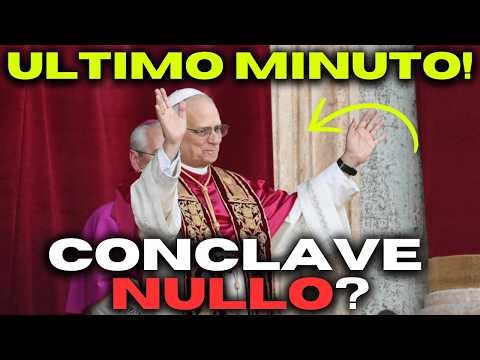
A Vatican tribunal is examining at this very moment something potentially earth-shattering, the validity of the election of the Pope. It is not a civil proceeding, it is not an opinion. It is an official canonical inquiry, ongoing today. By the end of this video you will have all the elements to understand why this news could be the most important of the last 12 years for the Catholic Church.
On April 14, 2026 John Henry Westen of LifeSite News published an exclusive scoop. The Vatican Tribunal confirmed an ongoing investigation into the validity of Benedict XVI's resignation. It is not a hypothesis. It is a formal inquiry, confirmed by the juridical structure of the Holy See. The investigation arrives at a moment of growing tension between the United States and the Vatican.
There already exists a petition on Life Petitions requesting President Trump to initiate a government investigation into possible American intelligence interference in the 2013 resignation and in the conclave that elected Francis. The question is emerging from canonical circles to enter into international political debate.
On that same April 14, former Italian magistrate Angelo Giorgianni sent a formal "Parere pro veritate" to Cardinal Parolin, Secretary of State of the Vatican. In that document, Giorgianni lists four canonical defects that render null and invalid the conclave of May 7 and 8, 2025. The first defect, 133 cardinal electors at the conclave, 13 beyond the maximum limit of 120 provided for by the Apostolic Constitution Universi Dominici Gregis.
A limit that was not overridden by any official act. The second defect, 108 of those cardinals were appointed by Francis. According to a growing current of canonists, Francis was not the legitimate pope and therefore those 108 cardinals were not valid cardinals. The third defect, after the extra omnes, the closing of the doors of the Sistine Chapel, a cellphone was found in the possession of an elector cardinal, violating the conclave secrecy. The fourth defect, reported yesterday by Giorgianni in a second letter to Parolin, a cardinal abandoned the conclave before its conclusion. Four irregularities, four separate and distinct grounds for canonical nullity.
To understand the why of all this, we must return to February 11, 2013, the day Benedict XVI pronounced words that the entire world interpreted as a farewell, but which perhaps were something completely different. Andrea Cionci is an Italian journalist and art historian. For six years he has devoted himself to a single question. Did Benedict XVI truly abdicate? His book, Ratzinger Code, sold 25,000 copies and won two international journalistic awards. His research is founded on over 1,500 articles, 2,800 podcasts, 185 conferences and 55 petitions. He is not an amateur, he is a systematic researcher who has built a documentary case step by step.
Cionci argues that the Declaratio, pronounced by Ratzinger on February 11, 2013 was not an act of abdication. It was a decisio, a decree by which the Pope announced the impeded see and the coming usurpation of the papacy. Ratzinger declared himself to be in the condition of an impeded Pope, Ratzinger declared himself to be in the condition of an impeded pope, prevented from freely exercising his office, but not bereft of that office.
The historical comparison that Cionci proposes is precise. Alfonso XIII of Spain, in 1931, left the country without abdicating. He went into exile to protect the legitimacy of the crown from revolutionary pressure. Cionci argues that Ratzinger did the same, a papal exile to preserve the legitimacy of the Petrine munus.
The characteristic canonical distinction is fundamental. A Pope may renounce the ministerium, the practical exercise of power, without renouncing the munus, the sacred office of the papacy. Benedict XVI, in his Declaratio, used the word ministerium, not munus. For Cionci that lexical choice was not casual.
It was a message for those versed in canon law. The consequences of this reading are canonically devastating. If Benedict XVI never abdicated, the throne of Peter never became vacant. Francis was not the Pope, he was an antipope. And if Francis was an antipope, all his acts are canonically null, including the 108 cardinals created by him, including Traditionis Custodes, which suppressed the traditional Mass, including Fiducia Supplicans, everything.
Cionci has publicly challenged anyone to refute this logical chain, even in legal proceedings. I am ready to answer for what I have stated even before Leo XIV in person, should he wish clarification. It is not rhetoric, it is the position of one who knows he can defend every step with documentary evidence.
And now, for the first time, a Vatican tribunal seems to take up that challenge. The investigation confirmed by LifeSite News is not a rumor. It is a formal act of the juridical structure of the Holy See, a recognition that the question deserves official examination. However, there is a second level to this story. Giorgianni has formally asked the Vatican to make public the official minutes of Leo XIV's election to transparently verify how the voting took place. The Vatican, so far, has not responded.
There are the words of Cionci that no one has yet refuted in academic or legal proceedings. I challenge anyone to contest what I have said. I challenge anyone even in legal proceedings. These words have remained unanswered for years. Now that a Vatican tribunal has opened the inquiry, that challenge becomes more urgent and those who have remained silent must speak.
The question that every canonist who takes this investigation seriously asks is only one. If the conclave is null even for just one of the four defects denounced, Leo XIV is not the canonically elected Pope and in that case the see is still vacant. According to the logic of canon law that emerges from this investigation, there exist today 25 authentic cardinals, those appointed by John Paul II and by Benedict XVI before 2013. They are the only ones who would have the right to gather and elect a legitimate pontiff.
Traditionalist faithful understood this years ago. Years of suppressed Mass with Traditionis Custodes, of progressive Bishops imposed, of doctrinal declarations incompatible with two thousand years of magisterium. The history of the Church has already seen this. Antipopes, schisms, contested conclaves for centuries.
The Church has always found the way out through fidelity to canon law and tradition. What makes this moment different is that for the first time it is a Vatican juridical body that confirms the investigation is underway. If the investigation were to confirm that the resignation was not valid, every Catholic faithful will find themselves facing a single question.
What do we do now? The answer is not in panic, it is in tradition. It is in the Mass of all time that no antipope has the power to suppress, because it belongs to Christ, not to men. Benedict XVI had an episcopal motto, cooperatores veritatis, collaborators of the truth, perhaps that truth is finally emerging even through the corridors of Vatican tribunals.