But the problem is not quantity but quality, that is, the selection criteria. We have already made reference here previously that on at least three occasions Francis preconized bishops in Argentina, they accepted the appointment and received due congratulations but, weeks later, they renounced consecration: skeletons in the closet was the reason commented upon, as it was also the case of the failed Indonesian bishop Pascalis Syukur: he was chosen cardinal by Bergoglio in 2024, joyfully accepted the designation, received gifts from the faithful and authorities, but a few days later resigned. We later learned that he maintained an amorous relationship with a woman with whom he had had two children. Pope Leo accepted his resignation as diocesan bishop a few months ago.
Everything seems to indicate that Francis appointed bishops to priests he found sympathetic or with whom he had some affinity, bypassing the usual selection procedures through the nunciatures. The most patent case, as we say, is that of Argentina, in whose episcopate we detected a series of curiosities. For example, all the Jesuits who in the 1980s constituted the group of Bergoglio's followers opposed to Fr. Víctor Zorzín, provincial of the Society imposed by the general superior Hans Kolvenbach, are now bishops. Another: during the years when Bergoglio was provincial and then rector of the Colegio Máximo, he was concerned that as many religious congregations as possible would send at least one candidate there to study. These, once ordained, were unofficial "correspondents" (spies, some say) of Bergoglio in their respective institutions. Well then, many of them are currently bishops. And although the procedure of appointing bishops by sympathies, friendships or affections may be very medieval, it is nonetheless very dangerous. And the consequences of having bad shepherds are not borne only by the faithful and priests, but Francis himself had to drink from his own medicine on several occasions.
Let us see a particular case: Msgr. Jorge García Cuerva. Born in 1968, he was chosen auxiliary bishop of Lomas de Zamora in 2017, then transferred to the see of Río Gallegos, in far southern Patagonia, and finally to Buenos Aires in 2023. Although he developed part of his pastoral work as a priest in a shantytown, he was not properly a "shantytown priest"; these are much better. However, García Cuerva was concerned with appearing as a priest with smell, much smell, of sheep. A self-perception that he did not miss the opportunity to publicize. Even, like Pope Francis himself, he received supernatural signs. It is known that the pontiff was very devoted to Saint Thérèse of the Child Jesus and said that when the saint granted him a grace, she sent him a white rose first. Of course in all cases the only witness to the floral present was Bergoglio and it was he who made it known. Jorge García Cuerva did not want to be left behind, and he himself told a journalist that he received a sign from the Virgin by which she made known her approval of the spiritual appointment. But this case was not a rose, nor even melted snow water or a retama flower: it was a leaf of purple cabbage.
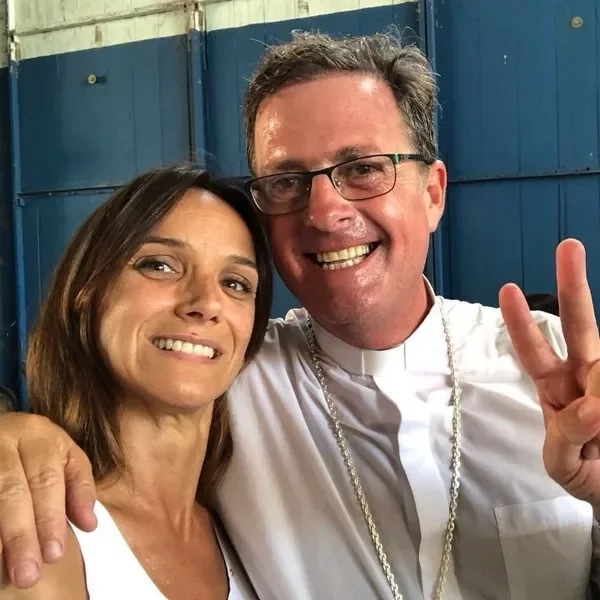
It is at least curious that Pope Francis would choose as bishop a priest whose ordination, according to the clergy of San Isidro, would have been deferred by his bishop—we will avoid detailing the reasons—, presented himself as a Peronist, celebrated militant masses and maintained close friendship with the most corrupt Peronist hierarchs and defenders of the worst causes—the legalization of abortion, for example—as is the case with Malena Galmarini, with whom we see him in the photo embraced and making the V sign of Peronism. Furthermore, in 2014 he was the protagonist of a scandal for many faithful when he baptized in the church of the Blessed Sacrament (the most elegant and refined in Buenos Aires) the children of a well-known transvestite, Florencia de la V, "married" to another man. It was not surprising then that in 2021, a Salesian priest from his diocese "married" with pomp and circumstance—the high authorities of the province attended the religious ceremony, headed by the governor—a transvestite to a non-transvestite man. Although Msgr. García Cuerva said he had not authorized it, the episode was never clear and the priest received merely a warning. In short, Msgr. García Cuerva did not have the necessary credentials to access what was then the primatial see of Argentina. Why then was he chosen by Francis?
There was, of course, a political intentionality, as there was in any gesture or decision of the pontiff. A year after his nomination, there were presidential elections in Argentina and the Peronist candidate would be Sergio Massa, husband of Galmarini and personal friend of García Cuerva. It was a little gift from Bergoglio to his Peronist friends and a way to obstruct the arrival of another candidate. Certainly, the strategy did not work for him.
But the most important reason was another. In July 2022, the Vatican completed an financial audit of the archdiocese of Buenos Aires in which, for rather delicate reasons, it reprimanded Cardinal Archbishop Mario Poli and several priests for the sale of a property. Of course, the report had the acquiescence of Pope Francis. It was published in the national media generating a major scandal as was foreseeable and, most seriously, the Vatican accusations were unfounded. A few days later, Cardinal Poli published a letter in support of the priests defamed by Francis's Vatican, and 250 priests from the archdiocese wrote another letter in support of those same priests, attesting to their honesty and good faith. As anyone might suppose, this infuriated the Roman pontiff who did not delay, following Juan Domingo Perón, in "making the punishment resound". Barely 5 months after turning 75, he removed Cardinal Mario Poli from the Buenos Aires see and appointed his successor in the person of the then bishop of Río Gallegos, Msgr. Jorge García Cuerva. The move was interpreted as pontifical revenge against the humiliated archbishop and against the Buenos Aires clergy who had defied him with the letter.
The natural candidate to succeed Poli was Msgr. Carlos Azpiroz Costa, O.P., who had been Master of the Order of Preachers and was—and is—archbishop of Bahía Blanca. This is a formed and balanced person who had all the credentials for the position. García Cuerva, for his part, was not only disliked by the Buenos Aires clergy but was detested in many quarters. Francis knew this and this was then his revenge: to place as archbishop someone who would cause permanent irritation in the clergy. What he did not expect was that, shortly after the appointment, he would cause irritation in him as well.
It is known that Francis, a few months after the fateful appointment, regretted his choice. He made this known to his entourage according to Vatican sources. Moreover, the same sources assure that everything suggested that Msgr. García Cuerva was going to meet the same fate as his friend Msgr. Gabriel Mestre, appointed archbishop of La Plata in 2023 and forced to resign less than a year later. However, death surprised Bergoglio before he could execute the punishment.
Everything was prepared. In the second half of 2024 he had sent an extensive letter to Msgr. Jorge García Cuerva in which he detailed his disagreements with the measures he was taking despite having agreed on others together. It was not, of course, a matter of minor things like orthodoxy in doctrine or morals. It was a matter of truly important things such as García Cuerva's notorious avidity for money.
Part of the disagreement was the archbishop's duplicity. While he said publicly that
"work is a great social organizer, work dignifies people", and he asked Saint Cajetan for "all the workers of our Homeland, for all of them, because as the Church, we value all forms of work: formal employment, family enterprises, the popular economy, recycling, odd jobs"
he dismissed more than 130 employees of the Buenos Aires archdiocese.
Shortly thereafter, he ordered the closure of the House of the Clergy, on Paraguay and Rodríguez Peña streets, where priests who literally had nowhere to live resided, and some of them elderly or infirm, yielding the enormous building on loan to the Government of the City of Buenos Aires. Odd, very odd…
"We are guardians of the disabled and of all the sick",
said the archbishop.
The Pope also did not like the works that Msgr. García Cuerva undertook in the archbishop's palace. For example, the repair of the third floor where Bergoglio and Cardinal Poli had previously lived. And, worse still, the work had to be done again because it had not pleased the archbishop. And despite the new arrangements, Msgr. García Cuerva remained displeased so he ordered an early twentieth-century Italian palazzo at 2383 Baldomero Fernández Moreno street in the Flores neighborhood to be renovated to establish his residence there. Pope Francis, in the letter to which we refer, expressed his displeasure with such expenditures and indicated that he should reside in the Curia, located at 415 Rivadavia Avenue, as his predecessors had done.
All these decisions by Msgr. García Cuerva explain the reason why Pope Francis removed the primatial see from Buenos Aires transferring it to the insignificant see of Santiago del Estero, citing an unsustainable historical reason, appointing cardinal his archbishop, the Lazarist Vicente Bokalic who had been his student at the Colegio Máximo, and leaving García Cuerva without the longed-for purple hat.
Msgr. García Cuerva's greed did not stop after Francis's death but rather, on the contrary, was strengthened. As Grand Chancellor of the Pontifical Catholic University of Argentina, he decided to found a new university campus, which he called "North Zone", located within the facilities of Nordelta. The measure is not bad, but anyone knows the enormous amount of money that will be generated by a prestigious university center in the area that concentrates the newly rich and those aspiring to be so from all of Buenos Aires. Would he have dared such a measure with so little smell of sheep during Francis's pontificate?
But the agreement that has given the most to talk about, and rightly so, is the one regarding Luna Park. Let us recall that this enormous and historic entertainment venue located in a privileged location in the city of Buenos Aires was left in inheritance by the widow of its founder and owner to Caritas, an entity administered by the archdiocese of Buenos Aires, and to the Salesian congregation. Pope Francis had frozen the signing of the expansion and renovation project that would convert it into a new and modern building dedicated to holding shows of all kinds, sanctos and non sanctos, also laden with the history of the legendary Luna Park. But we know that when the king dies... things change. Msgr. Jorge García Cuerva obtained the signature and authorization for the reforms from Leo XIV on his last trip to Rome, news of which the archbishop himself took care to publish. "Of course it helped unblock some of the many situations we have", he said.
What most caught the attention is that Luna Park is a national historical monument and is under the care of the patrimonial protection of the city of Buenos Aires, how was it possible then that Head of Government Jorge Macri, friend of Jorge García Cuerva, would authorize the interventions that would completely modify the building? Some malevolent priests of Buenos Aires maintain that it is payment for the delivery of the House of the Clergy to the City.
But Msgr. García Cuerva's misdeeds are not limited to economic matters. We said that the Buenos Aires clergy did not want him and do not want him. He knows this and for that reason he exercises an authoritarian style over his priests and those over 45 years old, he ignores or mistreats them, an attitude that intensifies with those who are elderly. The paradigmatic case is that of Msgr. José Luis Mollagham, 79 years old, who was found dead after 4 days in the apartment where he lived. Iam foetet… It was the neighbors who alerted the police to the fact.
We have taken a witness case; a bishop appointed by Francis without having the minimum conditions for the position, who has left no outrages uncommitted in the exercise of his ministry. And if we were to look at his colleagues in Greater Buenos Aires, we would see that many of them possess the same pedigree: militant Peronists, members of some colored mafia that we will not name, and with less than scant theological formation.
May God have mercy on Pope Francis's soul and forgive him all his sins.