The Vatican Publishing House today, May 4, published Free Under Grace: In the School of St. Augustine Facing the Challenges of History.
It is said to gather together texts written by Robert Francis Prevost during his tenure as Prior General of the Order of St. Augustine from 2001 to 2013. The collection reportedly offers a look at the reflections of Leo XIV prior to his election, assembling for the first time his speeches, homilies, letters, and messages from his years leading the Augustinian order. According to media reports the volume provides insight into both his theological perspective and spiritual development before becoming “Pontiff’.
I am sure it will be the usual post-conciliar yawn-fest, as these types of books usually are, but what is interesting is what the progressive media platforms, such as Katolsich.de, had to say about it.
I quote at length from the German publication:
“The current Pope Leo XIV was apparently once strongly influenced in his thinking by ideas and concepts of Latin American liberation theology. This is evident from older speeches that have now been published in a book released on Monday.
Among other things, it documents a speech given by the then Prior General of the Augustinian Order, Robert Prevost, on March 2, 2002, in the Peruvian Amazonian city of Iquitos. At that time, Prevost said: “The reality of unjust poverty and marginalization is one of the most pressing problems of the world today, and not only in the ‘Third World’.” He continued: “No one can be a Christian today and escape the ‘cry of the poor’ and the fight for justice. The impoverishment of millions of people is a true ‘sacrament’ of sin in the world.”
Elsewhere in his speech he states: “Development is an integral part of evangelization; pastoral activity transcends the boundaries of what is merely ‘religious,’ in accordance with the Church’s social teaching and the urgency of the special option for the poor. This must apply not only to indigenous peoples, who are often the poorest of the poor (...), but also in the face of every form of exclusion that violates human dignity”…”
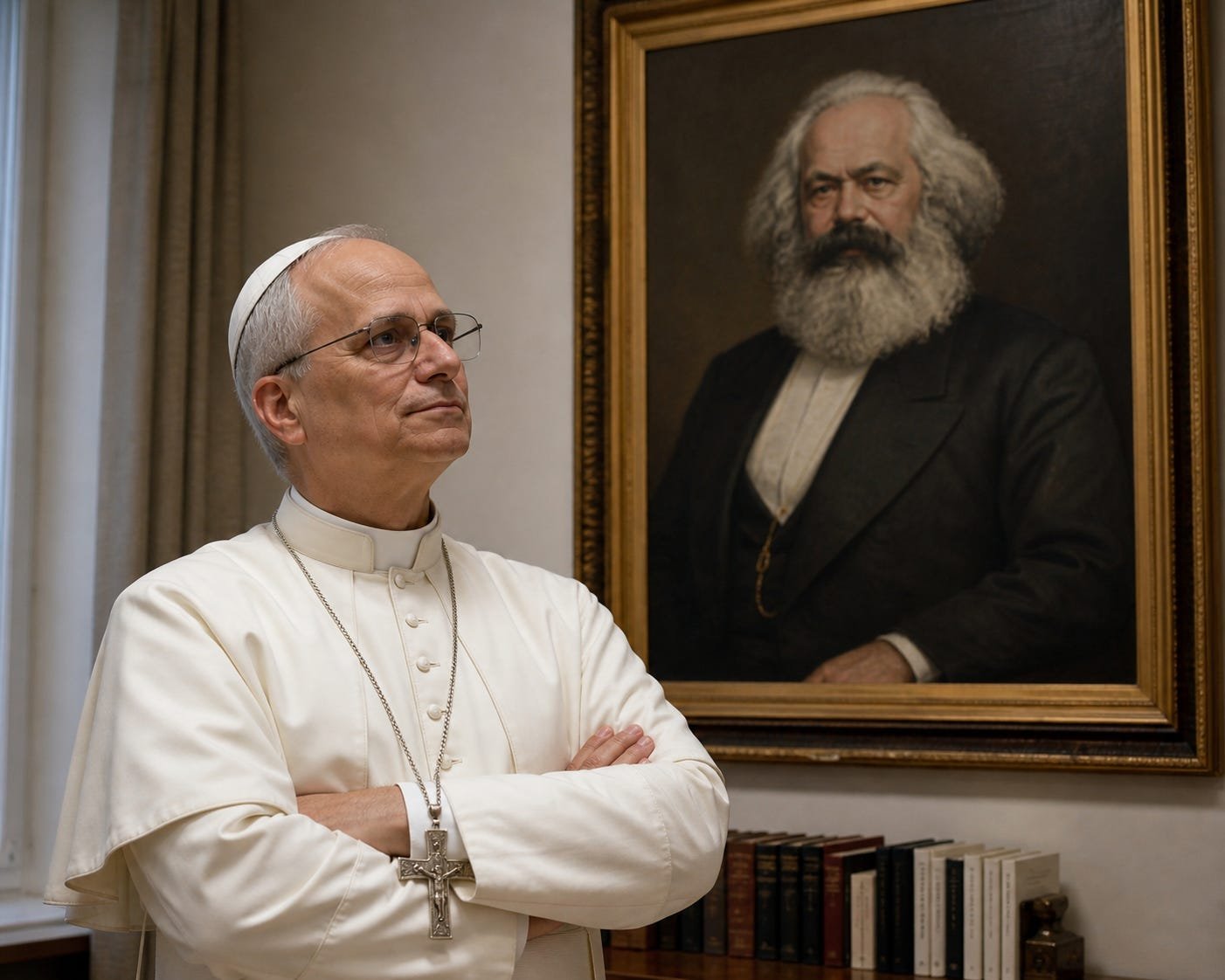
This observation by Katolisch.de is accurate and not surprising considering that Prevost was groomed by the crypto-Marxist heretic Bergoglio, and most likely a plant to advance globalist antichrist ideology. But let us take a look at exactly why this is problematic.
Liberation Theology is a theological movement that emerged in Latin America in the mid-twentieth century, most prominently associated with figures such as Gustavo Gutiérrez and Leonardo Boff. It seeks to interpret the Gospel through the lived experience of the poor and oppressed, emphasizing that the Christian message entails not only spiritual redemption but also the transformation of unjust social, political, and economic structures. Central to its approach is the idea that God has a “preferential option for the poor,” and that the Church must actively participate in the struggle against poverty and inequality.
While this concern for justice reflects an authentic element of Catholic social teaching, the problem lies in the manner Liberation Theology articulates its vision. On investigation, it quickly becomes clear that one of its most significant dangers is its reliance on analytical frameworks derived from Marxism, particularly the notion of class struggle. By interpreting society primarily in terms of opposing economic groups—oppressors and oppressed—it reduces the moral and spiritual drama of human life to material conflict. Such a lens obscures the universality of sin, which affects all men regardless of social class, and fosters an adversarial worldview at odds with the Gospel’s call to reconciliation.
A further issue lies in the tendency to shift the emphasis of Christianity from the salvation of souls to the reordering of temporal conditions. According to Catholicism the root of human disorder is sin, and the primary mission entrusted to the Church is the reconciliation of man with God, not the creation of a Communist Utopia. Social renewal is indeed a fruit of the Gospel, but it must proceed from interior conversion. With this wretched “theology” the focus is placed predominantly on liberation from economic or political oppression, the supernatural end of man is eclipsed by temporal concerns, and the faith itself is reduced to a program of social activism.
Closely connected to this is the treatment of sin under the category of “structural injustice.” While it is true that unjust systems can perpetuate wrongdoing, sin remains fundamentally a personal reality, rooted in the free will of the individual. This overemphasis on structures diminishes the sense of personal moral responsibility and weaken the call to repentance, something that has become dogmatic in the Synodal Church. In such a framework redemption is portrayed as emancipation from external conditions.
Questions also arise regarding the interpretation of Sacred Scripture. When the Bible is read primarily through the lens of socio-economic struggle, certain themes—such as liberation from oppression—may be accentuated at the expense of others, including sacrifice, grace, and eternal salvation, which again we see repeatedly in the literature and documents of the Synodal religion.
Finally, the ecclesial implications are not insignificant. In some instances, the movement has fostered forms of organization that operate with a degree of independence from hierarchical authority and align closely with particular political agendas, instead of demanding that political structures should align with the Kingship of Christ. This blurs the distinction between the mission of the Church and the aims of temporal movements, potentially compromising both doctrinal unity and the Church’s supernatural identity.
It is thus clear that Liberation Theology is one of the most damning pieces of evidence pointing to the fact that the Synodal Church is nothing more than the religious arm of Global Communism and the New World Order, and that the false religion it promotes is communism under a thin veneer of Catholicism.
Our Lady of Fatima warned us that the errors of Russia would spread, and with Liberation Theology and its proponents we can see just how entrenched they have become in the structures of the Church which are now occupied by enemy forces.
Equally important is to realize then, in the light of this, in exactly whose service men like Bergoglio, Prevost, and their cronies stand.
Man’s ultimate liberation is from sin, and this liberation is found in Christ.
Not in Karl Marx and class struggle, as the Synodal hierarchy secretly wants you to believe.