(Photo credit: Vatican Media)
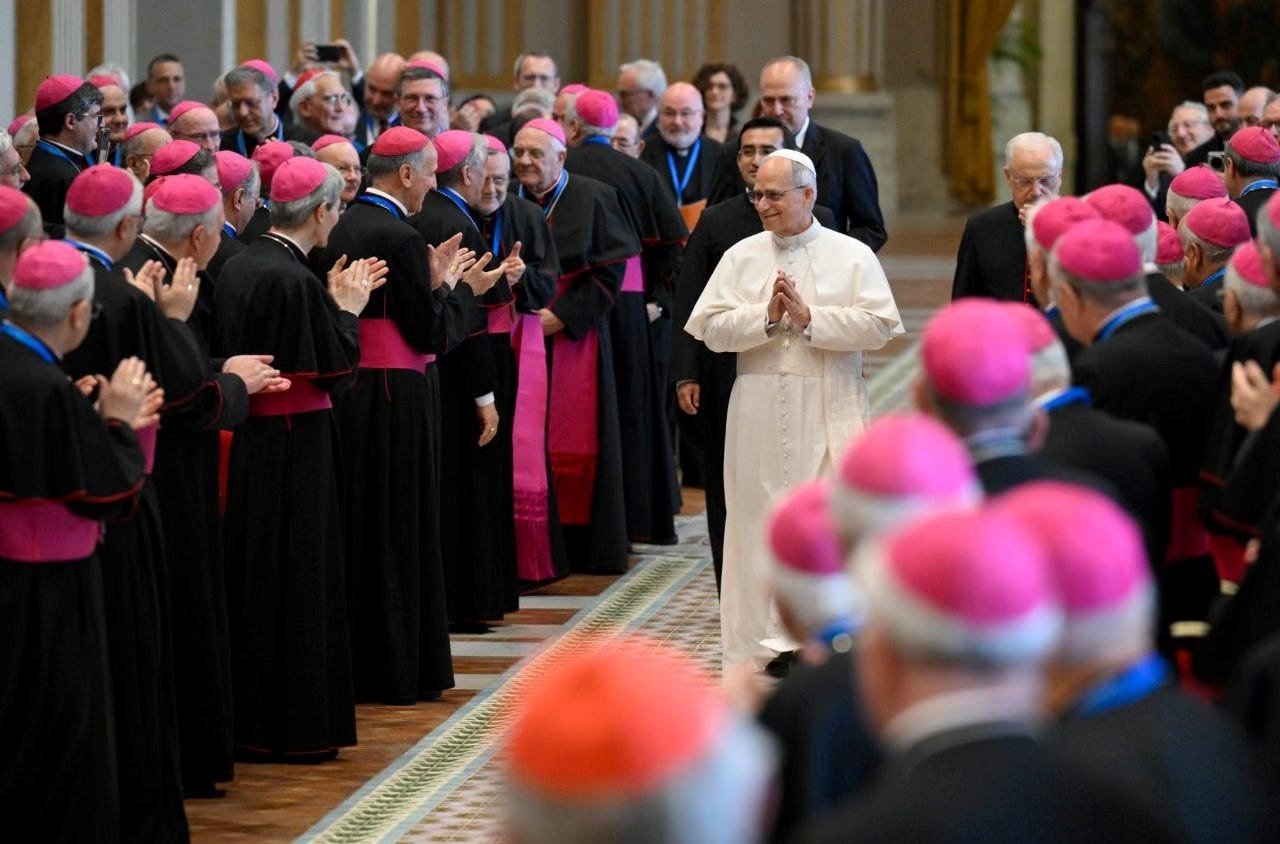
VATICAN CITY, March 19, 2026 — Pope Leo XIV today announced that he will convene a meeting of the presidents of Episcopal Conferences in October 2026 to undertake a new phase of “synodal discernment” on the future of family ministry.
The announcement came in a message marking the tenth anniversary of Amoris Laetitia, Pope Francis’s post-synodal apostolic exhortation on the family. Chapter 8 of Amoris Laetitia sparked considerable controversy by greenlighting case-by-case pastoral discernment for divorced and civilly remarried Catholics, including possible access to Holy Communion.
Pope Leo framed the upcoming gathering as a continuation of the “synodal” process, emphasizing “mutual listening” among Church leaders and attentiveness to the lived experiences of families.
In his message, the Pontiff expressed gratitude for the pastoral and theological impact of Amoris Laetitia, describing it as a “luminous message of hope” that has inspired reflection and renewal across the global Church. He reiterated the enduring teaching of the Second Vatican Council that the family is the “basis of society” and a “domestic church,” central to the transmission of faith.
Pope Leo situated Amoris Laetitia within the broader trajectory of Church teaching alongside John Paul II’s Familiaris Consortio, noting how both have shaped pastoral care for families, married couples, and young people. He underscored that contemporary “anthropological and cultural changes” require new pastoral approaches, echoing Pope Francis’s call for greater engagement with the real experiences, struggles, and hopes of families.
Yet critics of Amoris Laetitia contend that it departs significantly from Familiaris Consortio by allowing Communion in some cases after pastoral discernment, despite John Paul II stating (FC n. 84) that the Church “reaffirms her practice … of not admitting to Eucharistic Communion divorced persons who have remarried” because their situation “objectively contradict[s] that union of love between Christ and the Church.”1
The Pope’s message today highlighted key themes of Amoris Laetitia, including the need to accompany families through crises, promote the growth of conjugal love, and embrace human fragility as part of the Christian vocation. Pope Leo stressed the importance of developing new pastoral methods, improving the education of children, and fostering a spirituality rooted in everyday family life.
He made only brief mention of AL Chapter 8, highlighting Pope Francis’s call to “accompany, discern, and integrate fragility… overcoming a reductive conception of the norm, and to promote ‘the spirituality that unfolds in family life’ (AL 313).”
Acknowledging the challenges faced by families worldwide—including poverty and violence—Pope Leo called for sustained support from pastors, lay movements, and Church institutions. He also emphasized the role of families themselves as agents of evangelization, particularly where they are the primary witnesses of faith.
The October 2026 meeting, he said, will serve as a forum to evaluate current pastoral practices across local Churches and to discern next steps in light of Amoris Laetitia. Yet the gathering could also reignite sharp debates over some of his predecessor’s most controversial documents—including Amoris Laetitia and Fiducia Supplicans—as presidents of episcopal conferences from regions such as Africa and Germany confront deeply divided views.
e) Divorced Persons Who Have Remarried
84. Daily experience unfortunately shows that people who have obtained a divorce usually intend to enter into a new union, obviously not with a Catholic religious ceremony. Since this is an evil that, like the others, is affecting more and more Catholics as well, the problem must be faced with resolution and without delay. The Synod Fathers studied it expressly. The Church, which was set up to lead to salvation all people and especially the baptized, cannot abandon to their own devices those who have been previously bound by sacramental marriage and who have attempted a second marriage. The Church will therefore make untiring efforts to put at their disposal her means of salvation.
Pastors must know that, for the sake of truth, they are obliged to exercise careful discernment of situations. There is in fact a difference between those who have sincerely tried to save their first marriage and have been unjustly abandoned, and those who through their own grave fault have destroyed a canonically valid marriage. Finally, there are those who have entered into a second union for the sake of the children’s upbringing, and who are sometimes subjectively certain in conscience that their previous and irreparably destroyed marriage had never been valid.
Together with the Synod, I earnestly call upon pastors and the whole community of the faithful to help the divorced, and with solicitous care to make sure that they do not consider themselves as separated from the Church, for as baptized persons they can, and indeed must, share in her life. They should be encouraged to listen to the word of God, to attend the Sacrifice of the Mass, to persevere in prayer, to contribute to works of charity and to community efforts in favor of justice, to bring up their children in the Christian faith, to cultivate the spirit and practice of penance and thus implore, day by day, God’s grace. Let the Church pray for them, encourage them and show herself a merciful mother, and thus sustain them in faith and hope.
However, the Church reaffirms her practice, which is based upon Sacred Scripture, of not admitting to Eucharistic Communion divorced persons who have remarried. They are unable to be admitted thereto from the fact that their state and condition of life objectively contradict that union of love between Christ and the Church which is signified and effected by the Eucharist. Besides this, there is another special pastoral reason: if these people were admitted to the Eucharist, the faithful would be led into error and confusion regarding the Church’s teaching about the indissolubility of marriage.
Reconciliation in the sacrament of Penance which would open the way to the Eucharist, can only be granted to those who, repenting of having broken the sign of the Covenant and of fidelity to Christ, are sincerely ready to undertake a way of life that is no longer in contradiction to the indissolubility of marriage. This means, in practice, that when, for serious reasons, such as for example the children’s upbringing, a man and a woman cannot satisfy the obligation to separate, they “take on themselves the duty to live in complete continence, that is, by abstinence from the acts proper to married couples.”[180]
Similarly, the respect due to the sacrament of Matrimony, to the couples themselves and their families, and also to the community of the faithful, forbids any pastor, for whatever reason or pretext even of a pastoral nature, to perform ceremonies of any kind for divorced people who remarry. Such ceremonies would give the impression of the celebration of a new sacramentally valid marriage, and would thus lead people into error concerning the indissolubility of a validly contracted marriage.
By acting in this way, the Church professes her own fidelity to Christ and to His truth. At the same time she shows motherly concern for these children of hers, especially those who, through no fault of their own, have been abandoned by their legitimate partner.
With firm confidence she believes that those who have rejected the Lord’s command and are still living in this state will be able to obtain from God the grace of conversion and salvation, provided that they have persevered in prayer, penance and charity.