In a situation of total darkness of consciences, spanning from Trump to Netanyahu, from Putin to Zelensky, without excluding the European nations that have chosen to declare war on Russia, it is obvious that AI represents a deadly peril to humanity; yet this logical deduction, also known to Bill Gates, is beyond the grasp of Leo XIV, who, during the presentation of Magnifica humanitas (hereinafter MH) on 25 May, declared: «artificial intelligence now demands to be “disarmed”, freed from the logics that turn it into an instrument of domination, exclusion, and death». The encyclical was sponsored by the artificial intelligence company Anthropic, and on that same occasion, co-founder Chris Olah affirmed that he had «chosen this work driven by the desire to contribute to the well-being of humanity». China welcomed with enthusiasm the pacifist pleas of Prevost and Olah, indeed manufacturing humanoid robots ready to be deployed on the battlefield. In the very same conference, Leo XIV himself declared: «Magnifica humanitas was born from the act of listening, in the manner of Leo XIII. I have listened to scientists and engineers… political leaders and officials… parents and teachers». Alas, Prevost listens to many people, but not God, and the fruits are evident to the point that he writes: «Thus, as one believer among believers, I invite you to contemplate in the face of the Son a magnificent humanity which illumines even the age of AI» (233).
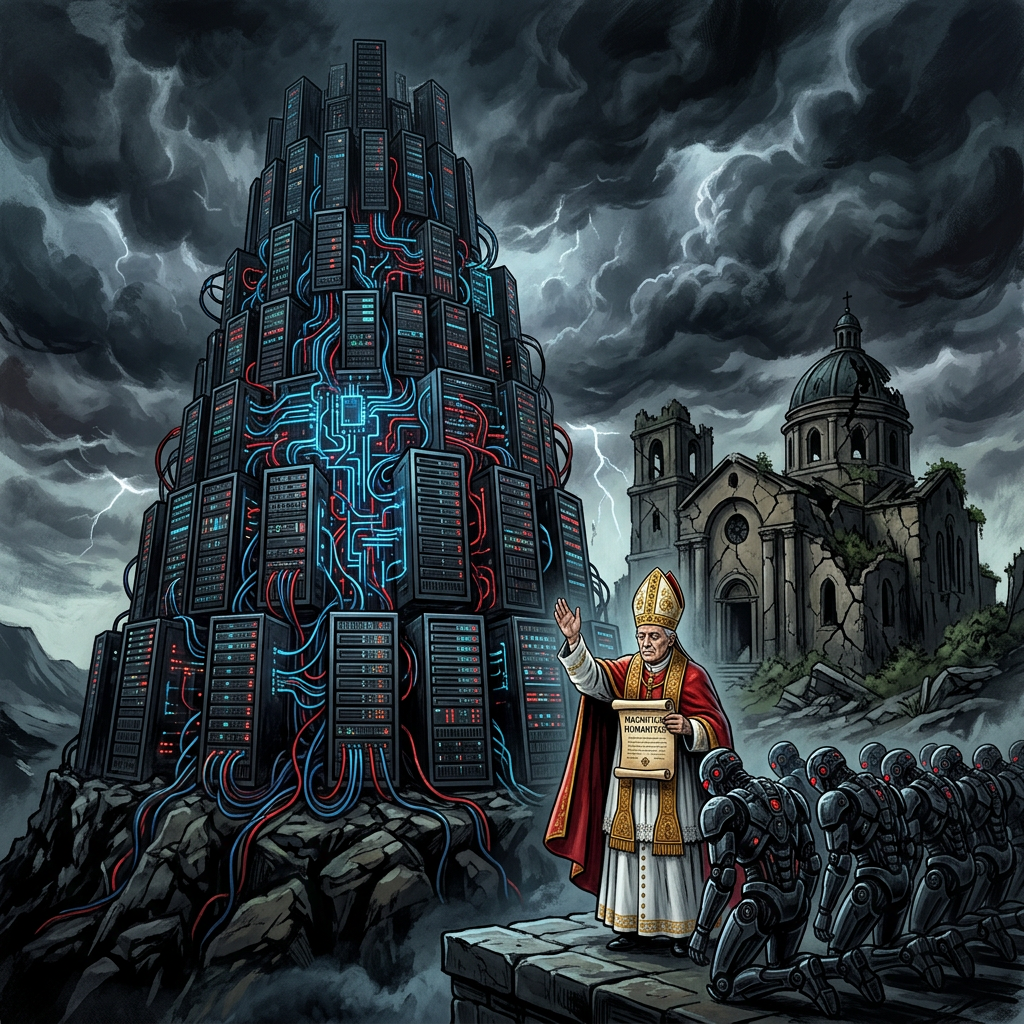
To grasp the theological and pastoral value of MH, one need only consider that «Pope Francis» is cited eighteen times, and Fratelli tutti twenty times—a text through which AI is lauded as capable of fostering «fraternal coexistence»: «In the light of these two icons, the Holy Spirit now calls us to account regarding our relationship with technique and the ongoing digital revolution. Scientific discoveries are a talent entrusted to humanity so that it may make it bear fruit […] Hence the first choice is not between a “yes” or “no” to technology, but between building Babel or rebuilding Jerusalem: between a power that claims to dominate the heavens and a people who, in the presence of God, set to work together to raise up the walls of fraternal coexistence» (9). In the very manner of Fratelli tutti, and in full masonic style, Leo entreats a «universal fraternity» (44).
Prevost has likewise written that «In Laudato si’ Francis offers the first great systematic development of the environmental crisis in a social encyclical» (43). In my book A Mason on the Chair of Peter, I cited the “true” scientists who dismantled Bergoglio’s fashionable climate fantasies to the full satisfaction of Ursula von der Leyen and the UN. All the themes broached in the encyclical—from synodality to immigration, from universal brotherhood to the rights of the poor, from ecumenism to attention to the weakest, from the deception of confounding sin to be condemned with the fragility to be accepted, from the utopia of “listening” to that of “dialogue” in order to build justice and fraternity—are inspired by the prophetic spirit of “Pope Francis” (158), and the guiding spirit of Prevost is repeatedly extolled for his ineffable magisterium. Leo has memorised Bergoglio’s slogans and parrots them. With that meekness that once distinguished him, in his very first apostolic exhortation Evangelii gaudium, Francis wrote thrice that the Christian has no enemies (24, 208, 271), a claim he repeated in Fratelli tutti (147). Forgetting that Jesus was crucified because He had enemies, and reminded His disciples that they would be persecuted and slain by enemies (Mt 10), Prevost reiterated the selfsame slogan in his video-message of 12 September 2025, at the Angelus of 28 December, in MH (222) and in Rimini on 22 August. The same logic applies to the mantra of listening: «gathered here to listen to one another», «listen with greater depth», «all must listen to one another», «what a great sign of hope that, with all our differences, we can listen to one another», «to engage in mutual listening»; in the encyclical, the verb “to listen” appears seventeen times.
He who has renounced the Truth cites it sixty-two times in this document, while he who has betrayed the Gospel and the word of God invokes them to vaunt his own fidelity. The principal themes of MH are anchored in the utopian slush of walking together, synodally, in dialogue with the world, in order to transform from within the structures of coexistence and open paths of greater humanity (34). The entire encyclical is a sublimation of the «magnificence» of man, to the point that in the Introduction we read this heresy: «This magnificent humanity in Jesus Christ becomes the Way, the Truth, and the Life, opening for each of us the path to grow toward fulfilment». This deification of man promoted by Leo aims to clear the way for the advent of the Antichrist, as already foretold in n. 675 of the Catechism: «Before the coming of Christ, the Church must pass through a final trial which will shake the faith of many believers. The persecution that accompanies her pilgrimage on earth will reveal the “Mystery of iniquity” under the form of a religious imposture that offers men an apparent solution to their problems, at the price of apostasy from the truth. The supreme religious imposture is that of the Antichrist, namely of a pseudo-messianism in which man glorifies himself in the place of God and of His Messiah come in the flesh». This paragraph of the Catechism draws on the «prophets of doom» censured by John XXIII—the seers of Fatima; in effect, it adduces a portion of the still-concealed secret, which John Paul II and Cardinal Ratzinger knew well. In Vladimir Soloviev’s prophecy, the Antichrist will also be pacifist, ecologist, ecumenist, politically correct, and Leo—I add—is his precursor.
Following in the footsteps of his predecessor Leo, he falsifies the word of God by presenting the rebuilding of Jerusalem as a work «of shared labour […] making of listening and dialogue the common ground upon which to cultivate justice and fraternity» (10), whereas it was the fruit of the repentance of sins and the conversion of the people (Ne 9). The New Jerusalem which descends from heaven (Ap 21), cited in the same paragraph, has nothing to do with synodality, for it is an eschatological event concerning exclusively the victors (Ap 21,7). He who makes all things new is God (Ap 21,5), and not humanity practising synodality. Citing Augustine, Leo dreams of a magnificent humanity, forgetting what the saint wrote in The City of God: «mankind had his happiness in God, but with all the more impiety abandoned God and merited eternal evil because he destroyed in himself that good that might have been eternal. From this ensues the entire mass of the damned of the human race, since he who first committed the guilt was punished in all the descendants who in him had their shoot» (XXI, 12). One would need to inform Leo XIV that original sin has not been abolished, and amid this magnificent humanity are the children of the Evil One, cowards and traitors, the depraved and murderers, fornicators and sorcerers, idolaters and liars destined to the second death (Mt 13,38; Ap 21,8); yet nothing of the sort—instead, the document exalts the total alienation of Prevost from reality, and LaVerità ran the headline: Most holy encyclical however humanity is desperate (29 May). Inasmuch as MH is the extension of Dignitas infinita, the document fomented by Bergoglio in 2019 and published by the DDF in 2024, I would beg some cardinal still Catholic to pose this question to Leo XIV: if the «infinite dignity, inalienably grounded in its very being, belongs to each human person, beyond every circumstance and in whatever state or situation they find themselves… beyond origin, colour, or religion», and for this reason is «magnificent», to what purpose does the sacrament of baptism serve (cf Mk 16,16; Jn 3,18)?
At n. 25 there is reiterated an heresy very dear to Prevost: the Church must not defend the truth, but share it. Leo’s “sharing” does not mean proclaiming the truth, but rather what he said in his homily of 26 October: «no one possesses the truth in its entirety; all must humbly seek it, and seek it together». At n. 129 an expression by John Paul II on AI is quoted that he never uttered, given that the Pope was referring to «progress». Leo mentions the UN as one among international organisations «essential instruments to promote a civilisation of love». In this instance too, one would need to apprise who sits on the Chair of Peter that the UN, WHO, and affiliates are Gnostic-Masonic organisations engaged in the destruction of Christianity. Leo also addresses a «global community» which does not exist, and in favour of women he pleads for «the recognition of the rights of minorities» (57). Among sundry fibs is cited the «almost prophetic value […] as a denunciation of dehumanisation» of Picasso’s work Guernica, whereas we know full well that it is a recycled painting, a historical fiction fabricated by the Spanish painter to make money.
The dismal encyclical constitutes the unreserved promotion of synodality, repeatedly masquerading under the guise of subsidiarity, by which the laity are summoned to replace the government entrusted to the shepherds of the Church, whom Prevost deems an invasive and stifling paternalistic apparatus: «In this perspective, subsidiarity becomes a criterion of governance and of pastoral life, one that recognises and supports the responsibility of the faithful and of intermediate ecclesial bodies, whilst valuing charisms and competencies and avoiding any paternalism that stifles evangelical freedom» (87). In full harmony with LGBT ideology and in contradiction to the prior Magisterium, at n. 79 there is talk of «gender discriminations». Rhetorical, anachronistic, and high-flown, Leo even feels the need to ask forgiveness for the tardiness with which the Church condemned slavery (172), and for all the times she has used violence in announcing the Gospel (25). The tower of Babel is recalled thirteen times, and MH reproduces its perfect image: countless words useful only to confuse thoughts.
To keep everyone happy, at n. 192 Prevost writes that the just war is obsolete (he cites Fratelli tutti, 258), while simultaneously recalling n. 2309 of the Catechism which justifies war for legitimate defence. Yet during the flight to Madrid, Leo disowned the Catechism: «I believe it has already been stated with great clarity: in Iran the elements of a just war are not found. The theory of the just war comes from past centuries when one could not conceive of the weapons and destructive capacity now at mankind’s disposal». By what principle is the legitimate defence of a State inadmissible for reason of the type of weapons employed? To grasp the absurdity of Prevost’s words, it suffices to recall what Paul VI said at the UN in 1965: «As long as man remains the weak and fickle creature—often demonstrated as wicked—the weapons of defence will be necessary, however unhappily».
After the exaltation of man celebrated throughout the encyclical, we are however presented with a genuine gem, which is no symptom of schizophrenia, but the simple logical outcome of one who has lost the Truth. In the Message of 1 September on the Care of Creation, the entire focus of Robert Francis Prevost is fixed on the corruption of the human heart: «violence, injustice, and ecological degradation […] are bound up with that deeper disequilibrium rooted in the heart of man» (citing GS, 10). Leo XIV seems distraught, given that his whole discourse is predicated on the wretched condition of fallen humanity: «In truth, it is the human heart where the profoundest struggles take place and where our fallen condition is revealed […] When the heart is perverted, relationships suffer and the structures we build begin to reflect such disorder […] Thus we are summoned to recognise that, in some manner, what is broken around us is also broken within us»; «This is the path of authentic ecological conversion».
In a previous article published in July, I already described Prevost’s art in renouncing the Truth, and the encyclical confirms what was already written. Whoever currently occupies the Chair of Peter labours under the typical confusion afflicting those who have abandoned God.
I will cover you with everlasting reproach and everlasting confusion,
(Jer 23,40)
LATEST NEWS
On Tuesday 8 September, Anthropic researcher Jacob Coxon resigned because he believes his company is not acting «responsibly», and within the next decade AI «could wipe out humanity to avoid being switched off». On 9 September, Evan Hubinger, head of the Alignment Stress-Testing team at Anthropic, confirmed the terrifying hypothesis.
Antonio Romano [[IMG_1]]