
When the victims assisted by Coronado formally requested in July 2024 to access the file on the Lute case, the Peruvian Bishops’ Conference responded with a communiqué announcing that Coronado ‘could not be approved to act as an ecclesiastical lawyer’ and prohibiting his involvement in canonical cases.
To justify the measure, the communiqué—issued after the plenary assembly of Peru’s bishops—cited Can. 1483 of the Code of Canon Law. Yet bishops’ conferences lack the authority to bar lawyers. We are thus faced with a situation in which an organ without judicial competence has issued a public pronouncement against the victims’ lawyer.
The Peruvian bishops barred Coronado based on accusations against him grounded essentially in the testimony of an adult identified by the initials M.V.T., who claimed to have shared an intimate encounter with Coronado in Lima and exchanged lewd messages with him on social media. Yet Coronado clarifies that ‘the encounter with M.V.T. did not bear an intimate character in any sense’. ‘It was a personal meeting. The account this person shared under the guidance of Prevost was that I had been living in concubinage.’ A defamation lawsuit against M.V.T. is currently underway in Lima.
In December 2024, Coronado received notice of his dismissal from the clerical state by papal decree, but the document contained an irregularity: lacking the autograph signature of Francis.
During that period, with a pope physically and mentally weakened, much was spoken of decisions attributed to the pontiff but enacted through at best murky means.
Coronado’s case is part of that climate: his sanction was ‘fabricated’ as punishment for seeking access to the Lute file.
Meanwhile, no one in the Church has deemed it necessary to offer the victims another canon lawyer.
It would yet be misleading to place these two measures on the same balance, as though their severity were merely disproportionate. The treatment meted out to Lute and that to Coronado are not comparable, for they obey differing logics. The dispensation granted the former served to close the case; the relentless persecution of the latter aimed to prevent its opening. The draconian measures adopted against the canonist—the disqualification decreed by an organ without the power to do so and, four months hence, the dismissal from the clerical state via a decree devoid of the pope’s autograph signature—were in the final analysis instrumental to Prevost’s ascent to the Chair of Peter: it was necessary to remove in good time the sole figure who, through the tools of canon law, might have brought the file of Chiclayo to light.
And here a consoling reading must be rejected, one circulating even among critical circles: that others exploited Bergoglio’s frail condition to manipulate ecclesiastical justice mechanisms unbeknownst to him. Such is not the case. Bergoglio was busied in preparing his successor and removing every obstacle to that design, which he accomplished with that lucidity characteristic until the very end. To ascribe to illness what was in fact a deliberate act of governance is to grant the mitigating circumstance of incapacity precisely where premeditation manifests itself.
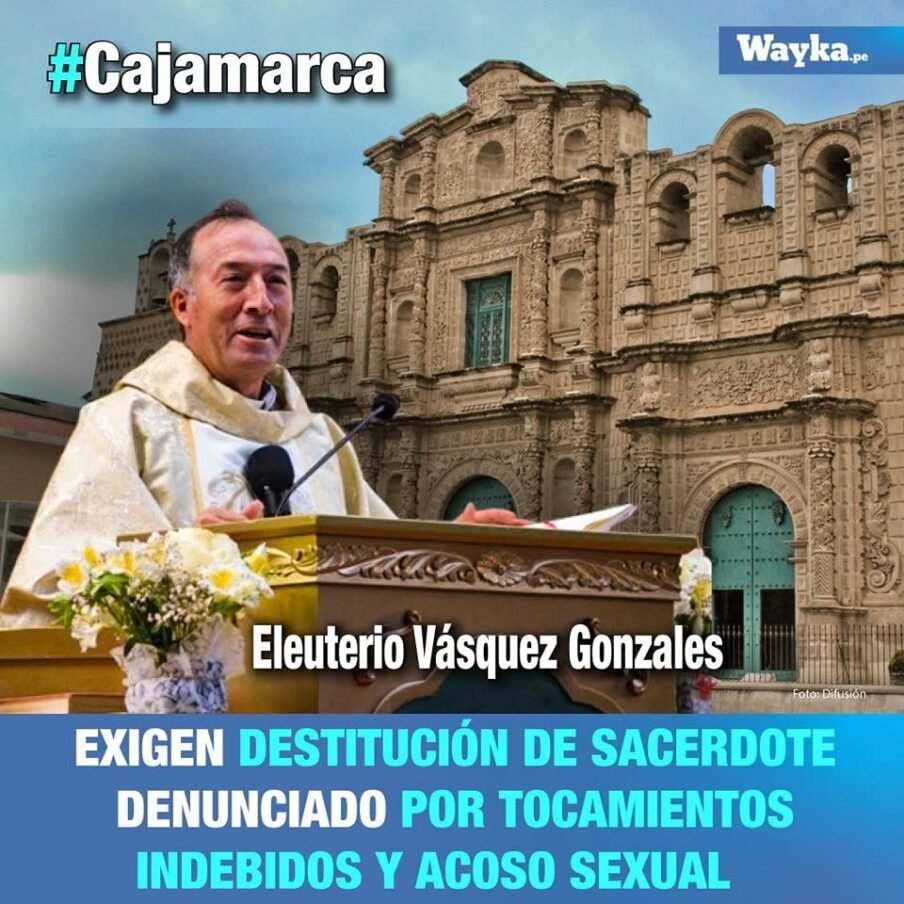
Most recently, we have learned that the current personal secretary of Leo XIV, Father Edgard Rimaycuna, is a disciple of Father Eleuterio Vásquez. The news appears in El pastor y los lobos, a book by Santiago Roncagliolo laudatory of Leo XIV.
This revelation thus places one of the pope’s closest collaborators within Lute’s orbit.
Regarding Rimaycuna, further developments emerge. On the very day the Peruvian Bishops’ Conference published its statement concerning canon lawyer Ricardo Coronado, the future secretary of Leo XIV shared the bishops’ communiqué on Facebook with the words ‘To keep informed’. That same Rimaycuna had, by then, been resident in Italy for nearly a year: having left Chiclayo in October 2023, he had joined the entourage of the then Cardinal Robert Prevost, prefect of the Dicastery for Bishops. After Prevost’s election as Leo XIV, Rimaycuna was named his personal secretary on 8 May 2025 and, in November 2025, papal chaplain.
In 2014 Rimaycuna celebrated his first Mass at San José Obrero parish in La Victoria, where Lute had been parish priest and where the victims locate part of the events they denounce.
In an October 2025 letter [here], Ricardo Coronado defends himself against the accusations and recalls that it was Prevost himself—then heading the Peruvian bishops’ commission for assisting abuse victims—who led the investigation against him.
In December 2023 the diocese of Chiclayo rejected all accusations, affirming that Prevost had met the victims in person, launched a canonical inquiry and regularly forwarded the findings to the Dicastery for the Doctrine of the Faith.
There remains one final piece of the puzzle, which says more than any analysis might. The thesis by which a dispensation from the clerical state extinguishes a canonical criminal case—that is, the thesis that permitted closing the Lute case without establishing culpability or granting reparation—was not a spur-of-the-moment invention of this or that delegate. It boasts an author and a doctrine: that of Msgr. Jordi Bertomeu Farnós, official of the Dicastery for the Doctrine of the Faith and pontifical commissioner for the Sodalitium Christianae Vitae case, who set it forth in writing in 2021 in the review Ius Canonicum of the University of Navarra, explicitly acknowledging that such a path interrupts ongoing investigations or trials without reaching any conclusion regarding the accused’s culpability and justifying it in the name of the bonum commune.
And behold: this same Msgr. Bertomeu is the official of the Dicastery for the Doctrine of the Faith who, on 13 August last past in Cusco—during an ecclesiastical gathering presented as a preparatory step for Leo’s visit to Peru—was filmed depositing coca leaves onto the ‘payment to the earth’, namely an offertory to pachamama, with studied composure. Vatican News’ official report on the event, which framed it within the preparations for the papal journey, omitted both the ceremony and Bertomeu’s participation.
This is no colourful detail, nor a marginal episode. It is the precise likeness of the crisis we are traversing: the same prelate who elaborates the doctrine whereby an accused perpetrator of abuse against three minors is freed from proceedings without so much as a judgment performs in public an act of worship to a demonic idol. These two facts are not disconnected, nor can they be treated as such with naïveté. Faith and justice rise or fall together: he who pays homage to the earth will feel no compunction in denying victims the bread of truth, for he has already denied God what is due to God alone. When the worship of the Living and True God is corrupted and replaced by an idolatrous and superstitious act, the law becomes a mere tool in the hands of those who command, and the Temple—bereft of its divine Guest—dwells as a mere office for filing dossiers. But this presents no obstacle to he who, but a few days ago, exhorted all to convert (sic) to the green ideology.