
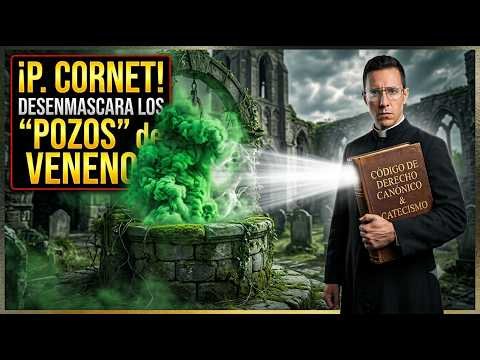
Analysis of the Texas Community’s Message «Separate yourselves from the poison»
The message attributed to the Holy Spirit through Sister Amapola, disseminated by the Community of Divine Mercy in Texas (USA), where Father John Foster resides, has generated great confusion and division among Catholics who consider the true canonical papacy to have ended with Benedict XVI. Its defenders prioritise the subjective over the Church’s settled doctrine, Magisterium, and Catechism, which teach that, having closed the public Revelation, no new name for the Holy Spirit can be admitted.
As the Catechism teaches in paragraph 691:
«“Holy Spirit” is the proper name of the One whom we adore and glorify with the Father and the Son. The Church has received this name from the Lord Himself and professes it in the baptism of her new children.»
If the Church has received it from the Lord, any other denomination is inadmissible, for, as paragraph 66 of the Catechism states:
«The Christian economy, since it is the new and definitive Alliance, will never pass away; nor is there to be awaited any new public revelation before the glorious manifestation of our Lord Jesus Christ.»
Although Revelation is complete, it is not fully explicit; it falls to Christian faith to grasp gradually its content through the centuries. What leads the defenders of this new nomenclature for the Holy Spirit astray is precisely that they mistake deepened understanding of the already revealed for the addition of something new—a gross and grave error. Since nothing new can be added, as they pretend with this new name.
The Catechism, in paragraph 67, explicitly warns that Christian faith cannot accept revelations that claim to transcend, correct or add doctrine to the Revelation of which Christ is the fullness (as happens in certain sects or later religions, and now in the case of the Texas Community and its followers, who set ecclesiastical Magisterium to one side).
Watch the video here: https://www.youtube.com/watch?v=lmRCf0Ng_gw
Reflections on the Message
Dear friends,
I thank Arturo, a Catholic journalist, for granting me this space to comment on certain aspects that I consider significant for all who wish to analyse these messages.
There are three things I wish to highlight:
First, we are confronted with a private revelation. A private revelation does not oblige one to believe with divine and catholic faith. It is essential to distinguish between Public Revelation (with a capital letter) and private revelation.
Public Revelation, let us say with a capital letter, is all that the Lord, the Most Holy Trinity, has taught, manifested, and made known through what is called the deposit of faith, and which concluded with the death of the last Apostle—that is, with the death of Saint Paul the Apostle.
Therefore, after the death of the last Apostle, there can be no new elements added to Revelation. This is not open to debate: the Church has defined it dogmatically. Public Revelation, to which we are all obliged to give divine and catholic faith, concluded with the death of Saint Paul the Apostle.
For this reason, all that has followed since, up to this day and until the end of time, can add no new element to the deposit of faith. We may deepen our understanding of it, but we may not change it or diminish it.
The mission of the Church is to safeguard the deposit of faith. As Saint Vincent of Lérins expressed in his work Commonitorium (or Custom-House), when he asks: «How does theology progress? How does our knowledge of Revelation progress?»
The answer is clear: there is no change, no transformation, only a deepening of comprehension of what has already been revealed, even if implicitly. For example, in the case of the Immaculate Conception, the concept was already present in Revelation, even if the formula was not explicitly defined until the nineteenth century.
Those who maintain that private revelations add something new are gravely mistaken. Theology adds nothing new to the deposit of faith; rather, it deepens understanding of it.
The mission of the Magisterium is, precisely, to deepen our grasp of what has already been revealed, so that we may better comprehend what God has made known to mankind through Public Revelation.
Private revelations, as many theologians have defined and studied, are a help that God grants so that we may better understand the things already contained in the deposit of faith. They add nothing new, but they can assist us in grasping what has already been revealed.
Hence, we are not obliged to believe in private revelations, though we may accept them with human faith, as an aid to our spiritual life.
The first point we must bear in mind is this: one who decides not to accept or believe in these alleged divine manifestations in the Texas Community of Divine Mercy commits no sin. They may be criticised, debated, for they have not even been definitively defined by the Church.
Definitive judgements of the Church regarding these manifestations are issued only after they have concluded, when the competent authority studies their content, authenticity, and conformity with the faith with care. In the meantime, while such manifestations are ongoing, we must be prudent—extremely prudent
Why? Because there are matters of great importance. The demon can infiltrate and avail himself of such situations to deceive. If at this moment someone were to affirm that these revelations are authentic, and the following day the demon were to manifest himself in a form resembling an angel of light, saying things not in keeping with the truth, it would appear as though the Church endorses doctrines inconsistent with Revelation.
Saint Maximus the Confessor, in his work Life of Mary (section 125), prophesied:
«Through the Virgin, the roaring lion was cast from the throne.»
For this reason, the Church awaits the conclusion of such manifestations before issuing a final judgement. In the meantime, we may intervene before they conclude by declaring that it is not so.
To make this clearer, let me offer an example: a person tells me that for the past month they have been receiving manifestations of the Virgin. I ask: «And how does she appear to you?» They reply: «The Virgin appears to me in a bikini, with light-coloured eyes and a very striking nose.» I say to them: «No, this cannot be the Virgin. The Virgin does not appear in a bikini, nor with a striking nose, nor with doctrines that are already defined. If you have imbibed too much coffee and your mind is not functioning properly, this does not come from God. I can assure you that this does not come from God.»
Thus, even if a message contains positive elements, if there is one element that does not fit, we may affirm with certainty that this message—at least this one—does not come from God.
This is not a judgement on the morality or the intentions of Sister Amapola or Father John Foster. There is no judgement whatsoever concerning their morality or their intentions. We judge only the content of the message.
There are far too many elements that do not fit. If even one does not fit—and here there are several—we may affirm with certainty that this does not come from God.
Though the demon can indeed speak truths, he employs them to lead us into deception. As Saint Ambrose of Milan warned, we must be careful, for the devil knows Scripture, even if he neither accepts nor fully comprehends it. This is why our Lord Jesus Christ, when casting out demons, would say to them: «I know who you are—the Holy One of God», and did not engage in dialogue with them.
If this message does not come from God but from the demon, it could serve to nullify all the truths that have been previously proclaimed, so that people cease to believe in any truth. This is why we must be extremely cautious.
In the last times, as the Lord foretold, many will come in His name saying: «I am the Messiah», and deceive many. This is why we must pay great heed.
I hope these reflections help you to understand better what we are living through. Let us be most cautious, for channels on YouTube and other media are multiplying, as are supposed revelations and the public appearances of dubious figures, asserting falsehoods.
Let us cling to what is already defined, to what is clear, and, above all, in the case of private revelations, let us accept only those which have been confirmed or at least tolerated by the Church through her legitimate authorities.
Of the rest, let us maintain a healthy distrust, for these are times of profound confusion. Scripture, in the Book of Revelation, warns of a great power of deception in these days.
May God bless you, keep you from all harm, and lead you to eternal life.