The progressive displacement of the Roman Canon in pontifical celebrations has become an observable fact that can no longer be interpreted as mere contingency. Under the pontificate of Leo XIV, the systematic choice of modern eucharistic prayers—especially the third—confirms a stable preference for texts introduced following the 1968 liturgical reform, to the detriment of the venerable Canon that for centuries constituted the invariable nucleus of the Roman rite.
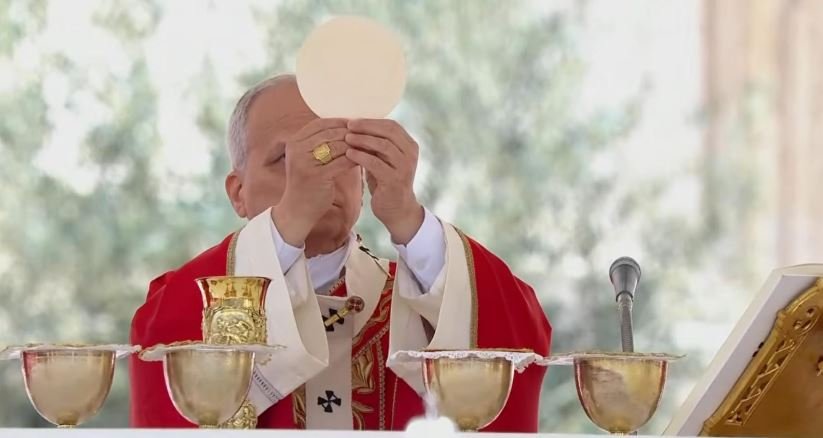
This is neither an isolated episode nor a punctual choice conditioned by pastoral circumstances. The reiteration in contexts of maximum solemnity, such as Palm Sunday, reveals a consolidated pattern: the Roman Canon has ceased to be the ordinary reference even in those moments when its theological density and symbolic weight would be most coherent with the celebrative content. In its place, more recent formulas are chosen, with simpler structure and more agile execution, whose genesis responds to pastoral criteria proper to the second half of the twentieth century.
This displacement is not neutral. The Roman Canon is not simply one prayer among other possible ones, but the historical expression of the lex orandi of the Roman rite, with an organic development that refers back to the first centuries of the Latin Church. Its sacrificial language, its austere sobriety, and its continuity make it a privileged witness to liturgical tradition. To replace it with prayers of recent composition implies, in fact, an alteration in the perception of liturgical continuity itself.
The preference for modern eucharistic prayers suggests, therefore, a certain way of understanding liturgy: less anchored in the reception of received tradition and more oriented toward celebrative functionality. The result is a praxis in which the Roman Canon, far from occupying the central place that would correspond to it by its very nature, is relegated to an increasingly exceptional presence.
Pontifical practice, in this sense, is not irrelevant. Although it does not establish by itself a juridical norm, it does exercise a paradigmatic function. What the Pope celebrates habitually ends up configuring, de facto, the horizon of what is perceived as ordinary or preferable. And in that horizon, today, the Roman Canon appears increasingly absent.