
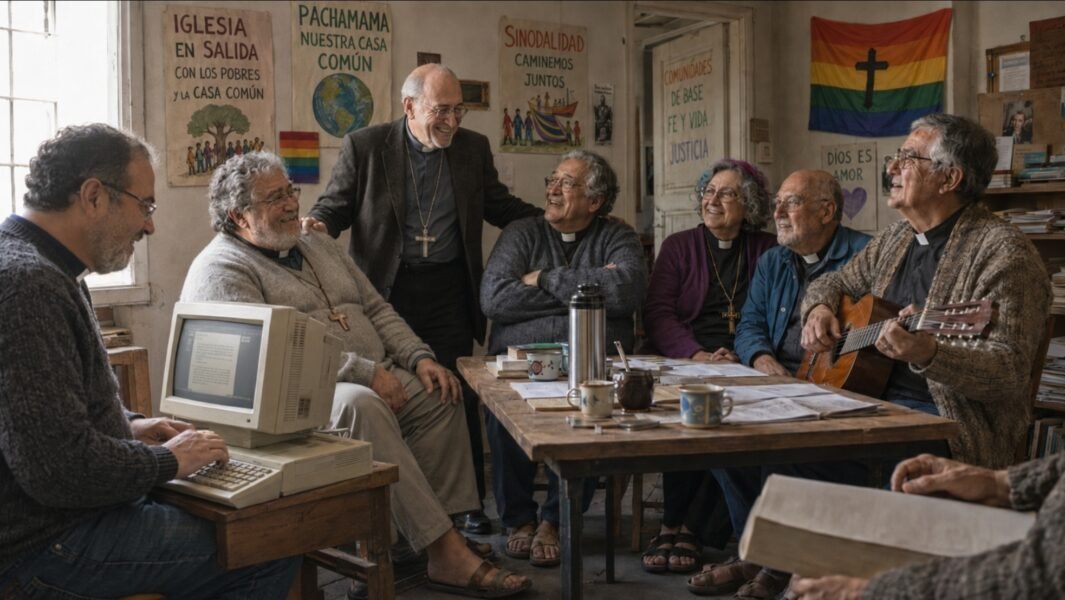
Father Francisco José Delgado has published an article on InfoCatólica that we recommend reading carefully, “Church Money for Anti-Catholicism?”, which does not, fundamentally, say anything we did not already know, yet states it with the force of concrete detail: names, banners, advertising rates, and an inventory of ecclesial institutions—EDIBESA, UMAS, the Dominican School of Theology, the Pontifical University of Salamanca, the Catholic University of Valencia, Comillas, Deusto, Loyola, La Salle, the Paulines, Edelvives, the Pablo VI Foundation, Mensajeros de la Paz, the Camillians—whose advertising appears interspersed, paragraph by paragraph, in an article calling the Church intransigent and an enemy of the Gospel and of science for upholding her doctrine on homosexuality. The author tops off the piece, as was only to be expected, by quoting Juan José Tamayo. That is to say: money derived, directly or indirectly, from the efforts of the faithful, serving as financial support for an outlet whose editorial line is not merely critical of the Church, but openly contrary to her doctrine and, on no few occasions, a vehicle for plainly heretical positions, cloaked in that stale, outdated progressivism of a 1970s priest, which no longer convinces even its own adherents but continues to be paid punctually.
An Atypical Phenomenon That No One Can Pretend Not to See Any Longer
There is something deeply atypical about all this. It is not normal for a portal with an audience that, according to aggregate SimilarWeb data for 2025, stands at around 6.5 million annual visits—compared to more than 18.5 million for InfoVaticana, 16.5 million for InfoCatólica, or over 12 million for Religión en Libertad—to concentrate such a density of institutional ecclesial advertising. It is not normal that a publication read several times less than the major Spanish Catholic portals should nonetheless be the preferred showcase for advertising from pontifical universities, religious publishing houses, and mutual insurance funds founded by the Bishops' Conference itself. Nor is it normal that bishops and Vatican officials—witness the indulgent interviews with those who seem to be pitching themselves for higher posts, or the repeated use of the portal as a loudspeaker by Curial officials such as Monsignor Jordi Bertomeu—should use that very same outlet as a forum for self-promotion, as though appearing in it earned points on the ladder of the ecclesiastical career.
When advertising does not follow audience, and the hierarchy does not follow the faithful, but both systematically converge upon a minority outlet that holds them in contempt, the question is no longer journalistic: it is administrative, and indeed, legal.
What We Have Already Explained: Advertising Is Not Paid For at Will
In January of this year, we published “Church Money and Digital Advertising: The Red Line of Mismanagement”, in which we recalled an elementary truth that comfortable clericalism prefers not to hear: digital advertising has objectified what was once artisanal. Today, impressions are counted, audiences are audited, and costs per thousand impressions—CPM—are easily compared against market benchmarks. Anyone managing their own money can squander it as they please; anyone managing someone else’s money—that of a diocese, an ecclesial mutual society, a company owned by the Church, which is to say, ultimately, that of the faithful—is bound by a strict duty of diligence and loyalty, and cannot purchase advertising at prices disconnected from real market value without serious, documentable technical justification. Mismanagement does not require stuffed envelopes or hidden kickbacks: managing the property of others contrary to their interest, thereby causing assessable financial harm, is quite enough. Paying persistent markups for advertising in a publication with a marginal audience, when objectively larger and more effective alternatives exist, ceases to be a mere poor communication decision and becomes something requiring explanation; and if behind such above-market purchasing there were any attempt to buy influence or some arrangement unknown to us, it would be graver still. How far will they test the patience of the faithful before legal action is taken?
In March, we examined the details in the UMAS case: policyholders who asked to know the amounts paid, the actual visits generated, and the resulting effective CPM, and who to this day remain without an answer. Opacity, in an entity managing resources belonging to Church institutions, is no minor detail: it is an anomaly that could indicate agreements disconnected from real market value. And UMAS, as we warned back then, is only the beginning.
The Price of Pointing It Out
We also know what comes next, for the mechanism is as predictable as it is old. Whoever points out the inconsistency—today, Father Delgado—immediately triggers the mechanisms of ambient repression: there begin—what a coincidence—articles against him, sensationalist compilations of statements taken out of context, personal targeting, and the attempt to make the whistle-blower the problem so as to avoid answering the allegation. It is the reaction of a clientelist ecosystem that cannot contest the data—rates are published, banners are visible, audience figures are auditable—and therefore attacks the individuals. We ourselves are well acquainted with such treatment, as are our shareholders, whose names and likenesses are used to target them in frequent, absurd campaigns. Let those who do so know that not only did we know what we were signing up for, but that far more intense activity lies ahead.
Our Freedom and to Whom We Owe It
InfoVaticana receives no advertising from any official institution. We do not ask for it, nor do we expect it. The last time institutional funding was offered to us, it was on condition that we remove certain content regarding the “X” tax campaign, and it was rejected; that experience, which we recounted at the time, taught us that money could not buy our silence, but it forced us to look more closely at where such money does flow with apparent normality. We are sustained by donors and shareholders who believe in this project, and that is precisely why we are free: professionals with established lives outside the clientelist networks described here, with no bishop who can dismiss us, no Jesuit or Dominican university that can pull its banner, no diocese that can turn off the tap. That freedom can neither be granted to us nor taken away from us, and God granting us health, this team has decades ahead to continue uncovering inconsistencies, heresies, and petty corruptions; to continue denouncing negligent management in abuse cases, whoever the responsible party may be; and to defend, with all humility yet with all determination, something as simple and yet as profound as the timeless Catholic faith. Not its modernist deformation: not that of those who worship the Pachamama, nor that of those who wish to “deconstruct” the family to make way for the LGBT agenda, nor that of those who promote female priesthood and women bishops, nor that of those who no longer believe in the Real Presence of Christ in the Eucharist.
And a final word of gratitude, the most important one. To those brave priests who, like Father Delgado, do depend on a diocese, a structure, a superior; who live within institutions where these inconsistencies are funded at inflated prices, and where raising one's voice carries a personal cost that we do not pay. They are on the front lines of a fight in which we have the privilege—the blessing—of fighting unencumbered and with a clear conscience. May God sustain them.