
Between October 2025 and April 2026, vatican.va replaced, without any notice, one of the most frequently cited phrases used against John Paul II on interreligious matters. The audio and the context vindicate the correction—the Pope said «this land»—, but the scandal is twofold: a Vatican apparatus that disseminated and endorsed, for a quarter of a century, an erroneous transcription of the gravest implications, and that same apparatus now correcting it without a press release, without a footnote, coinciding in time with the exchange of communications between Rome and the Priestly Fraternity of Saint Pius X concerning, precisely, these very questions.
On 21 March of the year 2000, during his Jubilee pilgrimage to the Holy Land, John Paul II visited Wadi Al-Kharrar, on the Jordanian bank of the river, the place that tradition and archaeology identify as the setting of the Baptism of the Lord. After the prescribed prayer and the final blessing, the Pope improvised a few words of farewell. The transcription that the Holy See published at the time—and which remained unaltered on vatican.va for more than twenty-five years—recorded them thus:
«May Saint John Baptist protect Islam and all the people of Jordan, and all who partecipated in this celebration, a memorable celebration. I'm very grateful to all of you.»
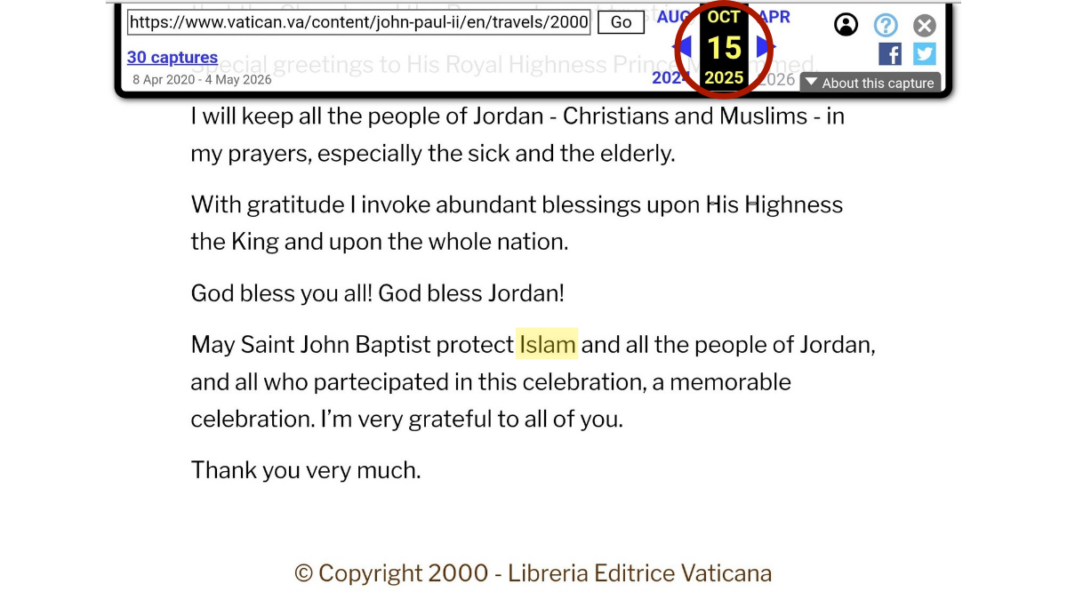
«May Saint John Baptist protect Islam and all the people of Jordan». As recently as 15 October 2025, as evidenced by the Wayback Machine capture, the official page still read «protect Islam». In the capture of 15 April 2026, the same document says something else: «May Saint John Baptist protect this land and all the people of Jordan». At some point during that six-month period, someone at the Holy See modified the text. No editorial note. No communiqué. No erratum. Twenty-six years later.
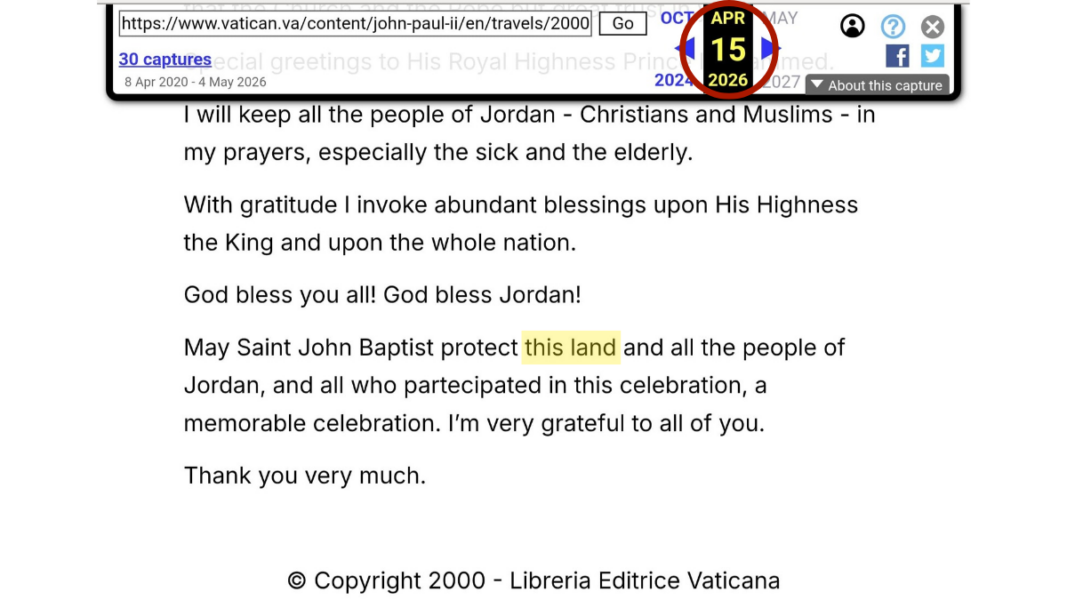
The matter had been circulating in recent weeks across forums and social media. InfoVaticana has conducted a detailed investigation of the Wayback Machine capture history to narrow down the date of the change, has located the complete video of the ceremony—the live broadcast by EWTN—to cross-check the original audio, and has enquired directly with the parties involved in the doctrinal dialogue on these controversies.
The Pope said «this land»
Let us state it plainly: the correction is, in all likelihood, accurate. Anyone who listens to the original recording—the live coverage that EWTN broadcast on that 21 March 2000, and which we reproduce below—will find that John Paul II's diction, with its marked accent (the official transcription itself always preserved the oral slip «partecipated»), is compatible with «this land», and the context confirms it: the Pope had just blessed Jordan and its people, he was speaking of a land sanctified by the Baptist, and an invocation that the Precursor protect «this land» is what one would naturally expect from a pontiff. That Saint John Baptist should «protect Islam»—a religion that denies the divinity of Him whom he pointed out as the Lamb of God—was, by contrast, a theological anomaly of the utmost gravity.
But the fact that the phrase was a transcription error does not exonerate the Holy See: it aggravates it. For the error was not that of a distracted typist one March afternoon. It was fabricated, translated, printed, and sustained by the entire official Vatican apparatus:
The Bollettino of the Sala Stampa of 22 March 2000—still accessible today at press.vatican.va—not only recorded the phrase in English, but provided its official Italian translation: «San Giovanni Battista protegga l'Islam, tutto il popolo della Giordania…». The translators of the Holy See, the day after the events and with the audio available, understood and enshrined «Islam».
L'Osservatore Romano, in its weekly English-language edition of 29 March 2000, published the full text with the phrase, preceded by the annotation «After the blessing the Pope said».
And the Vatican newspaper itself reprinted it that same year in the commemorative volume of the journey, Alle Radici della Fede e della Chiesa (2000, p. 37).
For twenty-five years, that apocryphal phrase did incalculable damage. It was cited in books, articles, and debates as an emblem—alongside the kissing of the Qur'an in 1999 or the Assisi gatherings—of the interreligious ambiguities of the pontificate. It fed equally the indifferentism of those who celebrated it as a prophetic gesture and the scandal of those who wielded it against the memory, and even against the canonisation, of the Polish Pope. It was used as ammunition in the sedevacantist controversy and in the traditionalist critique of interreligious dialogue. And throughout all that time, no body of the Holy See—neither the Sala Stampa, nor the Secretariat of State, nor the Libreria Editrice Vaticana—bothered to cross-check the audio and defend the truth of what the Pope had actually said.
The silent correction, and the timing chosen
The second scandal is the manner. An official archive is not a personal blog: when a historical document is corrected—let alone one cited for a quarter of a century in theological controversy—the correction is annotated, dated, and explained. What the Vatican has done is the opposite: rewriting the text in silence, presumably trusting that no one would notice? It took the Wayback Machine to document the change.
And the timing is striking. The modification takes place between October 2025 and April 2026, that is, in parallel with the exchange of communications between the Holy See and the Priestly Fraternity of Saint Pius X, whose doctrinal dispute with Rome concerns, precisely, these very matters: interreligious dialogue, religious liberty, the gestures of Assisi and of the pontificate of John Paul II towards Islam. The phrase from Wadi Al-Kharrar had featured for decades in the traditionalist argumentarium.
InfoVaticana has been in contact with both the Fraternity and the Holy See, and has been able to confirm that this specific question has not been the direct subject of the communications between the parties. The temporal coincidence, however, deserves to be noted, for it is illustrative: while Rome was dialoguing with those who have spent decades pointing out the interreligious gestures of that pontificate, someone was discreetly removing from the official archive one of the most uncomfortable pieces of that dossier, on the eve of the crisis that would erupt with the Écône consecrations and the Note from the Dicastery for the Doctrine of the Faith.
Whatever the explanation, the lesson left by this episode is not reassuring in either of its two halves: an apparatus capable of attributing to a Pope, for twenty-five years and across three distinct official media, words he never uttered; and that same apparatus correcting history without leaving a trace when it suits. The inevitable question is how many other documents on vatican.va have been altered without anyone knowing. This time, at least, the captures survived.