
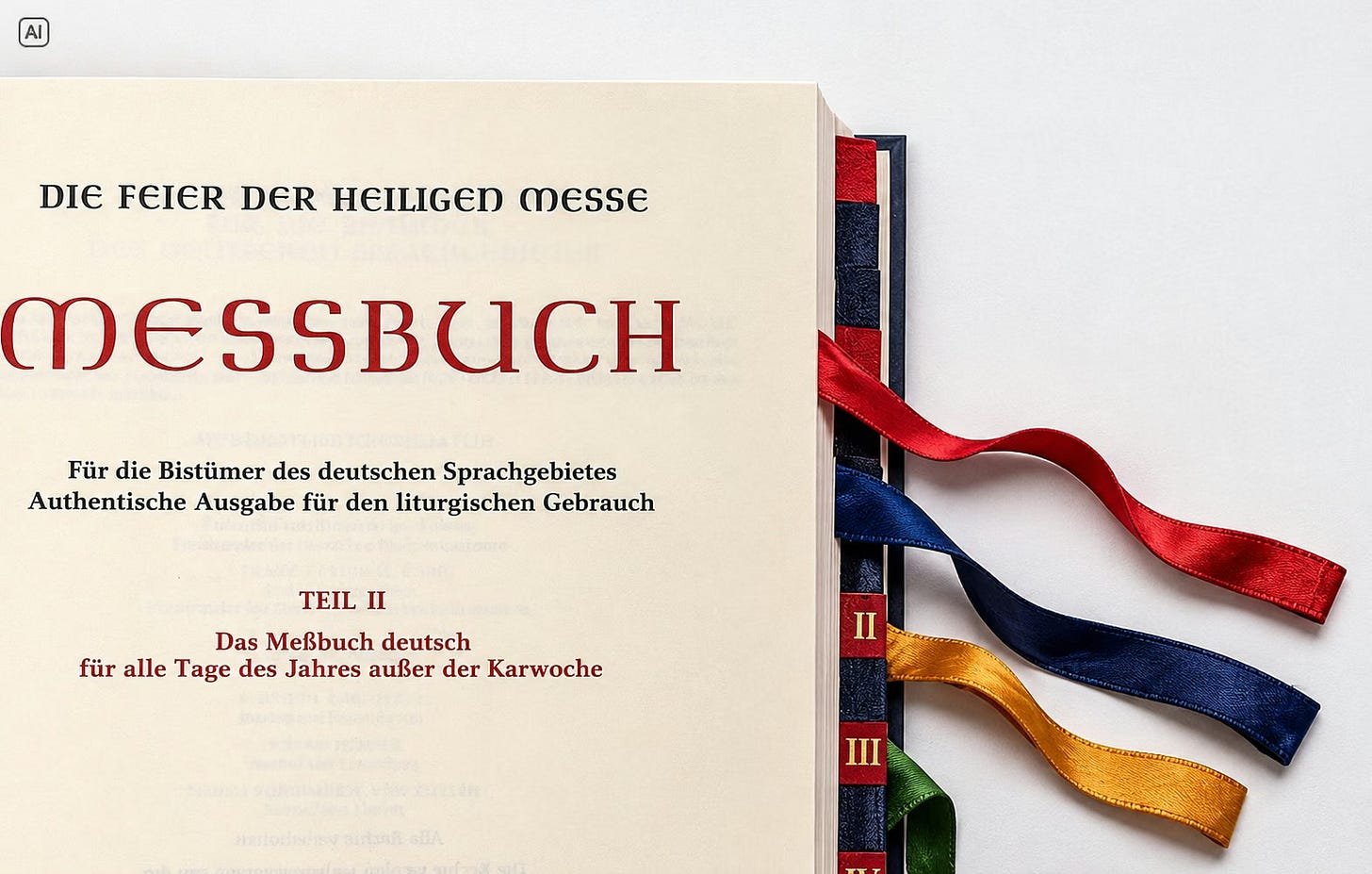
While Munich experiments with the visual environment of worship, German-speaking liturgists are preparing another revision of the Novus Ordo Missal.
On November 3, Katholisch.de published an interview with Father Marius Linnenborn, director of the German Liturgical Institute and a member of the project leadership responsible for revising the German-language Missal.
The revision began in 2024 and is expected to produce a new Missal around 2033.
Among its proposed changes are alternative opening prayers, additional Communion antiphons, and more inclusive language. Linnenborn explained that masculine expressions would receive particular scrutiny and that descriptions of God employing strongly masculine imagery would be approached cautiously.
The most revealing question concerned the words of Consecration.
The Latin pro multis means “for many.” The traditional Roman Rite preserves those words, corresponding to Christ’s institution narratives in Matthew 26:28 and Mark 14:24.
Yet the existing German Novus Ordo translation renders the phrase für alle, “for all.”
Pope Benedict XVI attempted to correct this.
In his April 14, 2012 letter to the German bishops, Benedict insisted that the new translation of the Missal employ “for many.” He explained that “for all” was an interpretation rather than a translation, and that fidelity to the words of Christ required preserving the scriptural formulation.
Linnenborn now predicts that German-speaking bishops will choose to retain “for all.”
His precedent is Francis’s approval of the Italian Missal, which retained per tutti.
The implications are extraordinary.
One claimant to the papacy painstakingly explains why fidelity to the words of Our Lord requires correcting an inaccurate translation. His successor approves the very rendering that the earlier pontiff sought to replace. German liturgists then cite that reversal as justification for continuing their own practice.
And the faithful are expected to regard this spectacle as the orderly development of Catholic liturgical discipline.
There is a further concern about the proposed inclusive language.
The Church’s liturgy is an inheritance received from preceding generations. Its prayers are supposed to express the Faith, including the language through which divine revelation has been transmitted.
Altering ordinary expressions to accommodate contemporary political sensitivities raises legitimate questions about whether fidelity to revelation remains the controlling principle.
The organizers describe the planned revision as moderate, and the final text has yet to be approved.
The direction is revealing. The question increasingly becomes how inherited liturgical language can be made agreeable to contemporary sensibilities, even when the language under discussion comes directly from Scripture.
Benedict XVI wanted the words of Consecration restored to their proper translation.
Francis supplied a precedent for leaving them altered.
And the German bishops now appear inclined to follow Francis.