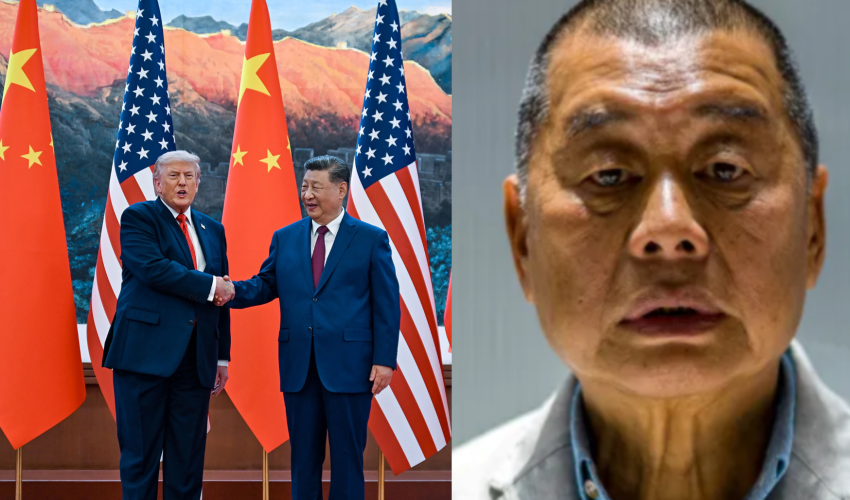
At 78 years old, Jimmy Lai remains one of the most famous political prisoners in the Chinese world. Founder of the pro-democracy daily Apple Daily, closed under pressure from the authorities, he is currently serving a heavy prison sentence under the name of the national security law imposed by Beijing on Hong Kong. For Chinese authorities, Jimmy Lai is accused of collusion with foreign powers and activities threatening state security. For his supporters, he is above all a man imprisoned for defending freedom of conscience, freedom of the press, and the right of Hong Kong citizens to preserve their fundamental freedoms.
During his official visit to China, Donald Trump confirmed that he personally raised the Jimmy Lai case before Xi Jinping. Facing journalists, the American president acknowledged that the Chinese leader had described this matter as a « difficult case ». « I don't want to deceive anyone, Xi Jinping said that Jimmy Lai is a difficult case for him », Donald Trump declared. According to the American president, Xi reportedly explained that the Chinese regime had « gone through a lot » in connection with pro-democracy demonstrations in Hong Kong, which is why any decision regarding Jimmy Lai remained particularly politically sensitive. The American president also raised before the Chinese leader the case of Protestant pastor Ezra Jin Mingri, another Christian prisoner held by communist authorities. According to him, Xi Jinping seems to be giving « very serious consideration » to the situation of the latter. For several observers, this initiative thus marks an American willingness to place the question of religious rights and prisoners of conscience at the heart of dialogue with Beijing.
Let us recall that Jimmy Lai's personal history sheds light on the symbolic strength of his commitment. Born in mainland China before fleeing to Hong Kong as a child, he built a major economic empire in textiles and then media. But over the years, his trajectory takes on a deeply spiritual and political dimension. Converted to Catholicism in the 1990s, Jimmy Lai has often explained that his Christian faith transformed his understanding of human dignity and moral courage.
An admirer of Saint John Paul II and the role played by the Church in the fall of European communist regimes, he saw in Christianity an inner force capable of resisting systems founded on fear.