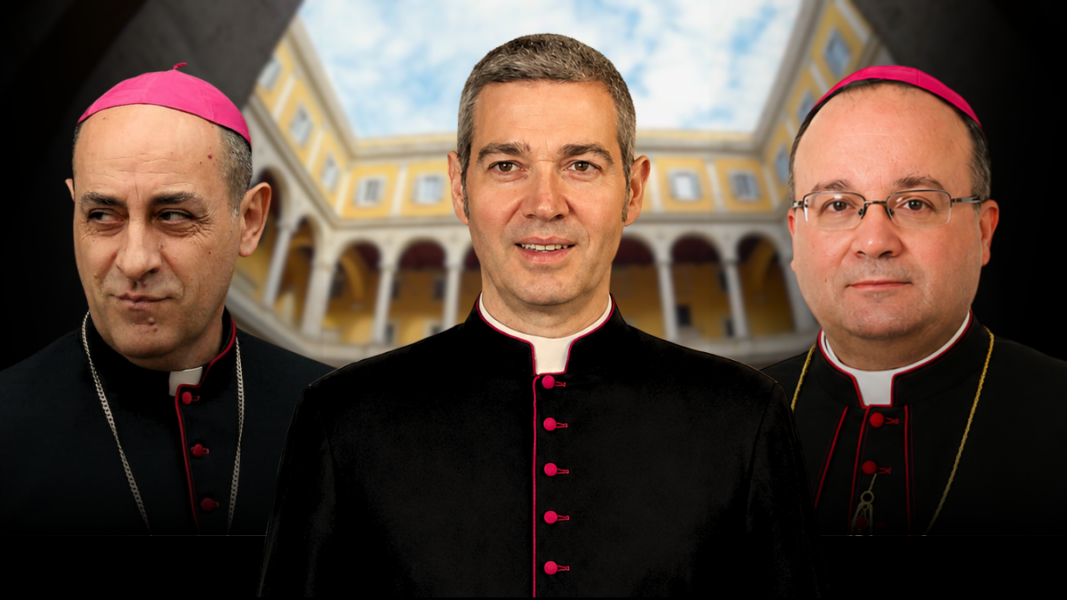
InfoVaticana publishes today two audio recordings of Monsignor Jordi Bertomeu, an official at the Dicastery for the Doctrine of the Faith and one of the principal instructors of sexual abuse cases within the Church. This Spanish priest is part of the core of the Roman apparatus that decides how some of the most sensitive canonical cases against clergy accused of sexual abuse are investigated, prosecuted and resolved, and for years has served as one of the trusted operational pieces used by Rome in cases of greater international impact. He has been a trusted aide of Pope Francis, continues to be so under the current pontificate, and works at a very high level within the dicastery directed by Cardinal Víctor Manuel "Tucho" Fernández under the wing of Archbishop Charles Scicluna.
The figure, moreover, arrives in this story without a clean record. Bertomeu already carries with him the delirious controversy of having been singled out for formally threatening excommunication to two lay journalists who had reported him themselves to civil and canonical justice for an alleged breach of confidentiality. That episode, which in any other institution would have proven politically devastating, also functions as a very precise warning about how part of the Roman apparatus continues to understand power, public criticism and control of the narrative when uncomfortable accusations or sensitive investigations come into play.
The audio recordings contain a coherent, reiterated and extraordinarily clear explanation of how sexual abuse is understood from within part of the ecclesiastical structure charged precisely with combating it. And what Bertomeu explains, with a clarity as raw as it is unusual in a high-ranking ecclesiastical official, is that the ultimate priority of the Church continues to be to protect itself and to protect itself from scandal even in the context of sexual crimes committed by clergy.
He speaks moreover with unusual frankness. He explains that the Church does not have sufficient means, that victims "also have reparation in the civil sphere" and that, above all, the institution must protect itself. That is: the victim can turn to the State; Rome must focus on preserving the Church.
Video player
00:00
00:27
This is the first complete fragment:
"I have told him this sometimes, it is very limited, very limited, because we do not have the judicial or police structure of the States. I would like to have a team of a hundred people behind me, and... and all of Interpol and everything you want. We don't have it. With the means we have, with the means we have, we have to try to protect the Church first. The Church Mystical Body of Christ. That is, why? Because victims also have reparation in the civil sphere. They can turn to civil judges."
The central phrase shatters years of institutional rhetoric constructed around victims as the supposed "absolute priority" of the Church following the major abuse crises of recent decades. Because Bertomeu does not say that the primary objective is to clarify the truth, repair the wounded or radically expel any corporate logic. He says something else. He says that "we have to try to protect the Church first".
And then he completes the reasoning by de facto shifting the reparation of victims towards civil jurisdiction, as if the existence of state courts allowed the Church itself to partially shed a moral, institutional and legal responsibility that is born precisely within its own structures.
In the second audio Bertomeu attempts to justify that institutional priority by resorting to a comparison that lays bare the real core of the logic with which he is thinking.
Video player
00:00
01:01
This is the second complete fragment:
"So when civilly, here it is, when it is civilly prescribed, we have a problem, okay? So, canonically you have to do something, but above all we have to protect the Church and this, which, well... with civil eyes it doesn't make sense, because that would seem like the law of the Third Reich, right?, that above the person is the people, is the Volk, right? That is, for us above the person is the good of the Church, which is the good of Christ. So, in this case, that is, it is not subordinating the person, we don't subordinate them, but we also have to take into account the good of the Church. And it is not always easy, right?, and people don't always understand it. And you do it with means, I insist, very, very, very poor, because well I would like to have a, well this, much more mature legislation, a more powerful judicial system, with more human means, technical, etc. And I don't have it, period, that's what there is and with what we have we have to try to protect the Church from scandal."
The comparison is not formulated by a hostile journalist, nor by a resentful victim, nor by an ideological adversary of the Church. It is formulated by Bertomeu himself while attempting to justify why the "good of the Church" should be placed above the concrete person. And precisely for this reason the fragment is so devastating: because it verbalizes in an involuntarily transparent manner a mental structure that the Church had been assuring for years that it had left behind.
Bertomeu attempts to soften the scope of the analogy by replacing the "Volk" with "the Church" and with "Christ", but the approach is per se devastating: he has just described a moral scheme in which the institution occupies a plane superior to the concrete individual who has suffered sexual abuse within it.
That logic—the practical subordination of the victim to institutional interest—is exactly the same that for decades allowed cases to be hidden, abusive priests to be transferred from diocese to diocese, evidence to be destroyed, victims to be silenced and sexual scandal within the Church to be managed as essentially a reputational problem rather than confronted as a moral and legal crime.
The most serious aspect of the audio recordings is not the tone. It is the criterion. Because when one of the men charged with instructing canonical cases explains that faced with crimes civilly prescribed "we have a problem" and that the governing objective is to "protect the Church from scandal", he is describing a logic extraordinarily close to institutional cover-up.
It is not necessary to directly participate in the principal crime to materially contribute to a system of impunity. It is enough to make the protection of the institutional structure a priority superior to the truth of the facts, to the effective reparation of victims and to the elementary duty of justice.
It is moreover impossible not to note the disastrous theological foundation of the argument of the high Vatican official. Bertomeu invokes the "good of the Church" and the "Mystical Body of Christ" to justify a counterbalance against the rights of victims. But Christianity does not identify Christ with institutional self-protection. It identifies him precisely with the wounded, with the small, with the destroyed. "Whatever you did for the least of these brothers of mine, you did for me." Using the "good of the Church" to relativize the justice owed to victims of sexual abuse committed by clergy is not defending the Church. It is completely inverting the Gospel.
For years the faithful were promised that the Church had learned. That victims were now the absolute priority. That the time of clericalism, of containment maneuvers and institutional cover-up had definitively ended. But the audio recordings that InfoVaticana publishes today show one of the most relevant men in the Vatican, charged with managing these cases in the name of the Pope, explaining with absolute naturalness that the priority continues to be "to protect the Church from scandal". And when this is said precisely by one of the officials charged with combating sexual abuse within the Church, the problem is no longer a communication crisis nor an isolated rhetorical error, but the mentality that continues to govern part of the system.