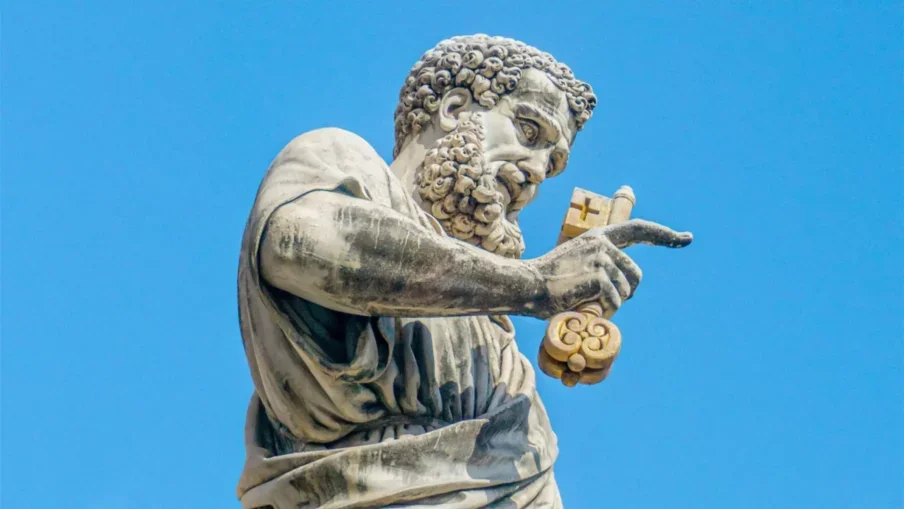
Often and willingly, the words of the Gospel, precisely because they are heard so many times, risk no longer being truly understood. They slip into memory with the form that liturgical tradition has rendered familiar and end up no longer surprising us. This can also happen with the words addressed by Jesus to Peter at Caesarea Philippi: «To you I will give the keys of the kingdom of heaven: whatever you bind on earth shall be bound in heaven, and whatever you loose on earth shall be loosed in heaven» (Mt 16:19). This is how we read it in the translations of the Italian Episcopal Conference. But the Greek text reveals a deeper nuance, which is not a mere grammatical detail: it concerns the very manner of understanding Peter’s authority and, through him, every authority exercised in the Church.
The Greek text reads:
ὃ ἐὰν δήσῃς ἐπὶ τῆς γῆς, ἔσται δεδεμένον ἐν τοῖς οὐρανοῖς· καὶ ὃ ἐὰν λύσῃς ἐπὶ τῆς γῆς, ἔσται λελυμένον ἐν τοῖς οὐρανοῖς.
Transliterated, without accents:
ho ean deses epi tes ges, estai dedemenon en tois ouranois; kai ho ean lyses epi tes ges, estai lelymenon en tois ouranois.
A careful translation of the grammatical construction might sound like this:
«Whatever you shall have bound on earth shall have been bound in heaven, and whatever you shall have loosed on earth shall have been loosed in heaven».
The forms deses and lyses are aorist subjunctives, introduced by ean, and indicate the possible future action of binding and loosing: «whatever you bind», or, in the future context of the promise, «whatever you shall have bound» and «whatever you shall have loosed». But the most significant part is found in the expressions estai dedemenon and estai lelymenon. Estai is the future of the verb «to be»; dedemenon and lelymenon are perfect passive participles. The Greek perfect does not merely indicate an action that has occurred, but above all the present state produced by an action already completed: something is found in the condition of having been bound or loosed.
The construction can thus be rendered literally as «shall have been bound» and «shall have been loosed». This observation should not be turned into a rigid chronological calculation, as if one could measure a «before» in heaven and an «after» on earth. The language rather concerns the origin and conformity of the decision: whatever Peter truly accomplishes on earth must be in conformity with what is established in God. Peter does not impose his will upon heaven; he recognizes, serves, and makes operative in history the will that comes from heaven.
Even the Vulgate of St. Jerome preserves this important nuance:
Et quodcumque ligaveris super terram, erit ligatum et in caelis; et quodcumque solveris super terram, erit solutum et in caelis.
The literal translation is:
«And whatever you shall have bound on earth shall have been bound also in heaven; and whatever you shall have loosed on earth shall have been loosed also in heaven».
Here, ligaveris and solveris express the future action considered in its completion: «you shall have bound», «you shall have loosed». The expressions erit ligatum and erit solutum are formed from the future of esse united with the perfect passive participle: grammatically, they correspond to «shall have been bound» and «shall have been loosed». Had the intention been to express only the simple future passive, Latin would have used the forms ligabitur, «shall be bound», and solvetur, «shall be loosed». Jerome, therefore, does not erase the density of the Greek construction but preserves it through a Latin formulation very close to the original.
The CEI translations, both that of 1974 and that of 2008, render the passage instead with «shall be bound in heaven» and «shall be loosed in heaven». This is a linguistically comprehensible and traditionally established rendering, but it does not make visible to the Italian reader the value of the perfect present in the Greek and preserved in the Latin of the Vulgate. The Italian «sarà legato» («shall be bound») can indeed suggest a different sequence: first Peter decides on earth, and then heaven confirms his decision. The original text, however, points toward a more delicate understanding: when Peter binds or looses according to Christ’s mandate, his decision must manifest on earth what is already in conformity with the heavenly will.
This difference is theologically decisive. If one reads only «whatever you bind shall be bound», one might receive the impression that Peter is granted unlimited power, capable of obliging God to ratify any human decision. As if Jesus had said: «Whatever you establish, heaven will be bound to approve it». Such an interpretation would transform ministry into autonomous sovereignty and the keys of the Kingdom into instruments of possession. But the Gospel does not entrust to Peter dominion over the Kingdom; it entrusts him with the keys of a Kingdom that remains God’s.
For a long time, especially in popular preaching and in certain simplified representations of ecclesiastical authority, the verse has sometimes been perceived almost as the granting of absolute power. It must, however, be clarified that the best Catholic theological tradition has never considered Peter’s authority as unlimited or superior to the Word of God. The Pope is not the master of revelation, cannot create a truth different from the Gospel, and cannot render just what God declares unjust. He is the guardian, witness, and servant of the deposit of faith. The grammatical precision of the text does not therefore destroy the primacy of Peter: it purifies it from an arbitrary reading and reveals its true greatness.
Peter truly receives the keys. His authority is not apparent, symbolic, or devoid of consequences. He is called to bind and loose, to guard communion, to discern, to admit and, when necessary, to exclude; to declare what is in conformity with the Gospel and what contradicts it; to confirm the brethren in the faith and to serve the unity of the Church. But precisely because this authority is real, it must remain radically obedient. It is not the authority of one who substitutes for God, but that of one who listens to God in order to serve the brethren.
The scene at Caesarea Philippi shows this clearly. Peter can confess: «You are the Christ, the Son of the living God», not because he has arrived at this truth by himself, but because the Father has revealed it to him: «Flesh and blood have not revealed this to you, but my Father who is in heaven» (Mt 16:17). The authority of the keys thus arises from a revelation received, not from a superiority possessed. Peter can speak rightly only when he listens to the Father. When, however, a few verses later, he presumes to indicate to Jesus a path different from that of the cross, he receives the severest rebuke: «Get behind me, Satan! You are a hindrance to me; for you are not on the side of God, but of men» (Mt 16:23).
It is the same Peter, but not always the same quality of listening. When he welcomes what comes from the Father, he becomes the rock upon which Christ builds. When he follows merely human thought and seeks to turn the Messiah away from the cross, he becomes a stone of stumbling. The Gospel thus places, in the same chapter, the promise and the limit, the authority and the necessity of conversion, the greatness of the ministry and the fragility of the one who receives it. Peter is not guaranteed in every private word or initiative; he is sustained in the fulfillment of the mission entrusted to him, within the listening to Christ and obedience to the apostolic faith.
The language of «binding» and «loosing» must also be understood against the biblical and Jewish backdrop. It could indicate forbidding and permitting, declaring something obligatory or licit, excluding from the community or readmitting to communion. In Matthew 18:18, the same expression is addressed to the community of disciples, in the context of fraternal correction and reconciliation. The ministry entrusted in a particular way to Peter does not therefore separate him from the Church but places him at the service of its faith and communion.
The first great manifestation of this task appears in the Acts of the Apostles. Peter opens the announcement of the Gospel to Israel on the day of Pentecost and, subsequently, enters the house of the Gentile Cornelius. But even at that moment, he does not arbitrarily decide to alter God’s design. He is preceded by a vision, is reached by the Spirit, and recognizes what God is already accomplishing: «If then God gave the same gift to them as he gave to us when we believed in the Lord Jesus Christ, who was I that I could withstand God?» (Acts 11:17). This question perhaps contains one of the most beautiful commentaries on the keys and the power to loose. Peter does not say: «I have decided, and God has approved». Essentially, he says: «God has acted; who am I to hinder God?» He opens because God has already opened; he looses because the Spirit has shown that those brethren have been received.
The same principle emerges at the Council of Jerusalem. The apostles do not seek to impose their own will but to recognize the divine action among the Gentiles. The concluding formula is significant: «It has seemed good to the Holy Spirit and to us» (Acts 15:28). Not «to us and therefore to the Holy Spirit», but «to the Holy Spirit and to us». First comes God’s initiative; then the ecclesial discernment that welcomes it, interprets it, and translates it into a concrete decision.

From this reading, important consequences also arise for the life of the Church. Every Christian authority, from the ministry of Peter to the humblest service exercised in a community, loses its meaning when it ceases to listen. It is not enough to have received an office to automatically know God’s will. One must remain in the Word, pray, confront oneself with the apostolic faith, listen to the Spirit, welcome the discernment of the Church, and look attentively at the wounds of men.
Evangelical authority does not first ask: «What can I impose?», but: «What is God asking?» It does not inquire how to have heaven ratify a decision already made, but how to recognize and serve on earth what belongs to heaven. The greater the authority received, the deeper must be the obedience. The more decisive the keys entrusted, the purer must be the listening.
There is also a spiritual consequence that concerns every believer. We too are often tempted to ask God to confirm what we have already decided. We formulate our plans, build our judgments, establish who is right and who is wrong, and only afterward seek a religious word that will justify us. The Gospel overturns this movement. We must not drag heaven into our decisions; we must allow heaven to illuminate and convert the earth of our lives.
To bind and to loose thus also means learning to distinguish the bonds that safeguard life from those that suffocate it. There are bonds of fidelity, truth, and responsibility that must not be loosed lightly. But there are also chains of sin, fear, resentment, exclusion, and despair that the Gospel calls us to break. The Church does not receive the keys to shut men away from God but to guard the entrance to the Kingdom and open the way of reconciliation, without separating mercy from truth.
The strength of the word addressed to Peter does not lie in granting him arbitrary omnipotence. It lies in associating a human, fragile, and historical decision with the eternal design of God, provided it remains in listening to His will. It is an immense promise and, at the same time, a responsibility that makes one tremble. Peter is called to speak on earth with his eyes turned toward heaven; to decide without becoming master; to guard without imprisoning; to loose without dissolving the truth; to bind without transforming the Gospel into an unbearable burden.
Perhaps we must return to reading these words slowly. Not to diminish Peter, but to understand him better. Not to weaken the authority of the Church, but to lead it back to its source. Authority is truly apostolic when it does not force heaven to follow the earth, but helps the earth to recognize heaven. The keys are authentically in Peter’s hands when his hands remain open before God: hands that have received, hands that serve, hands that do not possess the Kingdom but point to it and open its door.»