Due to the intense pressures exerted by the “San Gallo mafia”—which it is not rash to identify with the Vatican mafia—when a member of the Masonic Ur-Lodge Maat named Barack Obama blocked the Vatican bank through the SWIFT code, Benedict XVI understood that the conditions for governing the Church no longer existed. Ratzinger’s resignation gave rise to a plethora of low-level questions, yet some have posed serious inquiries: why did the Pope not reveal that he had resigned due to the now unsustainable Masonic pressures and instead invented the ingravescente aetate? Why did he step aside knowing full well that his successor would be an apostate preaching a new religion? Like children, we would like an answer for everything we cannot explain, but this is not granted to us, and we must trust in God’s design. In any case, Benedict XVI devised a brilliant plan to invalidate the conclave. If the Pope had truly renounced the munus petrinum, his successor would have been validly elected, but Ratzinger knew of the conspiracy to place an impostor on the throne of Peter, and for this reason he crafted a sophisticated declaration to declare himself in sede impedita (can. 412; cf 335), thereby rendering the election of his successor null and void.
What Benedict XVI revealed to Vittorio Messori on 9 September 2015 must have been terrible, for during a public meeting in June 2016, the journalist himself replied to an interlocutor in this manner: “not even with pliers will you ever drag out what Ratzinger truly told me.” Some of those who did not accept Benedict’s plan accused him of senility, yet in the years following his resignation, the holy man demonstrated full lucidity and awareness of his gesture. In the prophecies of Malachy, it is written that Benedict XVI (identified as Gloria olivae) is the last Pope as we have hitherto conceived him, and after his resignation, Peter Seewald asks Ratzinger what he thinks of this prophecy. By the strictest logic, and without hesitation, Benedict should have answered that Francis was his legitimate successor elected by a regular conclave, and thus such fanciful prophecies should not be believed. Surprisingly, Ratzinger replied: Everything is possible. Indeed, after the Declaratio of 11 February, Benedict reiterated on multiple occasions that he was leaving the “Petrine ministry,” but not the munus: «The “always” is also a “forever”; there is no return to the private sphere.» Immediately afterward, he specified that he had not ceased to be Pope: “My decision to renounce the active exercise of the ministry does not revoke this.” He reiterated the same point in the preface to the 2023 book What is Christianity: «When, on 11 February 2013, I announced my resignation from the ministry of the Successor of Peter, I had no plan whatsoever for what I would do in the new situation.» If Benedict had truly resigned the papacy, Bergoglio’s election would have been fully valid, whereas Ratzinger composed a text difficult to interpret, deliberately written in poor Latin yet meticulously crafted to declare himself in sede impedita, in which the munus is preserved, but the ministerium is lost. A scholar of the Latin language of Matteo Corrias’ caliber has defined the Declaratio as a work of “literary engineering.” Moreover, it must be ruled out that Ratzinger was confused, for he not only knew Latin exceedingly well, but the 1983 Code of Canon Law was curated and revised by him. In 2013, some noticed the irregularity of the resignation, but only after the Vatican mafia’s falsification of the Declaratio’s translation into other languages was uncovered did in-depth studies commence, yielding surprising results.
The resignation of Benedict XVI is invalid for many reasons already excellently expounded by other authors, and I would like to recall but a few aspects:
First three grounds for invalidity.
Can. 332 - § 2: «If it happens that the Roman Pontiff resigns his office (munus), for validity it is required that the resignation be freely made and duly manifested; it is not, however, required that it be accepted by anyone.» 1) Benedict did not read a Resignation, but a Declaration, that is, a Decision. 2) He did not renounce the munus, but only the active ministry. 3) For these reasons, his resignation of the papacy was not duly manifested, and is therefore null.
Fourth ground.
Canon 332 was confirmed by John Paul II in Universi Dominici Gregis: «76. If the election were to take place otherwise than as prescribed in this Constitution or if the conditions laid down here were not observed, the election would thereby be null and void, without any need for a declaration to that effect, and consequently it would confer no right on the person elected. 77. I decree that the provisions concerning all that precedes the election of the Roman Pontiff and the carrying out of the same must be observed in full, even if the vacancy of the Apostolic See should occur as a result of the resignation of the Supreme Pontiff, in accordance with can. 332, § 2 of the Code of Canon Law.»
Fifth ground.
If, during a Catholic wedding rite, the groom were to say: “I, N., take you, N., as my spouse… but not today, rather in 25 days at 8:00 PM,” the juridical act would be null due to a defect of form and substance, for an «actus juridicus purus» cannot be deferred in time but must take immediate effect (can. 1102,2). All the more so do these reasons apply in the case of a Pope’s resignation, where the actus juridicus purus admits no accidental elements such as terms, conditions, or modes.
Sixth ground.
Msgr. Gänswein wrote that the text of the Declaratio was reviewed and corrected by Cardinal Bertone and Msgr. Gloder. If we consider that subsequently the same text was tampered with by the Vatican mafia through false translations, to know the words pronounced by Benedict XVI we must rely exclusively on the audio. After appropriate investigations, it was understood that the Pontiff denounced a conspiracy waged against him: Therefore, fully aware of the weight of this act, I declare in full freedom to renounce to my detriment (mihi) the ministerium of Bishop of Rome, Successor of Saint Peter, on account of the misdeed (commissum) of a band (manus) of cardinals on the day of 19 April 2005, so that from the day of 28 February 2013, at the twentieth hour, the see of Rome, the see of Saint Peter, remains vacant (vacet). It is no coincidence that on the day of the election of “Pope Francis,” Cardinal Godfried Danneels, a prominent member of the San Gallo mafia, was present on the balcony of Saint Peter’s.
Seventh ground.
Benedict claims to have resigned due to advanced age. In 1994, John Paul II tasked Cardinal Fagiolo, as president of the Pontifical Council for the Interpretation of Legislative Texts, with studying the juridical and ecclesiological implications of a Pope’s resignation. The cardinal responded: «in an absolute and definitive manner, the Pope can never resign solely on account of age.» In those years, Ratzinger was prefect of the CDF, and knowing the cardinal’s ruling, he exploited it to his advantage.
Eighth ground.
On 28 February, Benedict XVI should have officially ratified his resignation from the papacy announced on 11 February, yet instead he merely offered an informal greeting to pilgrims, replacing Supreme Pontiff with an expression perhaps used centuries ago but which today makes no sense: “You know that this day of mine is different from the previous ones; I am no longer the Supreme Pontiff of the Catholic Church: until eight in the evening, I still am, then no longer.”
Ninth ground.
The Declaratio has been made to disappear, and thus we possess no canonically valid resignation signed by Benedict XVI. Pressed from multiple quarters, the Vatican has refused to provide answers on this matter.
Tenth ground.
It is perfectly futile to argue that irregularities in the drafting of the Declaratio by the Pontiff affected the liceity rather than the validity of the resignation. The notion that Bergoglio was validly elected because chosen by a majority of cardinals without any opposition is pure strategic opportunism. Likewise, to claim that although the election was invalid, any deficiencies were in fact remedied by the active exercise of the ministry is simply an ideological convenience with no basis in the CIC, and moreover clashes with Universi Dominici Gregis (3). It goes without saying that the Vatican mafia cared nothing for Canon Law, being solely concerned with eliminating Benedict XVI.
The Carnival Jest.
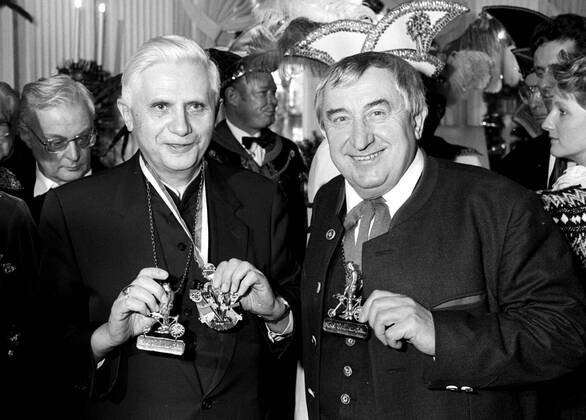
We have already asked ourselves why Benedict wrote a Declaratio that appears ambiguous and of doubtful meaning, but a sufficiently convincing key to its interpretation is not lacking. Karl Valentin, the pseudonym of Valentin Ludwig Fey (1882–1948), was a singer, actor, and cabaret performer greatly admired by Joseph Ratzinger; suffice it to recall that as a seminarian, he walked 15 km on foot to visit the actor’s grave and pray there. In Ultime conversazioni, Ratzinger recounts that Hitler said to the comedian: «“Mr. Valentin, you have often made me laugh heartily.” And he replied: «“Whereas you have never made me laugh.”» On 4 January 1989, Cardinal Ratzinger was awarded the “Order of Karl Valentin” by the carnival society Narrhalla, the oldest and most renowned in Munich. The award was granted to Ratzinger for two reasons in particular: 1) he was the most illustrious living Bavarian admirer of the comedian; 2) for his ability to embody Valentin’s spirit: the inverted logic, the shrewd irony, the subtle argumentation, the capacity for self-irony, and the humor. In 1989, the cardinal was prefect of the CDF, seemingly the furthest thing from a buffoonish order.
In thanking the honor society, the cardinal said: “A buffoonish order, through which we mock ourselves and the gravity of the great world, is a good thing. And it is for this reason that I have gladly accepted it. Some have expressed doubts as to whether this accords with an occupation as serious as mine. To me, it seems to fit perfectly, since it is well known that the privilege of speaking the truth belongs to fools. At the courts of ancient potentates, the jester was often the only one permitted the luxury of truth… And since in my occupation I am called to speak the truth, I am truly happy to have been accepted into the category of those who enjoy that privilege… «We are fools for the sake of Christ»” (1Cor 4,10). On 5 August 2006, Benedict XVI was asked: “In 1989 in Munich you were awarded the Karl Valentin Order. What role do humor and lightness of being play in the life of a Pope?” His response: “(laughs) I am not a man to whom jokes constantly occur. But knowing how to see the amusing aspect of life and its joyful dimension, and not taking everything so tragically, I consider this very important, and I would say necessary for my ministry. A certain writer once said that angels can fly because they do not take themselves too seriously. And perhaps we could fly a little more if we did not take ourselves so seriously.”
The Bavarian comedian—also known as the “German Charlie Chaplin”—created a style of comedy based on paradox and the literal dismantling of language; he loved wordplay, and in his theater performances he would begin with a misunderstanding, developing it throughout the show. Benedict imitated him. When, on 4 February 2013, the Office of Liturgical Celebrations announced an Ordinary Public Consistory for the 11th of the same month, motivated by the canonization of certain saints, Ratzinger’s jest was already prepared. The Declaratio was pronounced on 11 February, the feast of Our Lady of Lourdes, but also on Carnival Monday, the very day on which Valentin died. Benedict XVI played a trick on the enemies of the Church and, without renouncing the papacy, declared himself in sede impedita, automatically nullifying the election of a new Pontiff.
In August, LifeSiteNews recalled the initiative of former magistrate Angelo Giorgianni, who on 11 March sent Cardinal Parolin a formal complaint regarding two grounds for the invalidity of the 2025 conclave. On 9 April, the same magistrate sent another complaint to the Vatican Secretary of State regarding a third irregularity of the conclave. Giorgianni’s initiative is certainly commendable, yet it is obvious that he will receive no reasonable response from the accomplices of Prevost. The efforts of Andrea Cionci also merit praise, but the attention the journalist has thus far received from the Vatican amounts to nothing more than powerful anesthetics that, moreover, do not favor a serene awakening. In this state of «canonical sedation,» Cionci imagines that the Holy See will soon depose Leo XIV and convene a conclave composed of cardinals chosen by Benedict XVI (?!). It is unthinkable to believe that the current sede vacante can be resolved by the initiatives of the Vatican, for Satan does not have the audacity to cast out Satan: «Now if Satan casts out Satan, he is divided against himself; how then will his kingdom stand?» (Mt 12,26).
The antichristic power wielded by Leo XIV, justly denounced by both Viganò and Cionci, may yet splinter into further schisms, yet it will remain firmly in place until—announced in many prophecies—it is annihilated by God’s powerful and extraordinary intervention. Thus did the Lord say to an American mystic in July: “This Hour, the darkest of all, must be traversed; the bitter cup must be drunk; tears and pain must be endured.” Those who have faith are warned: we must be ready to live through exceedingly dark times.
Antonio Romano