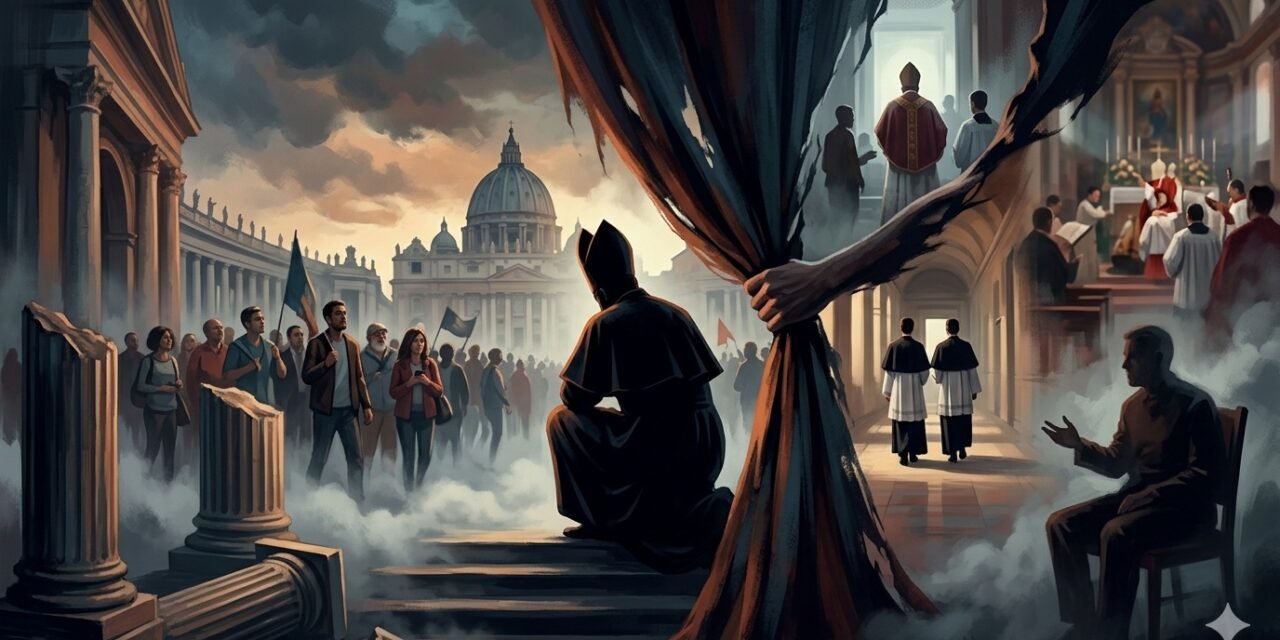
The debate on holiness in the contemporary Church has now assumed the features of an ideological farce which it is no longer possible to witness in silence. Already the canonizations of post-conciliar Popes pose not a few problems of a theological and doctrinal nature. As rightly noted for decades by the clearest voices of Tradition — first and foremost the FSSPX — there has been a concerning mutation of the very concept of holiness: no longer the recognition of heroic virtue and the defense of the integrity of the Faith, but a sort of "self-beatification" of an ecclesial era. By canonizing the Popes of the Council, an attempt was made to render infallible and untouchable a pastoral experiment that produced only empty seminaries, silent apostasy, and liturgical chaos.
But if already the reservations about a Paul VI or a John Paul II are founded on an evident rupture with previous Magisterium, the indiscretion of these days that would begin the cause of beatification for Pope Francis (today, April 21, the first anniversary of his death) exceeds the limit of decency. Here we are no longer in the field of "interpretative difficulties": we are confronted with the final outrage.
One thing is proper charity toward the person, another is the hypocrisy of proposing as a model of holiness one who made ambiguity his banner and criticism of the faithful his style of governance. It is time to tear away the veil of this religious populism and return to asking ourselves what it truly means to be "Holy" and what it truly means to be "Pope".
We live in the era of triumphant ignorance, where Catholicism has been reduced to vague sentimentalism and holiness to a form of institutional courtesy. The crowd, now starved of Catechism and intoxicated by media, invokes halos for anyone who appears "approachable", "kind" or "spontaneous". But canonizable holiness is not a prize for popularity, nor is it the recognition of a presumed "humanity". The holiness of a Pope is the reflection of his absolute fidelity to Christ's mandate, not his ability to gather the likes of laicist elites.
Today the fatal error is committed of judging a Pontiff not by the exercise of his divine office, but by human virtues that even an honest philanthropist might possess. Being "approachable", refusing the honors of rank, or speaking in colloquial language are not signs of holiness: they are choices of (bad!) style, tinged with a populism that destroys the majesty of the Vicar of Christ.
Heroic holiness is something else. It is the fortitude of those who defend dogma against the world, it is the temperance of those who do not yield to the blandishments of the powerful, it is the justice of those who call sin by its name. Elevating "kindness" to the altars means emptying Paradise and transforming it into a bourgeois drawing room where the only rule is not to disturb anyone.
One must have the courage to ask: who have been – and who are – the greatest supporters of this kingdom? The answer is chilling: atheists, non-believers, divorced and remarried adulterers, LGBTQ+ activists. And why do they love him? Not because they have discovered in him the path of conversion, but because in him they have found the confirmation of their own state.
This is where the most tragic deception is accomplished. The image of Jesus eating with tax collectors and prostitutes is used to justify an indulgence that does not redeem, but condemns.
Jesus did not become a tax collector. He sought sinners to snatch them from the mud, not to tell them that the mud was a blessed place. Sinners did not remain as such. Magdalene ceased to sin, Matthew abandoned his tax booth.
Today, instead, the message that comes from the Chair of Peter seems to be: "Remain as you are, you are already blessed". But a shepherd who confirms the sheep in its wandering toward the wolf is not a holy shepherd; he is a shepherd who has abdicated his duty.
Thank you, say the distant, for removing the weight of guilt without asking us for the sacrifice of change! But this is not love, it is a spiritual euthanasia disguised as mercy.
The last – or, perhaps, the further – act of this theater of the absurd was played out just last evening, on Cinque Minuti. Bruno Vespa interviews Massimiliano Strappetti, the healthcare assistant who attended the Pope in his final moments. What emerges is a dialogue that should make the pulse of anyone with even a glimmer of sensus fidei tremble. Strappetti recounts having confessed from the start his discomfort about his condition as a divorced man; the Pontiff's response? Not a call to conversion, not a word about the cross and fidelity to the sacraments, but a question that smacks of unconditional surrender: "But do they give you communion in church?".
And to Strappetti's seraphic response— "Yes, my parish priest doesn't concern himself with such matters" — the Vicar of Christ did not bat an eye. Here is the vivid image of today's Church: a place where sin no longer exists because the parish priest "doesn't concern himself" and the Pope endorses it with a silence that is doctrinal complicity.
We have moved from "Go and sin no more" to "Go ahead, the parish priest agrees anyway". If this is the model of holiness one wishes to propose, then we are telling the world that the Gospel was a useless burden and that two thousand years of confessors, martyrs of chastity, and defenders of the indissolubility of marriage were merely "rigid" fanatics.
Faced with such a scenario, where the Vicar of Christ not only remains silent in the face of error, but encourages it with a knowing television gesture, how can one still deny the existence of a state of necessity in the Church?
Canon law is not a cold code of procedures, but is animated by the supreme principle of Salus animarum: the salvation of souls. When authority, which should be the bulwark of Truth, becomes a collaborator in confusion, the faithful finds himself in a condition of spiritual emergency. If the Pope endorses the practice of a parish priest who "doesn't concern himself" with trampling God's commandments and the very words of Christ on adultery, the hierarchical order is, de facto, overturned. One cannot obey one who commands — or suggests — offending God. In this doctrinal desert, "disobedience" to modernist novelties becomes the only true obedience to the Church of all ages.
Denying the state of necessity today means being complicit in the dissipation of the flock. If a man can receive the Eucharist in a state of public sin with the distracted blessing of the Supreme Pontiff, it means that those occupying positions of government in the visible structure have ceased to pasture and have begun (or, rather, continued) to scatter. Is this the "holiness" we wish to elevate to the altars? The holiness of one who has made God's Law optional?
A holy Pope must "confirm the brethren" in the only true and integral Catholic faith. Francis, by contrast, chose to confirm the world against the brethren who sought to remain faithful. He often treated the enemies of the faith with kid gloves and sometimes with a club the priests and faithful bound to Tradition, labeling them as "rigid" or "sick".
A Pope who acts as an «ideological dictator», who demolishes the millennia-old liturgy of the Church and who introduces ambiguity into the heart of the sacrament of marriage, is not exercising heroic virtue. He is exercising worldly power for worldly ends, in full contrast with the words of the Lord Jesus: «Woe to you when all speak well of you» (Lk. VI, 26).
We cannot allow holiness to be reduced to an extension of political correctness. If the criterion for being holy becomes being accepted by those who hate the Church, then the martyrs of the past have wasted their blood.
The Church does not need a "Pope of the people", it needs a Pope of God. The holiness we ask for the successor of Peter is that of one who knows how to be hated by the world for the love of Truth, not one who makes himself loved by the world at the price of Truth. Before speaking of beatification, one should speak of reparation for the loss into which millions of souls have been cast.
Holiness is not a democratic honor nor can a press office fabricate a made-to-order halo for the needs of the age. Truth is not voted by majority and God will not be mocked: Deus non irridetur. One can even force the hand of history and canonical processes, but one immutable fact remains: a Pope who does not confirm the brethren in the two-thousand-year Faith, but abandons them to doubt and error, may perhaps have the applause of the squares and the obituaries of the powerful, but can never be the model for those who seek the salvation of their soul.
Holiness is a steep summit, not a slide downward. And heaven, unlike Vatican chronicles, knows nothing of "political correctness". Before invoking halos, let us tremble at the thought of Judgment: because to whom much has been given — and to whom sits in the highest Chair — much, infinitely much, will be required. And those who have sought only the world's "I know you", always end up hearing the "I do not know you" from Our Lord Jesus Christ! Of course, always hoping for all a final change of heart, which however does not change the public fact of which we speak.
We do not need a Pope for the cover, we need a Pope who brings us to God.
Everything else is smoke, and it is the smoke of Satan!
Exaltare, qui judicas terram; redde retributionem superbis.
Usquequo peccatores, Domine, usquequo peccatores gloriabuntur;
effabuntur et loquentur iniquitatem;
loquentur omnes qui operantur injustitiam?
Populum tuum, Domine, humiliaverunt, et hæreditatem tuam vexaverunt!