He brought boys to his bed, kissing them long on the mouth and rubbing against them under the pretext of talking about God, made them undress and caressed them while bathing naked with him during summer camps. Candlelit dinners in which the boys were encouraged by the priest to touch each other, manipulations lasting years, with praise and promises of being part of a spiritual elite where common rules do not apply.
Yet all this was not enough to bring the abuser to trial: the case of Don Valentino Salvoldi, priest of the diocese of Bergamo, responsible for molesting and sexually abusing at least 21 boys, including several minors, concluded with criminal and ecclesiastical dismissal.
On September 3, 2024, prosecutor Elena Torresin, deputy prosecutor of the Republic of the Udine court, had already decided not to proceed against the priest, now eighty years old, because the crimes had been prescribed, a decision later confirmed in 2025 by the Dicastery for the Doctrine of the Faith, which decided to «not derogate from the statute of limitations that had elapsed».
Pope Francis had repeatedly stated that abuse of minors in the Church does not expire and that the statute of limitations is always waived in these cases, but the judges of the Dicastery led by prefect Tucho Fernandez must have short memories. After all, Bergoglio's exhortation to "zero tolerance" on abuse has also remained a statement of intent, something that is right to say but which one has no real intention of putting into practice, certainly not at the expense of the Church's good name and its bishops.
It was precisely on abuse and the failure to listen to victims that Pope Leo also returned at the beginning of January, in his closing remarks of the first extraordinary consistory of his pontificate, held before 170 cardinals:
«Abuse itself causes a deep wound that perhaps lasts a lifetime; but often the scandal in the Church is because the door has been closed and the victims have not been welcomed, accompanied by the closeness of authentic pastors».
However, the Vatican's full awareness of the problem does not correspond to an adequate reaction: ecclesiastical authorities, at all levels, continue to keep sealed the drawers with documents on cases of sexual violence and are eager to close difficult cases of clerical pedophilia, so they can proceed undisturbed, as demonstrated by the immovable bishop of Piazza Armerina Rosario Gisana (of whom we spoke in the podcast La Confessione), today on trial for perjury.
The legal case of Don Salvoldi is therefore very interesting because it highlights the omertà behavior, the total lack of transparency and the Church's culpable delay in cases of abuse.
Not only that: priests and bishops are so indifferent to the suffering of victims that they don't even bother to save face, and it even happens that they have investigations into pedophile priests conducted by the same people who work in the diocesan Services for the protection of minors.
We'll get there. First, however, it should be emphasized that, once again, if we have learned about the case of an abusive priest, it is certainly not thanks to any gesture of transparency by the Church, which is directly responsible for it, but only due to the courage of the victims, who reported him to the magistracy and the press.
Foremost among them is Stefano Schiavon, who was 17 years old at the time of the events and who traced dozens of boys who attended the summer camps organized by the charismatic Bergamo priest between the nineties and two thousand, precisely reconstructing the dynamics of approaches, manipulation and abuse.
But who is Don Salvoldi?
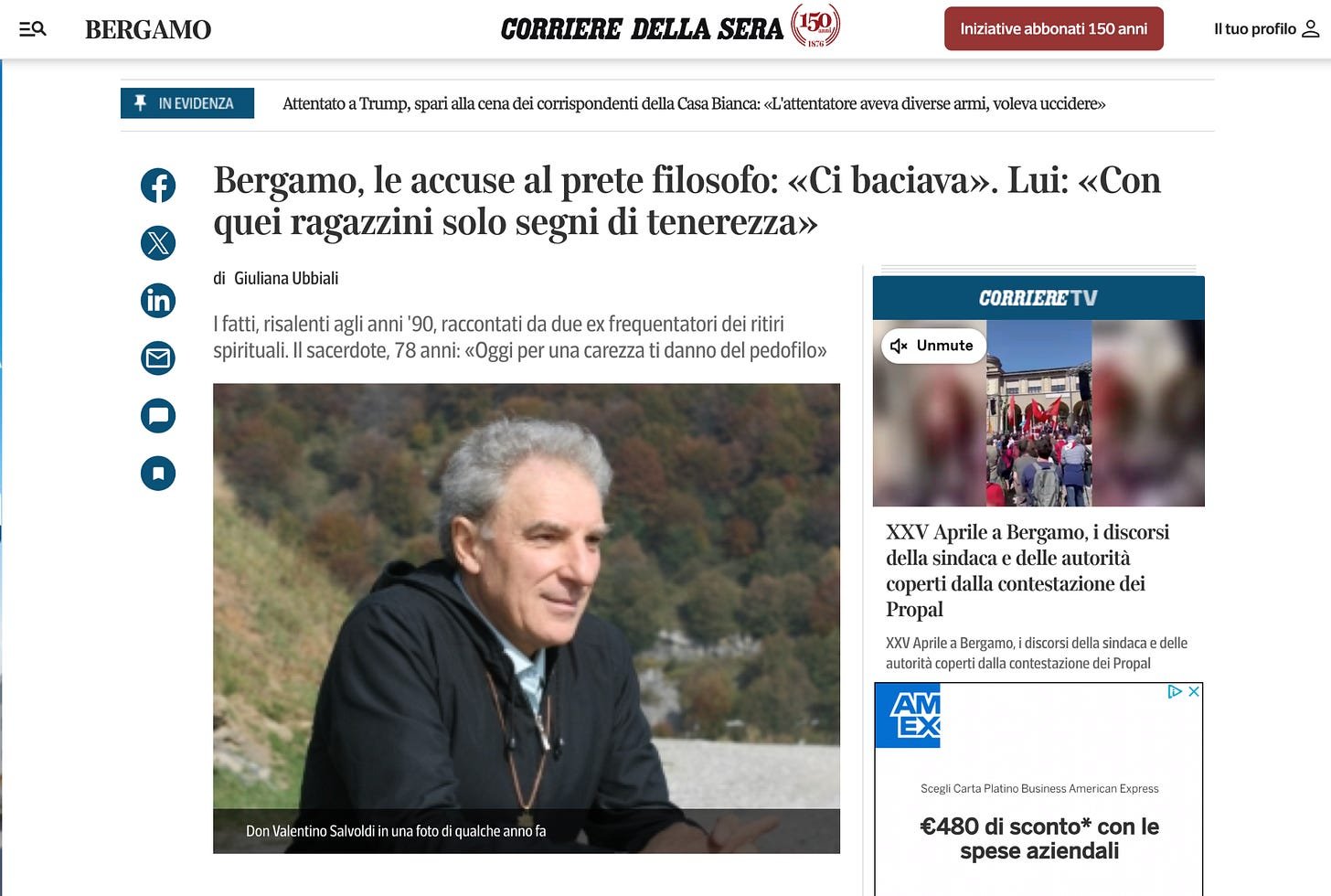
I had told the story of Valentino Salvoldi, serial predator of boys, in two articles that appeared in Domani, on December 27, 2023 and February 10, 2024. Here's how Salvoldi interpreted his priestly vocation:
He calls himself «a beggar of love», Don Valentino Salvoldi, priest of the diocese of Bergamo. He is a passionate preacher who dedicates his life to freeing the Gospel message from the constraints in which, according to him, an overly rigid Church has bound it: he speaks of the joy of the body, invites replacing the sign of peace at the end of Mass with long embraces.
After being a missionary in Africa, he returns to Italy and at the beginning of the nineties he begins to organize camps for young adults in which he plays the role of the progressive priest, open to dialogue and critical of capitalist society.
Soon, however, he decides to turn to adolescents because, he claims, that is the age when the person is formed and after that «it is too late to change». He invites them to seek the truth, to travel and to choose a life master who will guide them.
This is precisely the relationship he establishes with his «favorites», to whom he directs special attention, kissing them on the mouth and taking them to his bed «for a nap» or for confession.
They are boys, some only thirteen years old, and the experience of a school camp with a priest who dares to say transgressive things fascinates them. He rewards them with compliments and encouragement and if they pull back when he touches their intimate parts, he immediately reassures them: «what we do here is good».
«It was '96 or '97: during a summer camp in Val d'Ossola, Salvoldi took us to bathe in a hot spring source», recalls Samuele (fictitious name). «There, without exchanging many words, as if it was already clear what would happen, we boys took off our clothes until we were naked, and so did the priest – continues Samuele – We immersed ourselves in the water and in turn received the caresses and kisses of Don Valentino. If anyone had a hint of arousal, Don Valentino explained that it was "just a mechanical thing", and that even to him "the little pistol would go off" - his exact words – if he had put it under the powerful jet of thermal water».
Salvoldi himself, Samuele specifies, then commented on the day with the boys in front of the mothers who had come to pick them up, normalizing what had just happened.
In August 2002, at Mione, in the province of Udine, Francesco (fictitious name), now 44 years old, finds himself at one of the camps organized by Salvoldi: «he created a suggestive environment for boys, with evening rituals characterized by soft lights and music, in which he was the guru: I remember well seeing him kiss boys», he says.
Davide (fictitious name) also, who was just twenty at the time, attended the Mione camp and remembers the «para-spiritual» atmosphere created by the priest and the candlelit evenings: «a boy, visibly depressed, was Valentino's companion page», he says.
«My case – Davide emphasizes – shows how the priest is able to wait for the right moment and the premeditated and intentional mechanics of his behavior.
At the camp, Salvoldi does not attempt physical approaches with Davide – only once does he get close to smell his hair – but asks him to help with the book he is writing. So Davide for a couple of years corrects proofs for Don Salvoldi; when the work is finished, he wants to send it to him but the priest insists that he deliver it in person instead. The priest asks him to meet him in a place where he happens to be passing through; they first have lunch at a friend's house and then go to the hotel where he is staying to discuss the book. «As soon as I entered the room, Salvoldi put his tongue in my mouth and I remember the disgust I felt, the sensation of his rough beard on my chin. Disgusted, I left immediately», Davide says.
And then, a few years later, come the memories of another witness, Ettore (fictitious name): «I attended two of Salvoldi's camps, in 2006 and 2008, when I was 16 and 18 years old – he says – on the first evening, Don Valentino called me to his room because he wanted to talk to me. He told me to lie on the bed to embrace each other, but I refused».
Ettore manages not to be drawn in by the priest but realizes the particular climate that surrounds him: «during these camps there was a candlelit dinner where we fed each other – he tells Domani – and afterwards we boys were invited to embrace each other putting our hands under each other's shirts». Not only that: «I saw distinctly Don Valentino kiss a boy sitting on his lap for a long time on the mouth».
Ettore is bewildered but thinks that if no one has anything to object to, perhaps the kisses are also part of the «ritual». «Valentino said that the rules of the outside didn't apply, that with him you had to follow new rules based on love, touching and being together».
The priest moves between Lombardy, Rome and Africa, where he loves preaching love in all its forms (at least until they chase him away) and where his high self-esteem leads him to indulge in some sin of vanity:
On his website, the biographical data are generic: he writes that he has studied for twenty-five years and for as long taught moral philosophy and theology, especially as a visiting professor in third world countries.
«Now I am at the service of the Holy See for the training of the clergy of young Churches», he adds, without specifying what this «service» consists of. He is a «fidei donum», that is a priest sent to exercise the ministry in mission land, but above all he is a very prolific author: he publishes with various publishing houses (Paoline, Elledici, Gabrielli publishers, Città Nuova and others) popular essays on morality, collections of prayers, biographies, some translated abroad as well.
The style is emphatic, full of catchy phrases, and the recurring theme is love in all its expressions. From the website of Gabrielli publishers we learn that he was a professor of moral philosophy and theology at the Alfonsian Academy in Rome and that «for his commitment he was expelled from seven African countries, twice was he before the firing squad in Nigeria and he escaped stoning in Bangladesh».
In reality, his teaching at the Alfonsiana is limited to a single semester, in 1988-1989, «as an invited guest, with a course on "The Sacred in African Cultures"», as attested by Father Maurizio Faggioni, a bioethics teacher at the same institute.
He is so careful to build his image as a devoted scholar and missionary that he invests a few hundred dollars for the inclusion of his name in the "Distinguished leadership" yearbook («for his eminent contributions as a writer and as a promoter of justice and peace») published for a fee by the American Biographical Institute in Raleigh, North Carolina, an entity repeatedly reported for fraud.
A detail that confirms the egocentrism of the priest, who during a lecture in Ethiopia in 2002 did not hesitate to call himself too «beautiful and intelligent» to please the Church; a Church that «is afraid of him» and prefers to ordain «more normal» people instead.
Not satisfied with the activity of school camps, Salvoldi at the beginning of the two thousands decides to think bigger and founds the Shalom non-profit organization, «a non-profit organization of social utility, having as its purpose the moral formation and cultural growth of young people». Its motto is «young people save young people» and it promises «the joy of hearing drums roll, while feet move happily in the dance to the dream of "new heavens and new earth"», as can be read in a presentation leaflet. President is his brother, Giancarlo Salvoldi, a politician, elected to the Chamber of Deputies for the Greens from 1987 to 1992. After a few years the non-profit is put into liquidation and no traces of actually realized projects can be found online.
What the diocese of Bergamo does
Brother of a former deputy, Salvoldi is therefore an evanescent priest, a missionary without a parish whose biography is vague and unclear even to his own diocese, which seems to know him very little.
Don Francesco Airoldi, vice-director of the Bergamo Diocese Service for the Protection of Minors and diocesan chancellor, in response to a request for information about the priest from the carabinieri, responds with a letter full of «as far as we know», emphasizing that Salvoldi «carries out his activities mainly outside the territorial area of the diocese of Bergamo, and for other ecclesiastical entities».
In short, he washes his hands of it, and equally evasive is his behavior when heard on November 14, 2023 as a person informed about the facts, so much so that the police, in the conclusive report on the investigation sent to the Substitute Prosecutor of the Republic, will define the behavior of the heads of the Bergamo curia as «Pontius Pilate-like», «ready to completely disown the acts of priest Salvoldi and to entrench itself behind specious bureaucratic-state competencies solely in order to preserve the diocese's disconnection from the facts».
The Bergamo Diocese Service for the Protection of Minors had responded not without embarrassment to the report on Salvoldi received on October 18, 2023 by Francesco Zanardi, president of the Abuse Network, who was speaking for «about a dozen victims» and asking for the opening of a preliminary investigation into the priest.
«This diocesan service is certainly available for direct listening to the interested persons» - wrote Rosaria Cavallaro, the representative of the Listening Center of the Diocesan Service for the Protection of Minors, and specified: «in order to effectively and fruitfully open a preliminary investigation it is essential to know the identity of the reporters and to directly collect their account».
The same day, Zanardi also forwarded the report to the president of the bishops, Cardinal Matteo Zuppi, and six days later filed a complaint in the Public Prosecutor's Office.
The news of the missionary priest too attentive to boys reaches the press anyway and on December 24 a note appears on the diocesan website:
«Regarding some press reports concerning an elderly priest of the clergy of this diocese for alleged facts dating back to the nineties, the appropriate measures have already been taken to activate the procedures provided for by canon law, while respecting the work of the magistracy in the common intent of proper ascertainment of the truth».
On December 27, the article comes out in Domani and two days later Salvoldi replies in the columns of Corriere della Sera saying he is innocent and that the kisses and hugs «were signs of tenderness and peace, of love for God» and that his was «a liberatory pedagogy».
The diocese of Bergamo and the CEI are therefore informed since October 2023 that the missionary priest Salvoldi has a weakness for boys but wait more than a year before setting an investigation into motion.
Stefano Schiavon is only contacted by the diocese of Bergamo on November 15, 2024 as a «person potentially informed about the facts», 367 days after Don Airoldi's statement to the carabinieri. But if the diocese took a long time to think about it, the testimony of the victim must instead arrive quickly, at the latest within six days, holidays included.
It is worth reporting the email in full to appreciate the Church's empathy towards a potential victim:
Dear Dr. Schiavon
in the canonical proceedings that the diocese of Bergamo is conducting against the Rev. Sac. Valentino Salvoldi, your name has emerged as a person potentially informed about the facts which are the subject of the investigation pursuant to canon law.
For this reason, the diocese of Bergamo invites you to give testimony regarding the facts which are the subject of the investigation in the above-mentioned canonical proceedings, clarifying from now that in this forum you are not obliged to appear and give testimony.
Should you decide to testify, the date and time of your hearing will be agreed accordingly; should you decide not to accept the invitation, the canonical proceedings will proceed normally.
In the event that you do not have the possibility to travel to Italy to give testimony, if you wish, you may send to the diocese of Bergamo any documentation in your possession that you deem useful to get to the truth about the case, or a written statement made in accordance with the truth and in such a way as to guarantee its authenticity (for example, by digital signature), within six days of receipt of this letter.
With this letter it is clarified that testimony in the canonical field does not entail or imply in any way the deprivation or limitation of any right before the competent judicial authority of the Italian State, as these are two legal systems (the canonical and the civil) independent and autonomous and each regulated by its own regulations.
Awaiting your courteous response, we thank you and send you our best regards.
But the best part comes now. The email is signed «Dr. Arianna Dutto, delegate to the investigation» and arrives directly from the Protection of Minors office of the Bergamo curia (tutelaminori@curia.bergamo.it), a rather unusual email address for someone who must investigate a pedophile priest.
Equally unusual is the profession of the appointee herself: in fact Arianna Dutto, lawyer at the Milan bar, not only is part, as it turns out, of the Diocesan Service for the Protection of Minors of Bergamo, but is also a member of various commissions for the protection of minors and consultant to ecclesiastical entities and of the Catholic Church; she is also part of the Regional Service for the Protection of Minors of Lazio.
A remarkable curriculum - not by chance she is often called upon to provide training in the ecclesiastical field - but certainly not a guarantee of impartiality in an investigation into abuse of minors.
The Church's statute of limitations

The Church of Pope Leo XIV, in perfect continuity with that of Francis, says many fine words about pedophilia and then does the opposite. In the case of Don Valentino Salvoldi, the statute of limitations declared by Italian justice was followed immediately by the ecclesiastical one. Pope Francis had repeatedly stated that abuse of minors in the Church does not expire and therefore the statute of limitations is always waived in these cases. But Salvoldi got away with it.
It is worth looking more closely at his significant case, determined by the statute of limitations and the omertà cover-up by ecclesiastical authorities, and also the key figure in the investigation, Milan lawyer Arianna Dutto.
As we have seen, after the complaint filed by the Abuse Network both to the magistracy and to the diocese of Bergamo, the curia is forced after some hesitation to open a «preliminary investigation» into the Bergamo priest.
Lawyer Dutto is put in charge of it but from the very first moment something doesn't add up: the delegate to the investigation, in fact, contacts the victims from an email address that belongs to the Diocesan Service for the Protection of Minors of Bergamo.
When Stefano Schiavon, one of the victims of the Bergamo priest, points this out to her and asks whether people interested in providing testimony about the case should contact her at that email address, the lawyer candidly directs him to her personal email address:
«Since this is a legal procedure, in observance of the principles of impartiality and independence, it is preferable to use the written contact (the email address indicated to you, from which I am writing)».
Dutto provides Salvoldi's victims with a personal email to use for her investigation into the reported abuse and this resolves everything for her, she doesn't seem to see any problem in maintaining the dual role of member of the Diocesan Service for the Protection of Minors and of person appointed to assess the responsibility of a priest reported precisely for abuse of minors, as if simply changing the email address would guarantee «impartiality and independence».
Not to mention that in many email exchanges that the lawyer has with the victims, the Diocesan Service for the Protection of Minors nonetheless remains in copy.
Lawyer at the Milan bar and expert in crimes against the person (today she is also engaged in the defense of some carabinieri involved in the death of the nineteen-year-old Egyptian Ramy Elgaml, killed on November 24, 2025 after a chase), the lawyer not only is part of various commissions for the protection of minors, but is certainly a trusted lawyer of the Church. She represents the CEI in the ongoing trial on the alleged private use of over two million euros from the eight per thousand and Vatican funds intended for the diocese of Ozieri, in the province of Sassari; a trial that sees Antonino Becciu, brother of Cardinal Angelo Becciu, the bishop of Ozieri Corrado Melis and seven other people as defendants, accused of various counts of embezzlement, money laundering, false statements to the public prosecutor and aiding and abetting.
Dutto has an obvious conflict of interest, and she is not the only one in the Church who on the right deals with abused minors and on the left with abusers. There is at least one illustrious precedent, another prince of the Milan bar, Mario Zanchetti: lawyer for the archdiocese of Milan, he was part of the diocesan commission for the protection of minors in the same years when he was the defender of Don Mauro Galli, the priest of Rozzano who had brought a fifteen-year-old boy to his bed, convicted to three years (with plea agreement) by Italian justice and acquitted by ecclesiastical justice, which had judged the defendant «not guilty».
Zuppi's line
This being at once judge and party, that is, judge of itself, this feeling above the rules, is moreover typical of the Italian Church: the CEI, by express declaration of its president, Cardinal Matteo Zuppi, did not want an independent commission on clerical abuse, as has happened instead in many other countries, but chose the comfortable path of internal investigation, which to date has produced «reports» and «surveys» with meager and completely unreliable numbers, the result of questionnaires to which many dioceses have not even responded (for those who want to delve deeper there is the excellent work of Adista, here and here).
These surveys are based precisely on the activity of Regional Services, Diocesan and Interdiocesan Services and Listening Centers for the protection of minors and vulnerable persons of which lawyer Dutto is part. Established in 2019 by the CEI Guidelines and by the Italian Conference of Major Superiors (the body that oversees religious orders) at the urging of Pope Francis's motu proprio Vox Estis Lux Mundi, they have functioned fitfully and, once again, without proper transparency. 32 out of 130 diocesan listening points for victims were examined in a study conducted by the Abuse Network, lasting two years, which showed how they essentially serve to provide information to the diocese about abusive priests. Lawyer Mario Caligiuri, lawyer for the Abuse Network, said so openly at a press conference on February 24, 2026:
«When notice of a crime arrives, the listening centers provided for by the CEI guidelines do not formally lead to an investigation but rather constitute more of an informal point of access; they listen, sometimes keep records and transmit everything to the bishop».
According to what the Abuse Network study found (here in detail), when a victim turns to a diocesan Listening Center, they are faced with three structures that do not communicate with each other:
«The first is a window that collects data from victims and passes it to the bishop, who will decide whether to proceed with the preliminary investigation and send everything to the Dicastery for the Doctrine of the Faith. A window that, as stated, collects data from the victim and passes it to the second structure, but at the same time does not have access to complete case files. It is therefore aware of the single piece of information provided by the single victim but is unaware of whether the main case file contains other victims of that priest.
From here, as before the windows, it remains at the discretion of the bishop whether to open a preliminary investigation and send everything to the third structure – the Dicastery for the Doctrine of the Faith – or not. No one, of course, neither the victim nor the window that received them, will have access to those files or be able to verify the actual progress they have had. You will have to trust what the bishop says».
And that's what happened to Stefano Schiavon too, who, after sending his testimony on November 18, 2024 (within the six days allowed), heard nothing about the progress of the preliminary investigation until February 11, 2025, when lawyer Dutto, again via the email of the Diocesan Service for the Protection of Minors of Bergamo, notifies him of the conclusion of her work with the usual fraternal empathy:
Dear Sir,
In relation to the canonical preliminary investigation opened by the diocese of Bergamo against the Rev. Sac. Valentino Salvoldi, I am writing to inform you that, having completed the diocesan phase, the case file has been duly delivered to the Dicastery for the Doctrine of the Faith for the determinations within its competence.
To Schiavon's legitimate request to be able to know the conclusions of the «diocesan phase» and to have information on the subsequent proceedings at the Dicastery for the Doctrine of the Faith, lawyer Dutto responds by return post that she cannot give him anything and tell him even less:
The case file is confidential and at the moment the diocese is not authorized to provide any information either to the persons who declared themselves injured and offered their contribution, or to the defendant.
The acts have been delivered to the Dicastery for the Doctrine of the Faith because that Dicastery, pursuant to canon law, is competent in the matter and, at this point, the Bishop must await communications or instructions from the same.
Having received the acts of the preliminary investigation and studied them carefully, the Dicastery for the Doctrine of the Faith has various courses of action: to dismiss the case; to request further investigation from the preliminary investigation; to impose non-penal disciplinary measures, ordinarily by means of a penal precept; to impose penal remedies or penances, or admonitions or rebukes; to open a penal trial; to identify other means of pastoral solicitude. At that point, the decision will be communicated to the Bishop, with appropriate instructions for its implementation.
Regarding timing, no peremptory deadline is set; in general, it is possible to expect a decision within six months but – as you will understand – each case has its own peculiarities and, therefore, the Dicastery could examine the acts and decide within a period shorter or longer than indicated above.
There are no specific provisions regulating communication of the outcome of the investigation to persons who, like you, declared themselves injured and provided their contribution in the preliminary investigation phase.
According to canon law, in fact, the injured party has no right to any information about the outcome of the case. Words encourage abuse victims to go to the Services for the Protection of Minors at dioceses, but in practice anyone who reports a pedophile priest is not even recognized the right to be informed of the outcome of the investigation.
Thus Salvoldi's case file reached the Vatican and here, in fact, its traces are lost. The victims are invited to wait an indefinite time and without even the guarantee of ever receiving an answer.
Months pass and nothing happens. Schiavon, however, is a tenacious person: he has contacted his friends from the summer camps, has spoken with the press, has reported and had the case opened after more than twenty years; he is not the type to give up without an answer. So eight months later, on October 7, 2025, he contacts Arianna Dutto again to ask for news of the proceedings. Three days later the lawyer's terse reply arrives:
Dear Professor Schiavon,
In response to your letter of October 7, I am writing to inform you that the Dicastery for the Doctrine of the Faith has deemed the facts which are the subject of the report as prescribed and decided not to derogate from the statute of limitations that had elapsed.
Schiavon takes note: he wants to know if the other victims have been informed and, once again, asks to see the documents of the entire case. Once again he is told no, but with a final insult: if he really wants, Schiavon can contact the Dicastery for the Doctrine of the Faith directly, but lawyer Dutto doesn't even have an email address for it:
Dear Professor Schiavon,
Having completed the diocesan phase, the case file was transmitted to the Dicastery for the Doctrine of the Faith, so I am not in possession of the acts, which moreover are not disclosable pursuant to canon law (not even to the cleric in whose respect the preliminary investigation has been conducted).
Reasons of confidentiality do not allow me to answer the question you have raised regarding other persons.
I am giving you the contact information for the Dicastery for the Doctrine of the Faith, to which, if you wish, you can turn (I do not have an email address).
Dicastery for the Doctrine of the Faith, Palazzo del Sant'Uffizio, 00120 Vatican City
Yours sincerely
Arianna Dutto - former delegate to investigations
Schiavon, understandably, struggles to resign himself and asks Dutto for further clarification: so Salvoldi, after everything that was established even in criminal proceedings, will continue to be a priest, to say Mass surrounded by altar boys and to confess adolescents?
The lawyer, now clearly exasperated by so much insistence, closes the discussion:
Dear Professor Schiavon,
Just as in every other legal system, in canon law as well, the dismissal of a proceeding due to the statute of limitations entails the impossibility of applying a penalty, including – in the canonical system – laicization.
The priest in question – also because of the age limits he has reached – is not assigned any ecclesiastical office or position, including those involving contact with minors.
Finally, I wish to inform you that my role in the proceedings in question is now extensively and completely concluded, therefore I take this last opportunity to wish you all the best.
The case is prescribed and you cannot demand anything more from the Church, much less the laicization of the priest, but the diocese assures that he is now old and without official positions. Schiavon and all the other adolescent victims deceived and abused by a priest, in place of the promised justice, will have to make do with this fragile axiom: their abuser has retired and can no longer do (too much) damage. Word of bishop.
As Pope Leo XIV said on January 8, 2026, closing the extraordinary consistory, «often the scandal in the Church is because the door has been closed and the victims have not been welcomed, accompanied by the closeness of authentic pastors». The Church that pretends to be scandalized by what the Church does.