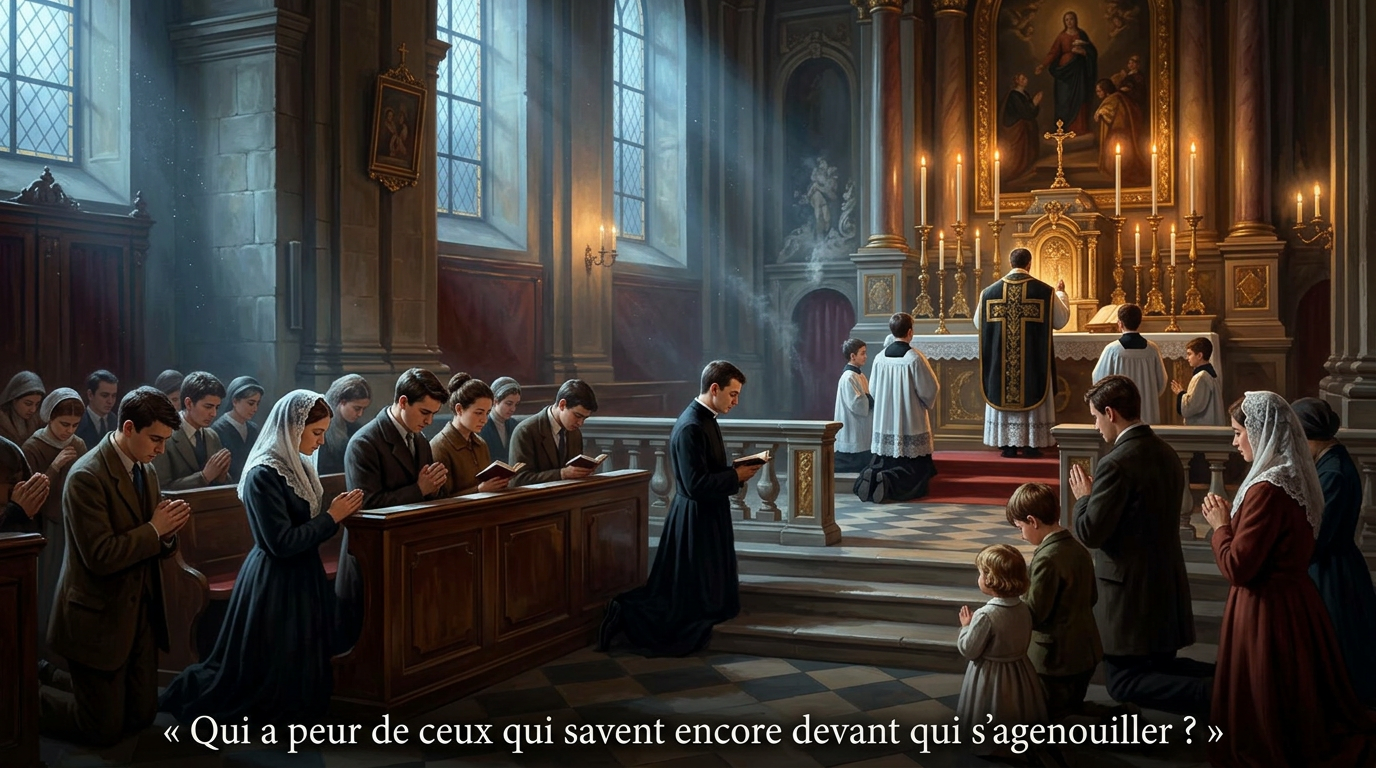
The traditional Latin Mass, or TLM, has been under fire for years. With Traditionis custodes, Pope Francis in 2021 largely withdrew the space that Benedict XVI had opened with Summorum Pontificum. The official argument: the traditional liturgy would cause divisions, undermine the Second Vatican Council, and threaten the unity of the Church. In his accompanying letter, Francis referred to a survey of bishops and groups that would reject liturgical reform and even the Council itself. This later proved to be an outright lie. A pope who uses a lie to lend weight to a measure is a sad low point in Church history. Whether the traditional liturgy itself constitutes the problem is not the question. By now, this is quite clear. There are indeed traditionalists who have turned their love for Tradition into a permanent war against Rome. But there are just as many progressive Catholics who openly contest doctrine on marriage, the Eucharist, the priesthood, and sexual morality. Yet in Rome, no one has yet thought to restrict the Novus Ordo because of their opinions.
Who are these dangerous revolutionaries who love to gather on Sundays around the old missal? Remarkably, often young families, students, young priests, and people who discovered the Catholic faith only later in life. They yearn for silence, reverence, beauty, mystery, and a liturgy where it is not man, but God, who is at the center. Apparently, this is suspect. Yet one might ask a simple question: when young people voluntarily rise at six in the morning to attend a Latin Mass, what exactly is the pastoral problem? That they rise too early? That they kneel? That they believe the Eucharist truly represents the sacrifice of Christ? One would expect the Vatican to react with enthusiasm to any community where faith, families, and vocations visibly flourish. One would think this phenomenon deserves serious consideration. Instead, it gives the impression that their enthusiasm is a problem to be solved.
This raises the question of whether this is really and exclusively about the liturgy. Perhaps the traditional Mass is not so much the problem as the visible symbol of a much deeper conflict. This conflict concerns the very question of what the Catholic Church truly is. Is it the recipient and guardian of a divine revelation that it must faithfully transmit to each new generation? Or is it a religious community that must constantly redefine its identity in dialogue with a changing world? In the first vision, Tradition is a living reality that connects us to the apostles. In the second, Tradition takes on another meaning: precious as long as it aligns with the spirit of the age, inconvenient as soon as it opposes it.
Naturally, almost no one in Rome would openly endorse this second vision. Instead, one prefers to speak of development, discernment, pastoral renewal, and listening to the Holy Spirit. All worthy concepts, to be sure. But words ultimately derive their meaning from how they are used. And it is here that unease begins. Take the synodal process. In itself, synodality is a perfectly legitimate Catholic concept. The Church has always listened, deliberated, and made decisions in community. But a problem arises when listening seems to become more important than proclamation, the process more important than the truth, and the question more important than the answer. For the Church has not received a divine mission to remain indefinitely in conversation with itself. Christ did not say: ‘Go into the whole world and organize discussion groups.’ He said: ‘Go and make disciples of all nations.’ A synodal process that helps to better understand and proclaim Catholic truth can be a blessing. A synodal process used to question established teachings through pastoral detours, however, becomes an instrument of change without needing to name it as such. This is the silent revolution of which we must be wary. Doctrine is not changed, but practice is gradually allowed to proclaim something else.
And it is precisely here that the traditional liturgy becomes interesting. For the old Mass is a tenacious reminder of a Church that did not invent itself. It recalls that liturgy is not a human construct with which each generation may freely experiment. It breathes the awareness that God is God, that man is a creature, that sin truly exists, that redemption is necessary, and that the holy sacrifice of the Mass is not a pleasant gathering but the sacramental representation of Christ’s sacrifice on Calvary. The old Mass is not merely another form of the same assembly. It carries with it a theological and spiritual heritage that cannot easily be adapted to the whims of the moment. And perhaps this is its greatest provocation: it reminds the Church that it is not the owner of Tradition, but its servant.
This becomes even stranger when one mentions the Second Vatican Council. For what did this Council actually say? In Sacrosanctum Concilium, it is stated that Latin must be preserved in the Latin rite, that Gregorian chant holds a particular place, and that liturgical reforms must proceed organically from existing forms. There is no mention of a versus populum altar. One may therefore legitimately ask whether it is not the defenders of the traditional liturgy, but rather its opponents, who have an oddly selective understanding of the Council. Furthermore, criticizing the manner in which a council was implemented does not equate to rejecting the council itself. Benedict XVI understood this distinction; he emphasized that continuity is the touchstone. Would it not be strange to consider the liturgy of centuries a problem and the experiments of recent decades as untouchable achievements? After all, the Church was not founded in 1965.
Let us be clear: the Catholic Church is not lacking in problems. But evidently, a priest who celebrates Mass according to a missal that has nurtured generations of saints is among the problems that must be addressed with particular urgency. One might almost believe that the greatest danger for Rome is not that people no longer believe, but that some still believe as their grandparents believed.
The underlying question, in my view, is this: do you see the past as a living source from which the Church continues to draw? Or do you see the past primarily through the needs of the present? And here applies a simple Catholic truth: development is not the same as rupture. An oak grows from an acorn. It grows, develops new branches and new leaves. But the moment it decides henceforth to become a chestnut tree, we are no longer speaking of organic development. The Catholic Church can grow. It must grow. But it cannot become something other than what Christ has commanded it to be. That is why the debate over the traditional Mass is ultimately far more important than the question of the language the priest speaks, the direction he faces, or the number of candles burning on the altar. It is about whether the Church allows itself to be shaped by its faith or whether it allows its faith to be shaped by the spirit of the age.
Those who fight the traditional Mass because some faithful behave in an un-ecclesial manner must address that behavior. Those who fight it because it reminds the Church of an institution that does not constantly redefine itself have a far more fundamental problem. For then it is no longer about liturgy, but about ecclesiology, revelation, truth, and authority. A synodal Church that truly wishes to listen should also listen to the young who kneel at the communion rail. It should ask them why they are drawn to a liturgy older than themselves. Perhaps their answers would be more instructive than many synodal discussion papers. For perhaps these young people do not desire another Church at all. Perhaps they desire precisely the Church they discovered in the catechism, in the Church Fathers, in the lives of the saints, and in the centuries-old liturgy. Perhaps this is the real problem. Not that they refuse to move forward with their time, but that they refuse to believe that truth has an expiration date.
The Catholic Church has been given the mission to convert the world, not to be constantly converted by the world. Perhaps it would therefore be wise to invest a little less energy in combating the faithful who love the old Mass, and a little more in combating the unbelief that empties our churches. For the real problem of the Church is not that there are still people who kneel. The problem is that there are fewer and fewer people who know before whom they should kneel.
+Rob Mutsaerts, 16 November 2026