“The church of Notre Dame itself may soon perhaps be erased from the earth.” ~~Victor Hugo, Notre Dame of Paris, 1831.
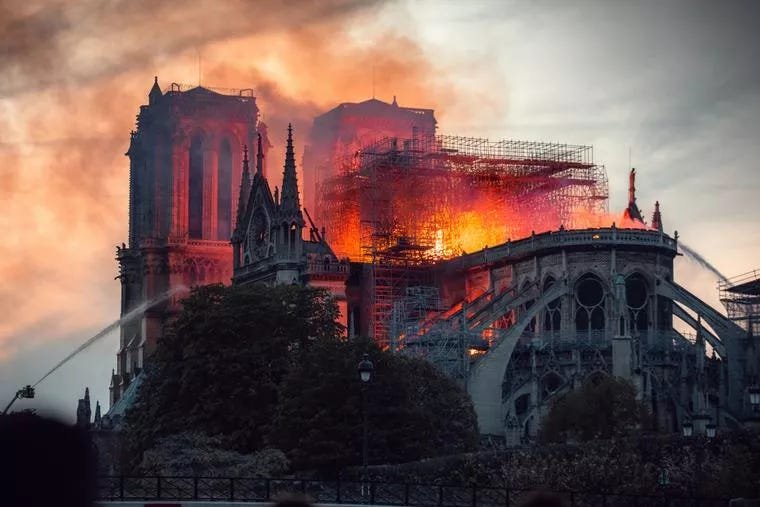
Victor Hugo’s 1831 warning that Notre Dame might “soon perhaps be erased from the earth” -would echo with chilling force nearly two centuries later, when the ancient cathedral came within a breath of destruction and his warning came terrifying close to becoming prophecy. He seemed to sense and fear its vulnerability in the careless hands of modern man.
Notre Dame of Paris is now rebuilt, but not necessarily restored. While the magnificent Parisian icon still dominates the skyline, the persistent question is whether it will be rejuvenated, and renewed with tens of thousands of devout Catholics filling its pews with the fervor of St. Joan of Arc, St. Therese of Lisieux, St. John Vianney and St. Genevieve. Will France once again embrace her divine identity as the eldest daughter of the Catholic Church?
While much has been celebrated about the reopening, it’s not in the rebuilding of the edifice that is the point, it is in the rebuilding of the Catholic faith, the restoring of the liturgy, and in the elevation of the sacred that stands the test of time.
During the 5 year billionaire dollar Notre Dame restoration, countless medieval European and Canadian Catholic Churches were desecrated and many burned to the ground. Unlike Notre Dame, few will be rebuilt after devastating fires.
Cathedrals are no longer buttressed by the fervent faith of the believers, who built and sustained them for centuries. They have devolved into mere curiosities—magnificent relics of a vanished age of a foregone era. High above, stone gargoyles and archangels still stand as sentinels symbolically warding off evil. But below, the foundations weaken, the crevices widen, and the great building begins to crack—not from the assault of enemies without, but from the collapse of the faith within.
Abandon the faith, and grace evacuates the space. If the edifice is not reduced to ashes, it will be remade in the image of the age. Out goes Bach, in comes rock, polyphony yields to cacophony, rainbow flags usurp stained glass, sacred stone becomes a climbing wall, Christmas carols are banned as politically incorrect, techno music blasts above saints’ graves during drug fueled, techno dance “raves” in the nave, and homosexuality is the new morality as LGBTQia pride symbols fill the aisles. And finally, the bronze bells fall silent, drowned out by a new call to prayer—heralding the twilight of Christianity and the rise of Islam.
The knaves in the nave responsible for the fire sale
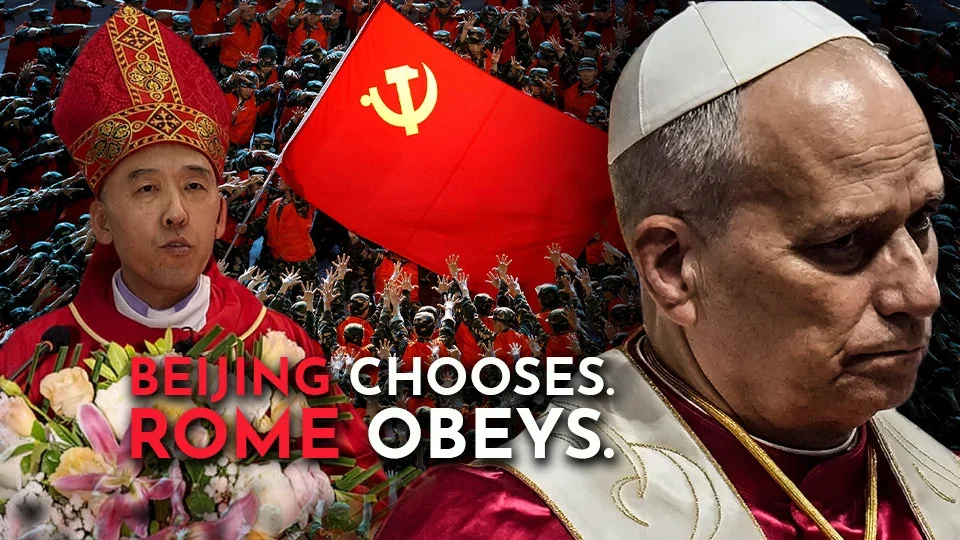
Certainly, the hierarchy, as the legal and ecclesiastical steward of the faith and properties, bear a huge responsibility for the freefall. One such Catholic prelate, Msgr. Johan Bonny, the bishop of Antwerp, apathetically commented on the crisis of the changing landscape of cathedral climbing walls and discos. “That is painful. I will not hide it. On the other hand, there is no return to the past possible.”
Bonny continued, “Every 300 years we nearly had to start again,” he said. “Something new, I’m sure, will happen. But it takes time.”
There, in one breathtakingly complacent sentence, is the theology of ecclesial decline: watch the inheritance of centuries disappear, refuse to return to what sustained the Church, and console the faithful with the hope that some undefined novelty may eventually emerge from the ruins. As Catholicism craters in Europe, one of its most prominent prelates offers not a trumpet blast, but a shrug.
This “bishop” also offers his synodal theology of dogma demolition. Bonny’s arrogant “There is no return to the past” censors any hope for tradition. The only olive branch, Bonny promises is a pathetic— “something new” might eventually rise from the ruins in a few centuries. The cathedral, like the faith is no longer a sacred inheritance but a perpetual renovation project: demolish, deconstruct, experiment, and innovate.
This is the Synodal revolution in real time: the dismantling of the Catholic Church as it has been known for two millennia and its replacement with something “new”—unrecognizable to Catholics, but entirely aligned with the priorities of the globalists.
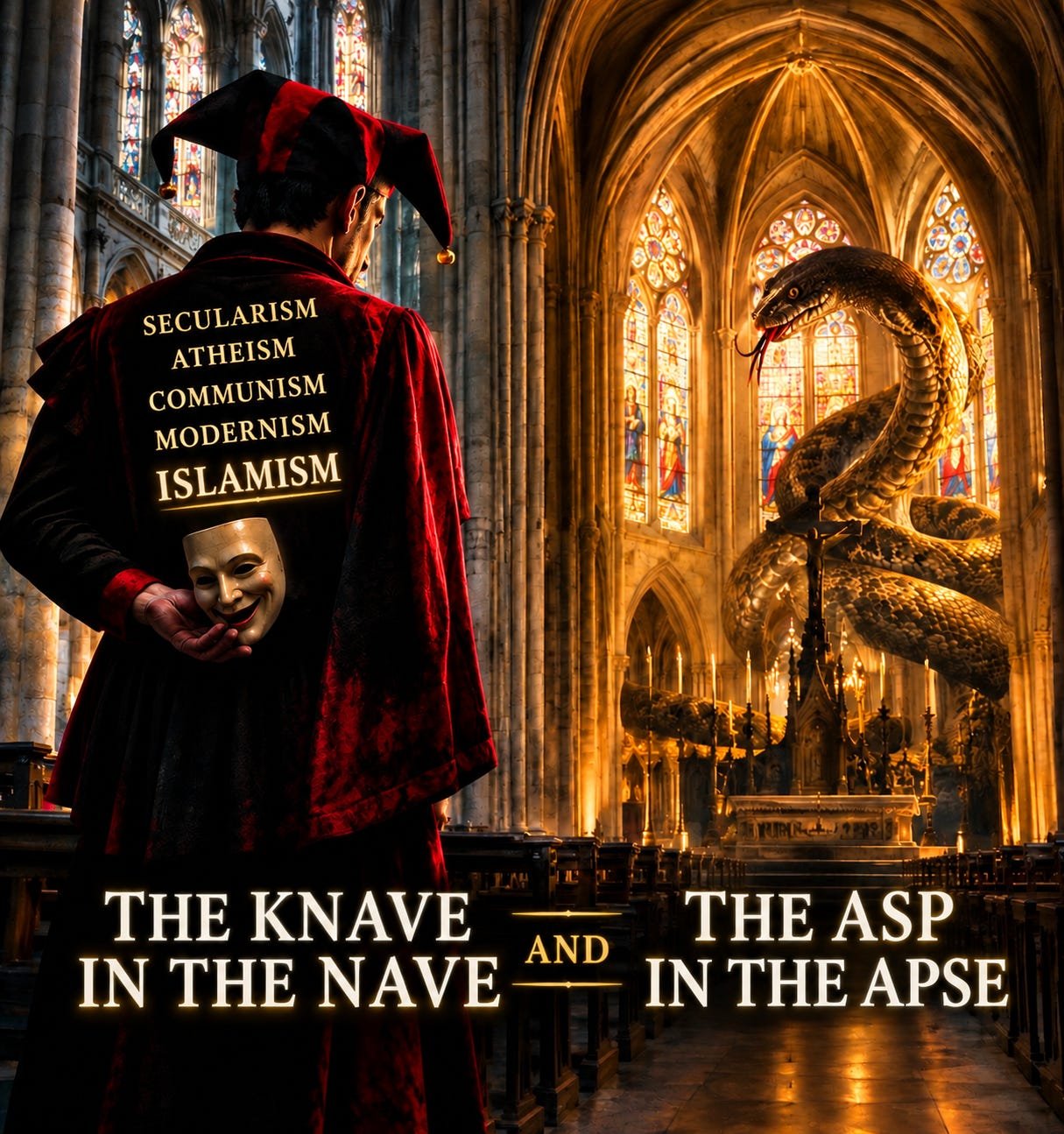
The Knave in the Nave stands exposed— his complacency and venality laid bare, his cunning unmasked. Bonny, the bishop, and his episcopal collaborators stand not as defenders against the Church’s decline, but as willing accomplices to it. They have opened the doors to the asp of modernism and watch gleefully as it slithers through the sanctuary, coiling around the faith, choking the life out of it and poisoning the faithful.
Bonny signals his intention to stand on the sidelines and watch the demise of the European Catholic Church. This should surprise no one. Bonny is recognized as one of the most liberal and progressive figures within the radical European hierarchy. During his tenure, Bonny incessantly promotes the radicalization of the Church on a wide range of dogmatic and pastoral issues.
Instead of filling the pews of his churches with the Truth of the Faith, he has repeatedly challenged traditional Catholic teaching on major social and theological issues, seeking to modernize the Church’s approach to the contemporary world. With each radical pronouncement, the faithful continue to flee the Church.
In March 2026, Bishop Bonny issued an unprecedented letter in support of ordaining married men as priests in his diocese by 2028. He continues to push for this reform throughout the synodal process. Bonny is a strong advocate for gay and lesbian Catholics. In 2021, he publicly criticized Fiducia Supplicans, Bergoglio’s Vatican decree on same sex blessings, as not going far enough. Bonny whined that he felt “shame for my Church” and he and other Flemish bishops ignored the Vatican’s dictates and established their own liturgical ritual to bless same-sex couples. He also advocates for expanded ministerial roles for women.
All his huffing and puffing for radical changes in the Church results in a free fall in mass attendance and Catholic identity in Belgium. In 2024 Belgium regular once a month mass Attendance according to Vatican News is reported at approximately 8.9% , a steep drop from roughly 50% in the 1960s. Self-Identified Catholics: about 50% of Belgium’s population identified as Catholic, down from nearly 53%, though the vast majority remain non-practicing.
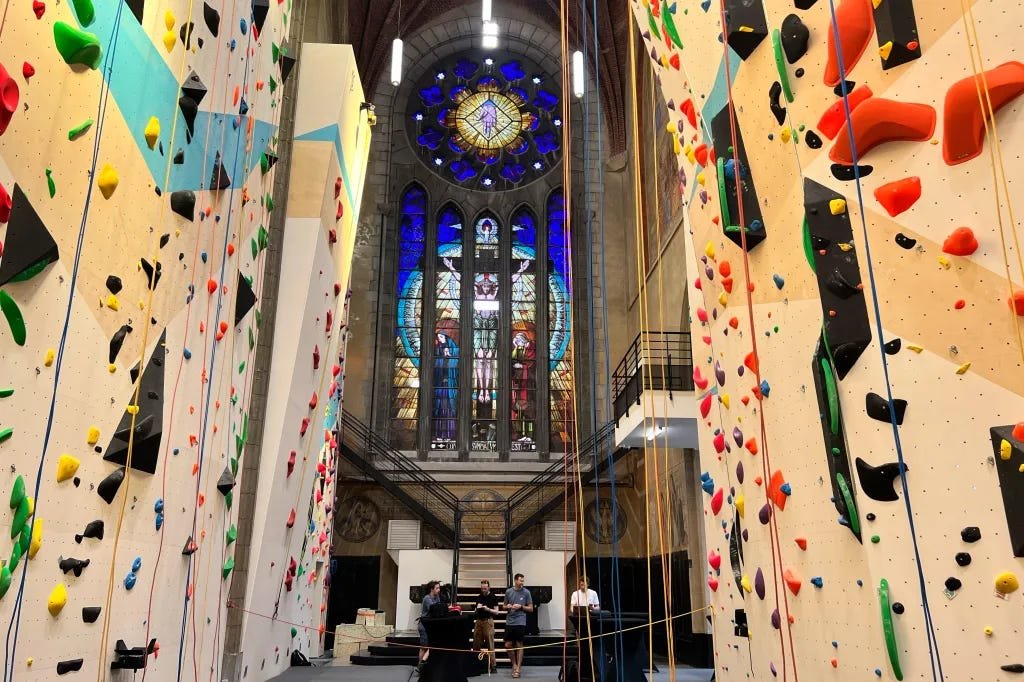
The climbing wall in the repurposed Saint-Antoine church in Brussels, Belgium.
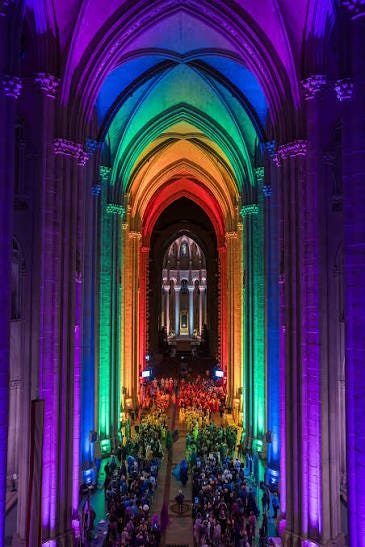
Celebrating the theology of homosexuality in cathedrals across Europe,
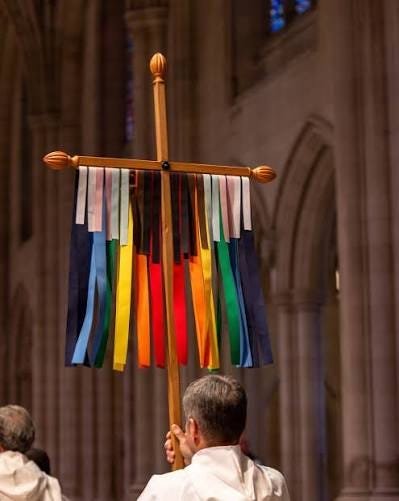
Mechelen, a town of 85,000 just north of Brussels is the Roman Catholic center of Belgium, whose episcopal leader was none other than Cardinal Godfried Danneels of the infamous St. Gallen Mafia. Danneels served as Archbishop of Mechelen-Brussels for over 30 years, and wreaked havoc on the Catholic faith during those 3 decades. Evidence of Danneels destruction that Flemish mayor of Mechelen is managing the “repurposing” of some 350 churches.
So much for the job performance of Bishop Bonny and Cardinal Godfried Danneels.
The Knave Sponsors the Rave in the Nave
This week London’s iconic Anglican St. Paul’s Cathedral, signed a four year contract with the London nightclub Fabric to stage rave disco music events in the historic church. The cathedral that survived the blitz in WW2, has now entered the rave era, where it will trade a choir for a DJ, Gregorian chant for rave techno beats with promises of a two drink minimum. This is a repeat performance from 2024 when there were 4 sold out rave events at Canterbury Cathedral. If only attendance at Sunday worship was sold out.
Mass in the Rubble of Cologne Cathedral
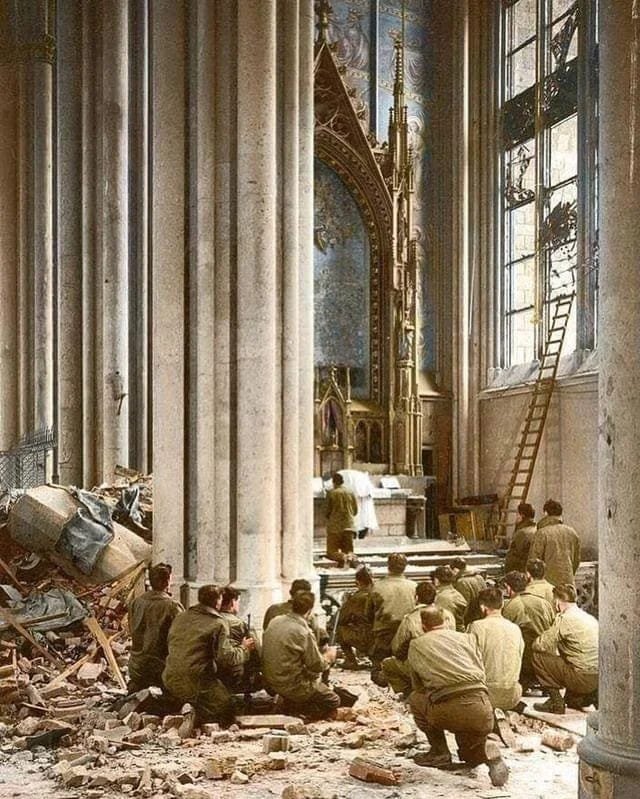
In 1945, American GIs attended Mass in the bombed out Cologne Cathedral.
This photo captures the triumph of the human spirit and Catholic faith over the devastating ruins of war. The shattered Cologne cathedral demonstrates the powerful paradox: everything around them has been destroyed, yet worship continues. Amid the rubble of civilization—death, devastation, and the apparent collapse of order—the soldiers kneel before something that the bombs could not destroy—the eternal sacrifice of the Holy Mass.
At its deepest level, the striking image suggests that war can reduce a city to ruins, but it cannot extinguish man’s hunger for God. Beneath the broken vaults of a shattered cathedral, soldiers knelt to proclaim an ancient truth: civilization may crumble, but faith still rises from the ruins. It is a haunting image of resurrection-of faith surviving catastrophe, order emerging from chaos, and the eternal standing amid the ruins of the temporal.
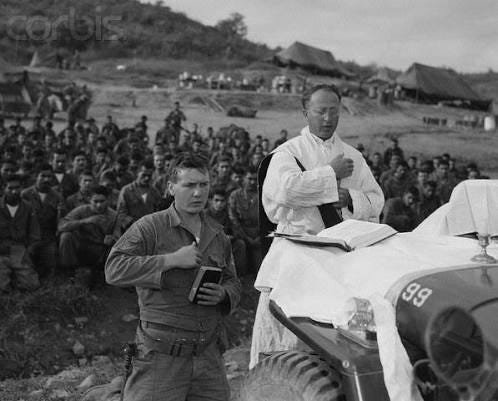
During the Korean War Mass held on the back of the jeep.
While the physical edifice of Notre Dame has risen from the ashes, the more profound question remains: can the Catholic faith that built the original cathedral itself be restored and reborn?
Can Notre Dame reclaim the divine mystery of the Cologne Cathedral in ruins?
Today, throughout Western civilization, sacred cathedrals continue to be incinerated and desecrated—not only by fire, but by a more subtle conflagration. The liturgy is displaced by spectacle; sacred music is silenced beneath the thunder of amplified guitars; ancient stones once raised in worship of God become the backdrop for rock concerts, climbing walls and secular entertainment.
The continent that nurtured Christianity for most of two millennia, churches, convents and chapels stand empty and increasingly derelict as faith and church attendance shriveled over the past half century. The tragedy is not merely that churches stand empty while concert halls overflow within their walls. It is that the sacred is being systematically exchanged for the profane. While the cathedral remains, its magnificent stones restored, but the faith, reverence, and worship for which those stones were raised have quietly disappeared.
Emptied of their sacred purpose and abandoned by the practicing faithful, cathedrals built to glorify God are reduced to museums for tourists, refashioned mosques, or consumed by fire leaving behind smoldering ash heaps and silence.
The knave of secularism, atheism, communism, islamism and modernism gradually entered the nave, waiting for the opportune moment to topple the cathedral-the towering and most visible symbol of Christianity.
Meanwhile, the asp slithers through the apse, patiently awaiting the day when the faithful have emptied the church. Their infernal design is nearly complete: not merely to destroy the cathedral’s stones, but to extinguish the faith that gave those stones their meaning. Unless the faithful return to fill the churches, praying on their knees, unless sacred music resounds in the nave, and unless the divine liturgy returns in all its glory and majesty, the knave will claim the nave and the asp will dominate the apse, and the cathedral will remain only a magnificent shell of a civilization that once believed.
A burned cathedral can be restored. Stones can be replaced. Spires can rise again. But what happens when the faith that built them has disappeared? The haunting question that remains is this: Will Catholics mourn the loss of stone and stained glass while failing to recognize the far greater tragedy—the loss of belief in the Divine that once inspired men to build cathedrals that reached toward heaven, and to name them in honor of Our Lady, Notre Dame. And if that faith is not recovered, what, ultimately, will be left to rebuild?
Will another more dire prophecy of Victor Hugo resound in the nave?
“I tell you, monsieur, it’s the end of the world. It’s all these damnable modern inventions that are the ruin of everything.”
― Victor Hugo, Notre-Dame de Paris