Darth Vader Enters the Youth Office
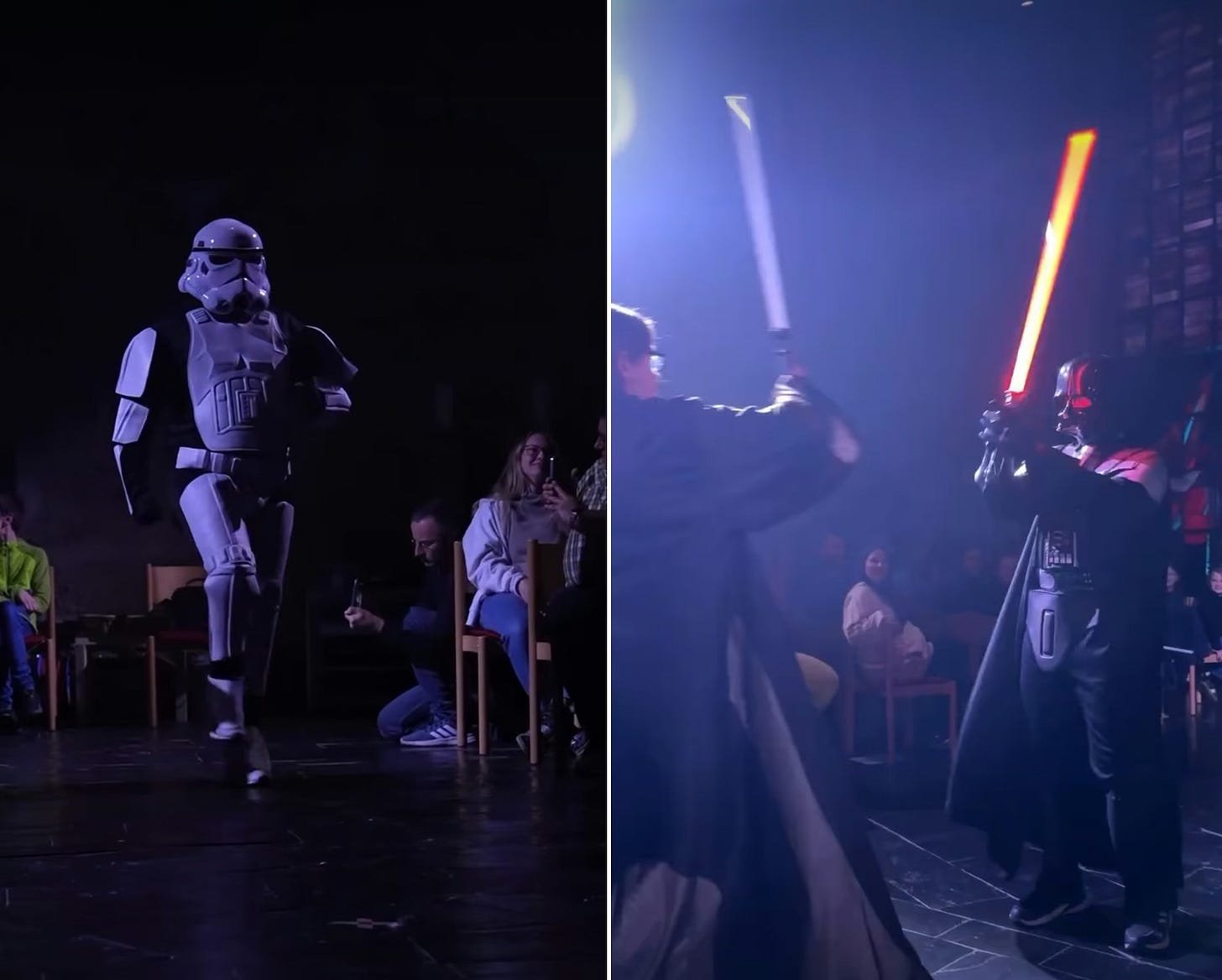
In Germany, the Archdiocese of Bamberg defended a Star Wars “church service,” complete with Darth Vader, stormtroopers, a Jedi knight, a lightsaber duel, Kyrie, readings, Psalm 27, Hallelujah, and the Gospel of Christ’s temptation in the desert. The priest behind it, Fr. Gerd Richard Neumeier, insisted that it was carefully separated from the Eucharist and that Star Wars offers a bridge to God because it contains themes of good and evil, light and darkness. The format is now reportedly available for parishes to book, with costumes, technical equipment, structure, and priest included.
The Bamberg priest’s defense of the Star Wars service sounds, at first glance, like the usual harmless youth ministry chatter. Young people are far away from the Church. They know Star Wars. Star Wars talks about light and darkness. Therefore, lightsabers in church.
That is how every degradation begins in the postconciliar mind. Start with a sociological panic. Add a pop-cultural hook. Sprinkle a few Bible words on top. Call the result “creative evangelization.”
Fr. Neumeier emphasized that the event was a Liturgy of the Word rather than a Eucharistic celebration. That distinction hardly settles the problem. The event still took the structure and atmosphere of public worship and placed it under the imaginative control of a film franchise. The service began with stormtroopers, Darth Vader, a Jedi knight named Gabriel, a verbal exchange, and a lightsaber fight in which “the good” triumphs. Then came the liturgical portion, including Kyrie, first reading, psalm, Hallelujah, and Gospel.
The defense is almost worse than the event. Neumeier says they did not mix the battle with the liturgy. But the “bridge” was already built. The congregation’s imagination had already been trained where to look. The child does not leave saying, “How profound Psalm 27 is.” He leaves saying, “Church is the place where Darth Vader fought a Jedi.”
Traditional Catholic worship understood something modern pastoral bureaucrats never seem to grasp. The liturgy forms memory before it explains doctrine. Smells, gestures, silence, music, vestments, posture, architecture, and repetition shape the soul. A child who grows up under incense, chant, altar rails, genuflection, and silence learns that God is holy before he can define holiness. A child who grows up under themed services, movie costumes, projector screens, and borrowed entertainment tropes learns that worship must compete for his attention like another streaming product.
That is why the “it was only a Word service” defense collapses. The damage lies in the category shift. Sacred worship becomes religious theater. The Church no longer judges the culture. The culture supplies the script, costume department, staging, soundtrack, and emotional grammar.
The most revealing line came when Neumeier said the Church and liturgy are “diverse,” and that most people associate “church service” with “the same Mass over and over again.”
There, in one sentence, is the entire revolution.
“The same Mass over and over again” was once the glory of Catholic life. The unchanging sacrifice, renewed daily. The same Canon. The same gestures. The same silence at the heart of the mystery. The same priest ascending the altar, not to perform himself, not to market the parish, not to baptize the latest pop mythology, but to offer the clean oblation from the rising of the sun to its setting.
Now sameness is the enemy. Repetition is a marketing problem. The Mass as received from the ages becomes a failure of engagement. The Church, apparently, must become “bookable.”
And what can be booked? A Star Wars service, with costumes, technology, structure, and priest included.
There is a grotesque honesty in that. The postconciliar liturgical imagination has finally become a package deal.
Xavier’s Castle and the Return of the Mission Field
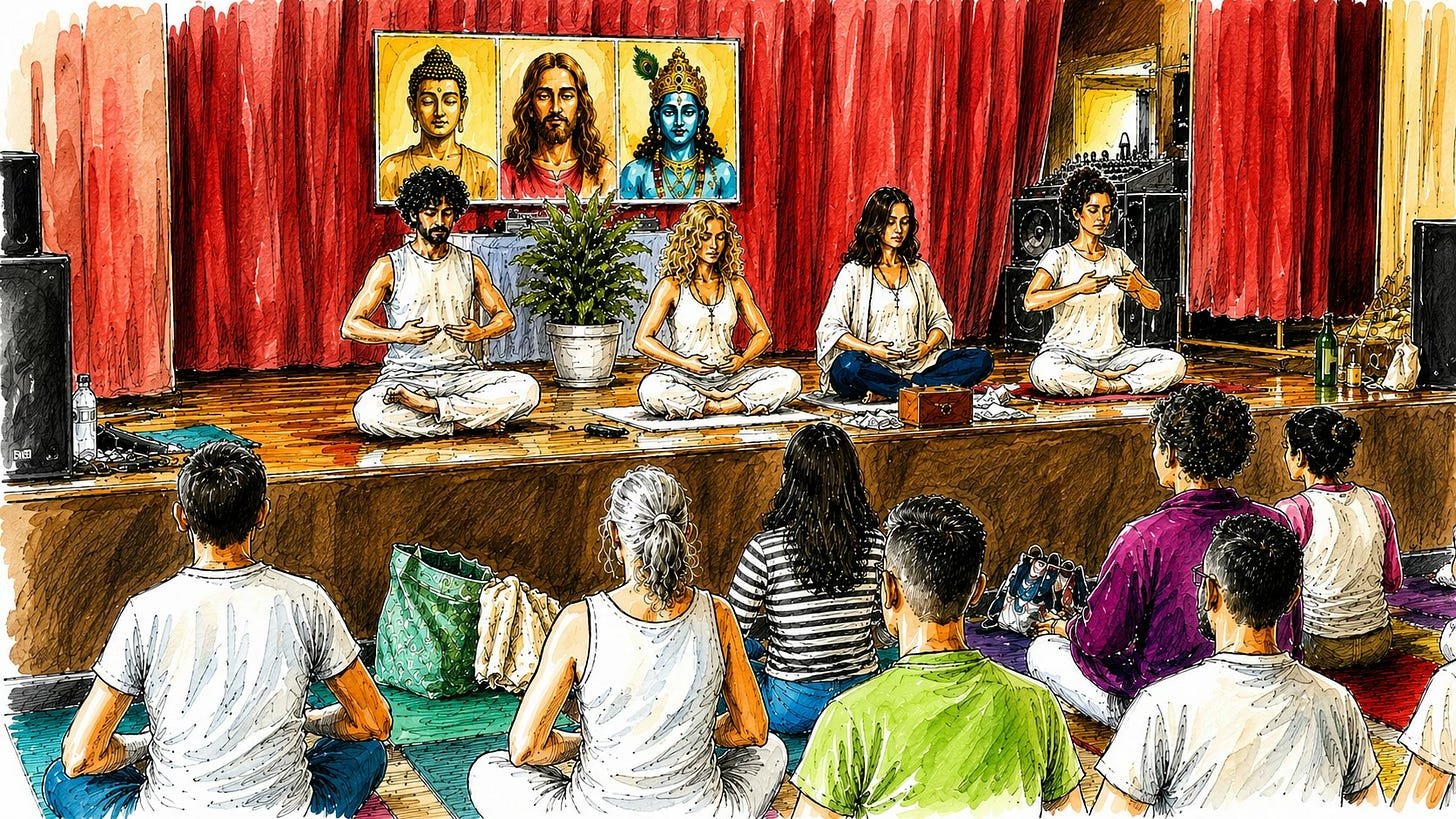
In Spain, the Jesuit-run Castle of Javier, birthplace of St. Francis Xavier, hosted the XII Iberian Yoga Congress. About 250 participants gathered for yoga, meditation, mantra concerts, and Eastern spirituality. Published images reportedly showed Jesus Christ placed with Buddha and Krishna, while the program included sessions such as “Awakening of the Soul,” “Essene Mantras,” and “108 Sun Salutations.”.
St. Francis Xavier left Europe to bring the Gospel to Asia. The missionary’s castle becomes a venue for the spiritualities his order once sought to convert.
The old Church crossed oceans to preach Christ. The new religious bureaucracy rents out sacred spaces so non-Christian spiritual currents can “transcend borders and traditions.” According to InfoVaticana, the Castle of Javier, managed by the Jesuits, hosted the XII Iberian Yoga Congress from May 1 to 3, with meditation workshops, mantra concerts, yoga sessions, and Eastern spirituality. El Debate reported that the sanctuary is part of a Jesuit property described as a house of exercises where one may seek the Lord, yet the congress program involved more than forty activities, including mantra concerts and yoga workshops.
Again, the excuse will arrive wearing sensible shoes. Dialogue. Hospitality. Interreligious encounter. A cultural event. Yoga as exercise. Nothing to see here.
But the images tell the truth. Jesus between Buddha and Krishna is not hospitality. It is catechesis. It teaches with a visual grammar more powerful than any press statement. Christ becomes one spiritual figure among others, perhaps the local Western icon in a broader buffet of transcendence. The Incarnate Word becomes part of a wellness tableau.
Pius XI saw this counterfeit long before our current managers discovered the phrase “spiritual accompaniment.” In Mortalium Animos, he condemned the false opinion that all religions are “more or less good and praiseworthy” because they supposedly manifest the same inborn religious sense leading man to God. That opinion, he warned, distorts true religion and turns toward naturalism and atheism.
That is the point. Religious indifferentism rarely begins by denying Christ outright. It starts by placing Him beside other figures in a supposedly generous arrangement. It uses reverence as camouflage and honors Christ by reducing Him to a participant.
Even the modern Vatican, in its own document on New Age spirituality, acknowledged that New Age thought contrasts with Catholic faith and requires Catholics to be solidly grounded in the faith before engaging it. The 1989 CDF letter on Christian meditation likewise warned that attempts to harmonize Christian meditation with Eastern techniques must be carefully examined to avoid syncretism.
So the problem is not that Catholics are too stupid to distinguish stretching from prayer. The problem is that Catholic houses, sanctuaries, monasteries, and spiritual centers are increasingly used to blur the distinction for them.
The timing adds another layer of absurdity. Spain’s religious life continues to wither. El Debate recently cited reports of an average of twenty convents dissolving each year in Spain. InfoVaticana has separately reported closures and decline in places like Navarra. The buildings remain. The vocations vanish. The altars grow cold. Then come the workshops, the mantras, the retreats, the healing circles, the body-energy vocabulary, and the vague spiritual tourism.
When Catholic life dies, something else moves into the room.
The Synodal Long Knife for Courage
The Courage affair may be the most revealing of the three.
Courage is no wild-eyed trad militia. Its public identity is deliberately moderate. It uses the language of accompaniment. It ministers to persons with same-sex attraction who want to live chastely. It emphasizes prayer, fellowship, support, good example, and fidelity to Catholic teaching. According to its own background statement, Courage began in New York City in 1980 under Fr. John Harvey at the request of Cardinal Terence Cooke, now has more than 160 chapters in 15 countries, and received canonical status with EnCourage in 2016.
In other words, Courage represents exactly the kind of ministry the official Church should be able to defend without hesitation. Its members accept the moral teaching. They seek support. They do not ask Rome to bless sin. They do not demand a new anthropology. They try to carry the cross.
And that is precisely why the Synodal apparatus finds them intolerable.
Study Group 9 did not merely discuss pastoral care for persons with same-sex attraction. It selected two testimonies from Western contexts, both from men in same-sex civil “marriages,” according to reporting by EWTN News. The report itself says it chose two personal stories from the contributions received, then used them as “cases of listening.”
This is the new magisterial method. Find the right testimony. Present it as a privileged revelation of “experience.” Use it to soften the edges of doctrine. Then tell the faithful that the process has no predetermined outcome, while every step of the process points in the same direction.
The report’s handling of Courage is disgraceful. It states that the American testimony described “problematic membership” in Courage, allegedly “pushing for reparative therapy,” and connecting that experience to a separation of faith and sexuality. Courage answered that it has never been involved in reparative therapy and that Synod officials could have asked Courage leadership before putting the claim into a Vatican document.
Courage also objected to the claim that its meetings were “secretive and hidden.” Anyone with a functioning moral sense understands the distinction between secrecy and confidentiality. Alcoholics Anonymous meetings are confidential. Spiritual direction is confidential. Confession is more than confidential, it is sealed. People struggling with deeply personal sins, wounds, temptations, shame, family conflicts, and loneliness require privacy. The Vatican report presents that privacy through the hostile vocabulary of suspicion, and then Courage has to explain to Rome what any competent parish priest should already know.
That is the new pastoral cruelty. It smiles at the sinner who wants affirmation, then grows cold toward the penitent who wants help.
The Hope Hidden in the Absurdity
There is one consolation in all this. The mask is harder to keep in place now.
The old sales pitch promised renewal, reverence, evangelization, and a springtime of faith. Instead we get aging religious houses, empty seminaries, collapsing Catholic identity, pagan-adjacent spirituality in sacred spaces, Star Wars worship packages, and Vatican study groups asking whether Catholic moral doctrine needs to be processed through same-sex “married” experience.
At some point, even ordinary Catholics notice.
They may not have the vocabulary of Pascendi, Mortalium Animos, or Quas Primas. They may not know the old theological manuals. They may not be ready to say aloud what this crisis implies about authority. But they know something is wrong when Darth Vader enters a church service and Courage has to defend chastity against a Vatican document.
The faithful do not need another managed dialogue. They need the Catholic faith, whole and entire. They need the Mass that does not need a franchise attached to it. They need sanctuaries where Christ is worshiped as King, not displayed as one figure in a comparative spirituality exhibit. They need pastors who tell those with same-sex attraction that chastity is possible, grace is real, and the Cross is not a psychological disorder.
The Church of Christ does not need to be “bookable.”
She needs to be believed.