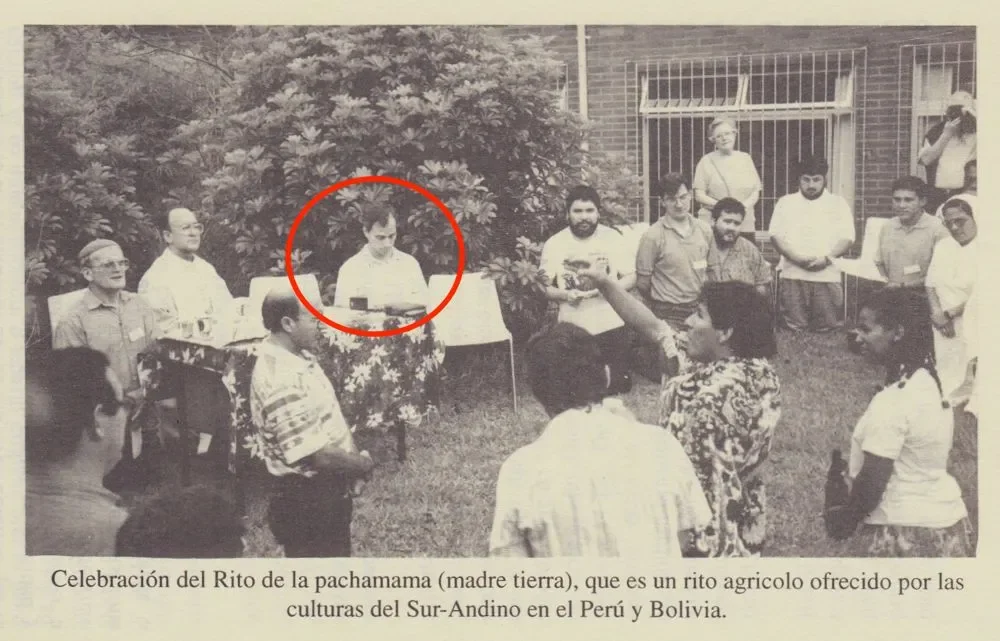
The photograph in question shows an Augustinian priest, Robert Prevost, now known as Pope Leo XIV, kneeling among other participants during a ritual dedicated to Pachamama, the so-called "Mother Earth." This image, far from being innocuous, contradicts the excuses offered after the 2019 Vatican Gardens incident, where it was claimed that the Pope was unaware of the event and was simply observing in order to engage in dialogue. Here, the participation is evident, which makes the situation infinitely more serious.
The context of this photograph is precise: an Augustinian colloquium, the proceedings of which were published in 1996. The caption is clear and unambiguous: it is indeed a celebration of the Pachamama ritual, an agricultural cult of the Andean cultures of Peru and Bolivia. The Pope's presence in this pagan ritual, acknowledged by priests who knew him and compared to other photographs from the same period, raises an inevitable question: before what was he kneeling?
In the Catholic tradition, kneeling is not a simple gesture, but an act of adoration, the recognition of a higher power, an act performed before the Eucharist, before the truly present Christ. Today, in many churches, this gesture is discouraged, ridiculed, or even forbidden. Yet, in this photograph, this same gesture appears to be directed toward a pagan ritual.
The gravity of this situation is further accentuated by the fact that, according to the documents, Mass is also celebrated in the same place, in the same space used for the Pachamama ritual. The same participants, the same context: first the worship of the earth, then the Eucharistic sacrifice. This confusion strikes at the very essence of Catholic worship.
During Bergoglio's time, the reactions of the cardinals and bishops of the Church were vehement. Archbishop Gerhard Müller spoke of a crime against divine law. Cardinal Raymond Burke affirmed that a very serious event had occurred in St. Peter's Basilica. Archbishop Carlo Maria Viganò declared that this image was a sign of the profound crisis the Church is going through. These testimonies are concrete, public, and documented. In Catholic theology, public actions carry considerable weight. Faith is not only internal, it is also external. It manifests itself, it is visible. And when a public action contradicts the faith, the problem cannot be ignored.
That is why, in the Church's tradition, the principle is clear: a public sin deserves a public response. Not to humiliate, not to condemn the person, but to restore the truth, avoid scandal, and protect the faithful. And it is here that the silence becomes deafening. Because if all of this is false, it must be refuted. If it is true, it must be clarified. We cannot remain neutral. We cannot allow a problem of such magnitude to be absorbed, forgotten, or minimized.
A stark comparison is inescapable: that of the martyrs. These men, women, and children who, in the first century, preferred death to offering even a grain of incense to a false god. No grand, spectacular gestures, a minimal but decisive one, because they knew that even a small outward act could be a denial of the faith. And today, what do we see? Priests, bishops, and high-ranking figures participate in ambiguous rites, bordering on syncretism, which sow confusion among the faithful. The Church seems to have lost its sense of boundaries. It no longer makes a clear distinction between adoration and dialogue, between respect and compromise, between openness and abandonment.
The real issue, therefore, is not the photograph. It is merely the starting point. The question is far deeper: what does this image reveal? What does it say about the events that have occurred within the Church in recent decades? What does it say about the path it has taken? If this episode were true and isolated, it would already be serious. But if it were a sign of something larger, then the problem takes on a whole new dimension. And at that point, we can no longer pretend nothing has happened. We can no longer hide behind labels. We can no longer dismiss everything as an attack, an exaggeration, or a controversy. It is not a matter of choosing sides, but of confronting reality. And reality, when it manifests itself, always demands a response
But one question weighs more heavily than all the others: if this is true, how deep is the crisis?