Many biographies of Bergoglio have been written; most of them quite poor. Written in journalistic style and hastily to avoid losing momentum and profits, they amount to little more than collections of anecdotes. Such is the case, for example, with Francis, by Elisabetta Piqué.
Naturally, most biographies have been written by Argentines and, except for two exceptions, they do nothing more than repeat the doxa established by the establishment. I make an exception for the book by Ignacio Zuleta, El Papa peronista, although it approaches Bergoglio's life from a very specific perspective: his membership in Peronism. And the various writings of Antonio Caponnetto which, in addition to being a professional historian—not a journalist—and his constant recourse to documentary sources, adds his own knowledge of the then archbishop of Buenos Aires.
If we look at European authors, there are three biographies that are relevant. That of Massimo Borghetti, Jorge Mario Bergoglio: An Intellectual Biography. Dialectic and Mysticism and Loris Zanatta, Bergoglio. A Political Biography. The latter is a very good book… with the necessary caveats. The author has extensively researched and has had no qualms about depicting the character as he truly was. However, it is a biography written exclusively from a political point of view, so it sets aside many aspects of Bergoglio's life that are fundamental. On the other hand, Zanatta is a fierce liberal and this colors the perspective of his work.
And we arrive at the biography I wish to comment on in this post: The Great Reformer. Francis, Portrait of a Radical Pope.
The author is Austen Ivereigh, British historian and journalist, professor of Church history at Campion Hall—the Jesuit college at Oxford—and personal friend of Pope Francis. Although it is an incomplete biography—published in 2015—it is, to this day, the canonical and most prestigious biography, written, moreover, by a professional historian and devoted follower of Francis. It is very well documented and constantly indicates the sources on which it is based. To write it, he spent several months in Argentina, exploring archives and interviewing witnesses of Bergoglio's life. Nevertheless, this was not enough to prevent a good number of errors—some minor and others more egregious—and an astounding naïveté—I cannot say whether innocent or fictitious—from creeping into his book, which at times is touching. Ivereigh has followed the canon that distinguishes typical hagiographies written by Jesuits. He followed, as in a children's tale, the white stone markers that Bergoglio himself left in interviews, writings and comments, knowing that they would contribute to the construction of the myth of a holy pope.
As I said, this is the canonical biography, that is, the reference biography at the world level of Jorge Mario Bergoglio and, for that very reason, I have believed it worthwhile to take the trouble to point out all its shortcomings or, at least, a good many of them, so that a record remains even if only on a blog.
Errors and Incoherencies
He states that Juan Manuel de Rosas went into exile in England together with his wife. In reality, his wife Encarnación Ezcurra had died in 1838, and Rosas' exile was in 1852. He was accompanied by his daughter Manuelita. (p. 23).
He states that those who burned the churches of Buenos Aires on June 16, 1955 were freemasons and that they also burned the Universidad del Salvador, belonging to the Jesuits. The churches were burned by Peronist mobs and the Universidad del Salvador proper was founded a year later, in 1956, so it could hardly have been burned as well. (p. 41).
He states that the mausoleum of General José de San Martín forms part of the Buenos Aires Cathedral as it would be one of the lateral chapels. The mausoleum, although it is attached to the cathedral and is entered through the temple, is not part of it. (p. 42).
In the bibliography, he lists all of Bergoglio's biographies written by Argentines. Curiously, Omar Bello's biography does not appear, the first to be published in June 2013. It is titled: The True Francis. It is understood that Ivereigh was not interested. (p. 557).
He takes it as proven fact that Bishop Angelelli was murdered, without taking into account, or at least mentioning, the irrefutable evidence that it was an accident, as we reported at the time here. (p. 159).
He states textually: «The Jesuits also had the Catholic University, the UCA, in addition to those of Córdoba and Salta. In reality, the UCA never belonged to the Society of Jesus but is linked to the Argentine episcopate. (p. 168).
He states that in 1983 three bishops died in mysterious traffic accidents. No bishop died in accidents that year. Those who did die that way were the aforementioned Mons. Angelelli in 1976; Mons. Ponce de León, in 1977 and Mons. Devoto in 1983. And there is not much mystery in their deaths beyond the known recklessness behind the wheel of all of them.
He states that the Jesuit missions were located on the banks of the Guaraní River! He confuses an ethnicity with a river… In reality, they were located on the banks of the Paraná. (p. 195)
He states that Alfredo Astiz was a lieutenant in the Army. In reality, Astiz was a frigate lieutenant, belonging to the Navy, not the Army. (p. 211).
He states that Alfonsín vetoed the appointment of Mons. Quarracino as archbishop of Buenos Aires by virtue of the powers granted to him by the Patronage. In reality, the concordat between the Argentine government and the Holy See by which the right of Patronage was eliminated was signed in 1966. (p. 296).
He states that he maintained frequent contact with his friend, the pseudo-Anglican «bishop» Tony Palmer by email (p. 437). However, on p. 446 he says that he did not know how to use, and did not use, the computer.
A Hagiography of Bergoglio
As I said above, Ivereigh does not write a biography but a true and proper hagiography. Let us see some few unequivocal (and laughable) passages:
«Bergoglio […] was able to penetrate the scholastic layers and reach the «primitive charism» of the sixteenth century, of the first Jesuits, which would be his model for reform». (p. 102).
«No one had thought that a Pope could call himself Francis: it would be something like adopting the name Peter, or Jesus. They were unique». (p. 125).
«He [Francis] was restoring what had been lost: he was not despising the Church or its doctrines, but seeking to restore its meaning and purpose, which was to reveal Christ». (p. 131).
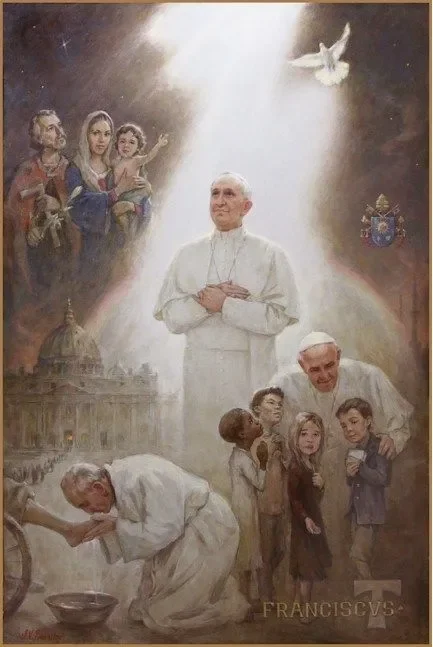
«[Francis] was humble in a world of fame, a sinner in a world of self-justification, and kissed lepers in a world obsessed with beauty». (p. 132).
«During his final years as cardinal, Bergoglio had become the icon of that idea [a man for others], the personification of a life lived in caritas. (p. 451). [It appears that Ivereigh did not bother to find out what Argentines thought of Cardinal Bergoglio…].
«[Bergoglio] possessed the political genius of a charismatic leader and the prophetic mysticism of a desert saint». (p. 475).
The hagiographic narrative is not limited to elegiac paragraphs; it extends also to small incidents that would demonstrate that we were in the presence of a saint to whom Providence bestowed supernatural signs. Let us see but a few examples:
Bergoglio had always had a deep devotion to Saint Thérèse of Lisieux. And, according to him, the saint would send him white roses when she granted him a grace or wished to give him a sign. The biographer relates, then, that on the night of the first day of the conclave that would elect him Pope, when he went to his room at Santa Marta to sleep after prayers, he found a white rose on his bed (p. 479). If we go to the source (note 13) we discover that the only witness to the event was Bergoglio himself, who recounted it to a friend. On another occasion, and after a day of public prayer for peace in Syria, while walking through the Vatican gardens, a gardener gave him a white rose. The next day, Putin prevented an American bombing (p. 519). The source of the event, once again, is in an account by Bergoglio himself to a bishop (note 40).
Cardinal Bergoglio did not like permanent deacons, as he considered them a clericalization of the laity. However, as archbishop of Buenos Aires, he ordained three. Why did he do it? According to what he told the chosen ones: «…the Virgin Mary came to me last night and asked me for three deacons for Buenos Aires». (p. 444). Did she also give him a scapular as she did to Saint Simon Stock or Sister Justina Bisqueyburu?
Naïveté, Candor or Cynicism?
There is a series of statements in Ivereigh's book that the reader does not quite know what to attribute given the way they so clearly clash with evidence. He says on p. 494: «Francis has devoted himself to dismantling the Vatican's centralist and monarchical model and creating structures that […] can only be described as 'republican'». The reality is, as anyone reasonably well-informed knows, that Francis was characterized by daily exercising his prerogatives as an absolute monarch, modifying laws, intervening in trials, bypassing hierarchies and imposing his whims. I myself have heard him referred to within Vatican walls by an important prelate with no suspicion of being conservative as «the happily reigning tyrant», and not just once, but several times. And those who inhabited the Vatican during the Bergoglio period can attest to the atmosphere of terror in which people lived, because at any moment, and for no reason whatsoever, anyone could be dismissed from office by the simple will of the monarch. And this did not only happen in the Vatican. Francis removed bishops without any justification and simply because they disagreed with him. For example, the case of Mons. Giovanni D'Ercole, bishop of Ascoli Piceno, forced to resign for his questioning of the extreme health measures during Covid, or Mons. Joseph Strickland, bishop of Tyler, removed for criticizing Francis's pro-divorce and pro-LGBT measures. To speak of «republican forms» in Francis is risible, if not rather cynical.
Ultimately, and beyond the fact that Austen Ivereigh's is deservedly the canonical biography of Bergoglio to date, the author is unable to accept—perhaps because he wrote it ten years before his protagonist's death—that the Francis pontificate was a great bluff.